Search


Citations et références (3)
Invitrogen™
ProcartaPlex™ Rat Cytokine & Chemokine Panel, 22plex
Le panneau de chimiokine & cytokine de rat 22-Plex ProcartaPlex permet d’étudier la fonction immunitaire en analysant 22 cibles protéiquesAfficher plus
| Référence | Quantité |
|---|---|
| EPX220-30122-901 | 96 dosages |
Référence EPX220-30122-901
Prix (EUR)
5 220,00
Each
Quantité:
96 dosages
Prix (EUR)
5 220,00
Each
Le panneau de chimiokine & cytokine de rat 22-Plex ProcartaPlex permet d’étudier la fonction immunitaire en analysant 22 cibles protéiques dans un seul puits à l’aide de la technologie Luminex xMAP. Le panneau est composé de deux sous-panneaux modulaires qui permettent une large sélection initiale pour déterminer les cibles d’intérêt et les études ultérieures analysant des sous-ensembles fonctionnels spécifiques de cytokines qui peuvent être achetés séparément. Les sous-panneaux peuvent entièrement être associés les uns aux autres ou à des dosages simplex individuels correspondant aux cibles dans le panneau.
Les panneaux préconfigurés ProcartaPlex sont largement testés pour la combinabilité, l’interférence et la réactivité croisée des analyses afin de fournir le plus haut niveau de validation et de précision. Tous les panneaux ProcartaPlex sont fournis avec les réactifs nécessaires pour effectuer le dosage.
Les panneaux multiplex ProcartaPlex sont disponibles en plusieurs formats et peuvent être utilisés sur six espèces (humain, souris, rat, primate non humain, porcin et canin). Consultez notre page d’dosages immunologiques ProcartaPlex pour plus d’informations et de produits disponibles.
Liste de cibles [région de microbille] :
Cytokines : G-CSF (CSF-3) [12], GM-CSF [42], IFN gamma [25], IL-1 alpha [14], IL-1 bêta [19], IL-2 [20], IL-4 [21], IL-5 [27], IL-6 [18], IL-10 [15], IL-12p70 [39], IL-13 [35], IL-17A (CTLA-8) [53], TNF alpha [45]
Chimiokines : Éotaxine (CCL11) [62], GRO alpha (CXCL1) [43], IP-10 (CXCL10) [22], MCP-1 (CCL2) [51], MCP-3 (CCL7) [48], MIP-1 alpha (CCL3) [47], MIP-2 [13], RANTES (CCL5) [44]
À propos des dosages ProcartaPlex pour la plateforme Luminex
Les immunodosages ProcartaPlex, basés sur les principes d’un ELISA en sandwich, utilisent deux anticorps hautement spécifiques se liant à différents épitopes d’une protéine pour quantifier simultanément toutes les cibles protéiques à l’aide d’un instrument Luminex. Les dosages multiplex ProcartaPlex nécessitent seulement 25 µl de plasma ou de sérum, ou 50 µl de surnageant de culture cellulaire, et seulement quatre heures pour obtenir des résultats analysés.
Caractéristiques :
• Des résultats reproductibles et fiables : validés en panneau selon la norme la plus élevée de l’industrie, avec des tests de combinabilité des cibles protéiques et de réactivité croisée
• Plus de résultats par échantillon : mesurez simultanément plusieurs cibles protéiques dans un seul échantillon de 25 à 50 µl
• Plateforme de multiplexage Luminex largement référencée pour la détection et la quantification des protéines
Les dosages ProcartaPlex utilisent la technologie Luminex xMAP (profilage multianalyte) pour la détection et la quantification simultanées de maximum 80 cibles protéiques dans un échantillon unique de 25 à 50 µl provenant de plasma, de sérum, de surnageants de culture cellulaire et d’autres liquides corporels.
Les microbilles Luminex dans le dosage ProcartaPlex sont colorées en interne avec des proportions précises de fluorophores rouges et IR pour créer des signatures uniques de façon spectrale qui peuvent être identifiées par les systèmes de détection Luminex xMAP (par exemple Luminex 200, FLEXMAP 3D et MAGPIX). Comme le dosage ELISA sandwich, le dosage ProcartaPlex utilise des paires d’anticorps appariées pour identifier la protéine d’intérêt. Dans un dosage multiplex, chaque microbille unique d’un point de vue spectral est marquée avec des anticorps spécifiques pour une protéine cible unique. Les protéines liées sont identifiées à l’aide d’anticorps biotinylés et de la streptavidine-R-phycoérythrine (RPE). La conjugaison d’anticorps spécifiques d'une protéine à une microbille distincte permet d’analyser plusieurs cibles dans un seul puits.
La différence la plus significative entre un dosage ProcartaPlex et un dosage ELISA est que l’anticorps de capture du dosage ProcartaPlex est conjugué à une microbille et n’est pas adsorbé par un des puits de la microplaque. Ainsi, les réactifs de dosage ProcartaPlex flottent librement dans la solution. Pour la détection, l’instrument Luminex 200, par exemple, contient deux lasers : un pour distinguer la signature spectrale de chaque microbille et un autre pour quantifier la quantité de fluorescence de la RPE. Cette dernière est proportionnelle à la quantité de protéine présente dans l’échantillon. Les dosages multiplex ProcartaPlex peuvent profiler plus de protéines cibles à l’aide d’un échantillon nettement moins important. Cela leur prend autant de temps que pour effectuer un dosage ELISA sandwich traditionnel.
Les panneaux multiplex ProcartaPlex sont disponibles en plusieurs formats et peuvent être utilisés sur six espèces (humain, souris, rat, primate non humain, porcin et canin). Consultez la page thermofisher.com/procartaplex pour plus d’informations et pour les produits disponibles.
Les panneaux préconfigurés ProcartaPlex sont largement testés pour la combinabilité, l’interférence et la réactivité croisée des analyses afin de fournir le plus haut niveau de validation et de précision. Tous les panneaux ProcartaPlex sont fournis avec les réactifs nécessaires pour effectuer le dosage.
Les panneaux multiplex ProcartaPlex sont disponibles en plusieurs formats et peuvent être utilisés sur six espèces (humain, souris, rat, primate non humain, porcin et canin). Consultez notre page d’dosages immunologiques ProcartaPlex pour plus d’informations et de produits disponibles.
Liste de cibles [région de microbille] :
Cytokines : G-CSF (CSF-3) [12], GM-CSF [42], IFN gamma [25], IL-1 alpha [14], IL-1 bêta [19], IL-2 [20], IL-4 [21], IL-5 [27], IL-6 [18], IL-10 [15], IL-12p70 [39], IL-13 [35], IL-17A (CTLA-8) [53], TNF alpha [45]
Chimiokines : Éotaxine (CCL11) [62], GRO alpha (CXCL1) [43], IP-10 (CXCL10) [22], MCP-1 (CCL2) [51], MCP-3 (CCL7) [48], MIP-1 alpha (CCL3) [47], MIP-2 [13], RANTES (CCL5) [44]
À propos des dosages ProcartaPlex pour la plateforme Luminex
Les immunodosages ProcartaPlex, basés sur les principes d’un ELISA en sandwich, utilisent deux anticorps hautement spécifiques se liant à différents épitopes d’une protéine pour quantifier simultanément toutes les cibles protéiques à l’aide d’un instrument Luminex. Les dosages multiplex ProcartaPlex nécessitent seulement 25 µl de plasma ou de sérum, ou 50 µl de surnageant de culture cellulaire, et seulement quatre heures pour obtenir des résultats analysés.
Caractéristiques :
• Des résultats reproductibles et fiables : validés en panneau selon la norme la plus élevée de l’industrie, avec des tests de combinabilité des cibles protéiques et de réactivité croisée
• Plus de résultats par échantillon : mesurez simultanément plusieurs cibles protéiques dans un seul échantillon de 25 à 50 µl
• Plateforme de multiplexage Luminex largement référencée pour la détection et la quantification des protéines
Les dosages ProcartaPlex utilisent la technologie Luminex xMAP (profilage multianalyte) pour la détection et la quantification simultanées de maximum 80 cibles protéiques dans un échantillon unique de 25 à 50 µl provenant de plasma, de sérum, de surnageants de culture cellulaire et d’autres liquides corporels.
Les microbilles Luminex dans le dosage ProcartaPlex sont colorées en interne avec des proportions précises de fluorophores rouges et IR pour créer des signatures uniques de façon spectrale qui peuvent être identifiées par les systèmes de détection Luminex xMAP (par exemple Luminex 200, FLEXMAP 3D et MAGPIX). Comme le dosage ELISA sandwich, le dosage ProcartaPlex utilise des paires d’anticorps appariées pour identifier la protéine d’intérêt. Dans un dosage multiplex, chaque microbille unique d’un point de vue spectral est marquée avec des anticorps spécifiques pour une protéine cible unique. Les protéines liées sont identifiées à l’aide d’anticorps biotinylés et de la streptavidine-R-phycoérythrine (RPE). La conjugaison d’anticorps spécifiques d'une protéine à une microbille distincte permet d’analyser plusieurs cibles dans un seul puits.
La différence la plus significative entre un dosage ProcartaPlex et un dosage ELISA est que l’anticorps de capture du dosage ProcartaPlex est conjugué à une microbille et n’est pas adsorbé par un des puits de la microplaque. Ainsi, les réactifs de dosage ProcartaPlex flottent librement dans la solution. Pour la détection, l’instrument Luminex 200, par exemple, contient deux lasers : un pour distinguer la signature spectrale de chaque microbille et un autre pour quantifier la quantité de fluorescence de la RPE. Cette dernière est proportionnelle à la quantité de protéine présente dans l’échantillon. Les dosages multiplex ProcartaPlex peuvent profiler plus de protéines cibles à l’aide d’un échantillon nettement moins important. Cela leur prend autant de temps que pour effectuer un dosage ELISA sandwich traditionnel.
Les panneaux multiplex ProcartaPlex sont disponibles en plusieurs formats et peuvent être utilisés sur six espèces (humain, souris, rat, primate non humain, porcin et canin). Consultez la page thermofisher.com/procartaplex pour plus d’informations et pour les produits disponibles.
Usage exclusivement réservé à la recherche. Ne pas utiliser pour des procédures de diagnostic.
Spécifications
Plage de dosageVoir le certificat d’analyse
Sensibilité du dosageVoir le certificat d’analyse
À utiliser avec (équipement)Instruments Luminex™
FormatKit multiplex
Gamme de produitsProcartaPlex
Type d’échantillonSérum, plasma, surnageants de culture cellulaire (SCC), Plasma, Cell Culture Supernatants
Volume d’échantillonSérum, plasma : 25 μl ; CCS : 50 μl
Conditions d’expéditionWet Ice
CombinabilityCombinable
Type de produitPanneau multiplex
Quantité96 dosages
Research AreaImmunology, Cytokines, Chemokines
EspècesRat
Unit SizeEach
Contenu et stockage
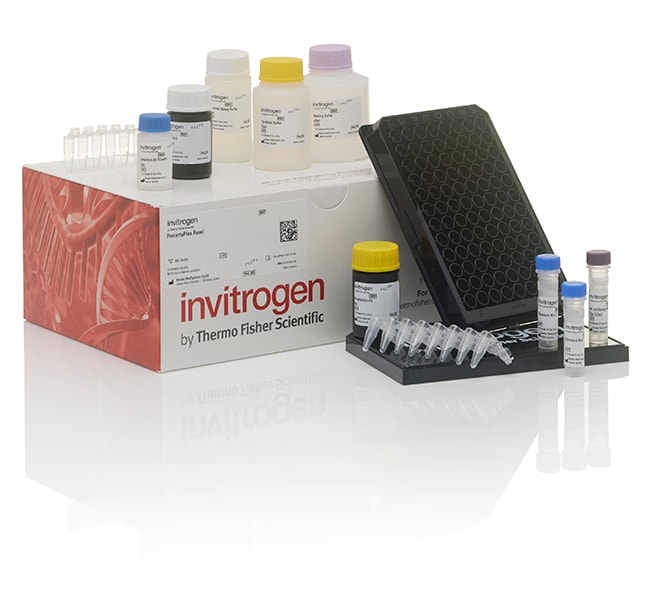
• 2 flacons de mélange standard de rat A (lyophilisé)
• 1 flacon de mélange de microbilles de capture de cytokine (1X)
• 1 flacon de mélange de microbilles de capture de chimiokine (1X)
• 1 flacon de mélange d’anticorps de détection biotinylés de cytokine (50X)
• 1 flacon de mélange d’anticorps de détection biotinylés de chimiokine (50X)
• 1 flacon de tampon de lecture (1X)
• 1 flacon de tampon de lavage (10x)
• 1 flacon de streptavidine-PE (1X)
• 1 flacon de tampon de dosage universel (1X)
• 1 flacon de diluant d’anticorps de détection (1X)
• Barrette de 8 tubes
• Film adhésif
• Plaque de 96 puits à fond plat, noire
À conserver entre 2 et 8°C.
• 1 flacon de mélange de microbilles de capture de cytokine (1X)
• 1 flacon de mélange de microbilles de capture de chimiokine (1X)
• 1 flacon de mélange d’anticorps de détection biotinylés de cytokine (50X)
• 1 flacon de mélange d’anticorps de détection biotinylés de chimiokine (50X)
• 1 flacon de tampon de lecture (1X)
• 1 flacon de tampon de lavage (10x)
• 1 flacon de streptavidine-PE (1X)
• 1 flacon de tampon de dosage universel (1X)
• 1 flacon de diluant d’anticorps de détection (1X)
• Barrette de 8 tubes
• Film adhésif
• Plaque de 96 puits à fond plat, noire
À conserver entre 2 et 8°C.
Foire aux questions (FAQ)
What is the size of the Luminex beads you currently use?
I am interested in performing Luminex assays using BioSource kits, and I have a Luminex xMAP system. Besides the kits and system, what other reagents and equipment will I need?
Do the Luminex beads require special care in handling?
Why would the Luminex acquisition software display "Sample Empty" messages during analysis?
What are the Luminex beads made of?
Citations et références (3)
Citations et références
Abstract
HE4 Overexpression by Ovarian Cancer Promotes a Suppressive Tumor Immune Microenvironment and Enhanced Tumor and Macrophage PD-L1 Expression.
Journal:J Immunol
PubMed ID:33903172
'Ovarian cancer is a highly fatal malignancy characterized by early chemotherapy responsiveness but the eventual development of resistance. Immune targeting therapies are changing treatment paradigms for numerous cancer types but have had minimal success in ovarian cancer. Through retrospective patient sample analysis, we have determined that high human epididymis protein
In-depth characterization of the neuroinflammatory reaction induced by peripheral surgery in an animal model.
Journal:J Neural Transm (Vienna)
PubMed ID:30039507
Delirium is a common complication seen after surgery and anesthesia, in particular in older patients. Although the etiology of postoperative delirium is only incompletely understood, various lines of evidence suggest that proinflammatory signaling from the peripheral site of inflammation to central nervous system results in a decrease of cerebral acetylcholine
Subcutaneous administration of a neutralizing IL-1ß antibody prolongs limb allograft survival.
Journal:Am J Transplant
PubMed ID:29633557
Cytokine-expression profiles revealed IL-1ß highly upregulated in rejecting skin of limb allografts. We investigate the effect of intragraft treatment with a neutralizing IL-1ß antibody in limb transplantation. Following allogenic hind-limb transplantation, Lewis rats were either left untreated or treated with anti-lymphocyte serum + tacrolimus (baseline); baseline immunosuppression + anti-IL-1ß (1 mg/kg