Search


Citations et références (21)
Invitrogen™
ProcartaPlex™ Mouse Cytokine & Chemokine Panel 1A, 36plex
Le panneau de chimiokine & cytokine de souris 36-Plex ProcartaPlex 1A permet d’étudier la fonction immunitaire en analysant 36 ciblesAfficher plus
| Référence | Quantité |
|---|---|
| EPX360-26092-901 | 96 dosages |
Référence EPX360-26092-901
Prix (EUR)
7 350,00
Each
Quantité:
96 dosages
Prix (EUR)
7 350,00
Each
Le panneau de chimiokine & cytokine de souris 36-Plex ProcartaPlex 1A permet d’étudier la fonction immunitaire en analysant 36 cibles protéiques dans un seul puits à l’aide de la technologie Luminex xMAP. Le panneau est composé de quatre sous-panneaux modulaires qui permettent une large sélection initiale pour déterminer les cibles d’intérêt et les études ultérieures analysant des sous-ensembles fonctionnels spécifiques de cytokines qui peuvent être achetés séparément. Les sous-panneaux peuvent entièrement être associés les uns aux autres ou à des dosages simplex individuels correspondant aux cibles dans le panneau. Les mêmes cibles se trouvent dans le panneau de convenance de cytokine & chimiokine de souris 36-Plex ProcartaPlex 1A (No de catalogue EPXR360-26092-901) qui est dans un format prêt à l’emploi et qui nécessite moins de pipetage.
Les panneaux préconfigurés ProcartaPlex sont largement testés pour la combinabilité, l’interférence et la réactivité croisée des analyses afin de fournir le plus haut niveau de validation et de précision. Tous les panneaux ProcartaPlex sont fournis avec les réactifs nécessaires pour effectuer le dosage.
Les panneaux multiplex ProcartaPlex sont disponibles en plusieurs formats et peuvent être utilisés sur six espèces (humain, souris, rat, primate non humain, porcin et canin). Consultez notre page d’dosages immunologiques ProcartaPlex pour plus d’informations et de produits disponibles.
Liste de cibles [région de microbille] :
Th1 / Th2 : GM-CSF [42], IFN gamma [38], IL-1 bêta [19], IL-2 [20], IL-4 [26], IL-5 [27], IL-6 [28], IL-12p70 [39], IL-13 [35], IL-18 [66], TNF alpha [45]
Th9 / Th17 / Th22 / Treg : IL-9 [34], IL-10 [13], IL-17A (CTLA-8) [52], IL-22 [33], IL-23 [37], IL-27 [36]
Cytokines inflammatoires : G-CSF (CSF-3) [12], IFN alpha [30], IL-3 [14], IL-15 / IL-15R [54], IL-28 [64], IL-31 [76], IL-1 alpha [56], LIF [18], ENA-78 (CXCL5) [57], M-CSF [21]
Chimiokines : Éotaxine (CCL11) [62], GRO alpha (CXCL1) [43], IP-10 (CXCL10) [22], MCP-1 (CCL2) [51], MCP-3 (CCL7) [48], MIP-1 alpha (CCL3) [47], MIP-1 bêta (CCL4) [72], MIP-2 alpha [55], RANTES (CCL5) [44]
À propos des dosages ProcartaPlex pour la plateforme Luminex
Les immunoessais ProcartaPlex sont basés sur les principes du dosage ELISA en sandwich, utilisant deux anticorps hautement spécifiques se liant à différents épitopes d’une protéine pour quantifier simultanément toutes les cibles protéiques à l’aide d’un instrument Luminex. Les dosages multiplex ProcartaPlex nécessitent seulement 25 µl de plasma ou de sérum, ou 50 µl de surnageant de culture cellulaire, et seulement quatre heures pour obtenir des résultats analysés.
Caractéristiques :
• Des résultats reproductibles et fiables : validés en panneau selon la norme la plus élevée de l’industrie, avec des tests de combinabilité des cibles protéiques et de réactivité croisée
• Plus de résultats par échantillon : mesurez simultanément plusieurs cibles protéiques dans un seul échantillon de 25 à 50 µl
• Plateforme de multiplexage Luminex largement référencée pour la détection et la quantification des protéines
Les dosages ProcartaPlex utilisent la technologie Luminex xMAP (profilage multianalyte) pour la détection et la quantification simultanées de maximum 80 cibles protéiques dans un échantillon unique de 25 à 50 µl provenant de plasma, de sérum, de surnageants de culture cellulaire et d’autres liquides corporels.
Les microbilles Luminex dans le dosage ProcartaPlex sont colorées en interne avec des proportions précises de fluorophores rouges et IR pour créer des signatures uniques de façon spectrale qui peuvent être identifiées par les systèmes de détection Luminex xMAP (par exemple Luminex 200, FLEXMAP 3D et MAGPIX). Comme le dosage ELISA sandwich, le dosage ProcartaPlex utilise des paires d’anticorps appariées pour identifier la protéine d’intérêt. Dans un dosage multiplex, chaque microbille unique d’un point de vue spectral est marquée avec des anticorps spécifiques pour une protéine cible unique. Les protéines liées sont identifiées à l’aide d’anticorps biotinylés et de la streptavidine-R-phycoérythrine (RPE). La conjugaison d’anticorps spécifiques d'une protéine à une microbille distincte permet d’analyser plusieurs cibles dans un seul puits.
La différence la plus significative entre un dosage ProcartaPlex et un dosage ELISA est que l’anticorps de capture du dosage ProcartaPlex est conjugué à une microbille et n’est pas adsorbé par un des puits de la microplaque. Ainsi, les réactifs de dosage ProcartaPlex flottent librement dans la solution. Pour la détection, l’instrument Luminex 200, par exemple, contient deux lasers : un pour distinguer la signature spectrale de chaque microbille et un autre pour quantifier la quantité de fluorescence de la RPE. Cette dernière est proportionnelle à la quantité de protéine présente dans l’échantillon. Les dosages multiplex ProcartaPlex peuvent profiler plus de protéines cibles à l’aide d’un échantillon nettement moins important. Cela leur prend autant de temps que pour effectuer un dosage ELISA sandwich traditionnel.
Les panneaux multiplex ProcartaPlex sont disponibles en plusieurs formats et peuvent être utilisés sur six espèces (humain, souris, rat, primate non humain, porcin et canin). Consultez la page thermofisher.com/procartaplex pour plus d’informations et pour les produits disponibles.
Les panneaux préconfigurés ProcartaPlex sont largement testés pour la combinabilité, l’interférence et la réactivité croisée des analyses afin de fournir le plus haut niveau de validation et de précision. Tous les panneaux ProcartaPlex sont fournis avec les réactifs nécessaires pour effectuer le dosage.
Les panneaux multiplex ProcartaPlex sont disponibles en plusieurs formats et peuvent être utilisés sur six espèces (humain, souris, rat, primate non humain, porcin et canin). Consultez notre page d’dosages immunologiques ProcartaPlex pour plus d’informations et de produits disponibles.
Liste de cibles [région de microbille] :
Th1 / Th2 : GM-CSF [42], IFN gamma [38], IL-1 bêta [19], IL-2 [20], IL-4 [26], IL-5 [27], IL-6 [28], IL-12p70 [39], IL-13 [35], IL-18 [66], TNF alpha [45]
Th9 / Th17 / Th22 / Treg : IL-9 [34], IL-10 [13], IL-17A (CTLA-8) [52], IL-22 [33], IL-23 [37], IL-27 [36]
Cytokines inflammatoires : G-CSF (CSF-3) [12], IFN alpha [30], IL-3 [14], IL-15 / IL-15R [54], IL-28 [64], IL-31 [76], IL-1 alpha [56], LIF [18], ENA-78 (CXCL5) [57], M-CSF [21]
Chimiokines : Éotaxine (CCL11) [62], GRO alpha (CXCL1) [43], IP-10 (CXCL10) [22], MCP-1 (CCL2) [51], MCP-3 (CCL7) [48], MIP-1 alpha (CCL3) [47], MIP-1 bêta (CCL4) [72], MIP-2 alpha [55], RANTES (CCL5) [44]
À propos des dosages ProcartaPlex pour la plateforme Luminex
Les immunoessais ProcartaPlex sont basés sur les principes du dosage ELISA en sandwich, utilisant deux anticorps hautement spécifiques se liant à différents épitopes d’une protéine pour quantifier simultanément toutes les cibles protéiques à l’aide d’un instrument Luminex. Les dosages multiplex ProcartaPlex nécessitent seulement 25 µl de plasma ou de sérum, ou 50 µl de surnageant de culture cellulaire, et seulement quatre heures pour obtenir des résultats analysés.
Caractéristiques :
• Des résultats reproductibles et fiables : validés en panneau selon la norme la plus élevée de l’industrie, avec des tests de combinabilité des cibles protéiques et de réactivité croisée
• Plus de résultats par échantillon : mesurez simultanément plusieurs cibles protéiques dans un seul échantillon de 25 à 50 µl
• Plateforme de multiplexage Luminex largement référencée pour la détection et la quantification des protéines
Les dosages ProcartaPlex utilisent la technologie Luminex xMAP (profilage multianalyte) pour la détection et la quantification simultanées de maximum 80 cibles protéiques dans un échantillon unique de 25 à 50 µl provenant de plasma, de sérum, de surnageants de culture cellulaire et d’autres liquides corporels.
Les microbilles Luminex dans le dosage ProcartaPlex sont colorées en interne avec des proportions précises de fluorophores rouges et IR pour créer des signatures uniques de façon spectrale qui peuvent être identifiées par les systèmes de détection Luminex xMAP (par exemple Luminex 200, FLEXMAP 3D et MAGPIX). Comme le dosage ELISA sandwich, le dosage ProcartaPlex utilise des paires d’anticorps appariées pour identifier la protéine d’intérêt. Dans un dosage multiplex, chaque microbille unique d’un point de vue spectral est marquée avec des anticorps spécifiques pour une protéine cible unique. Les protéines liées sont identifiées à l’aide d’anticorps biotinylés et de la streptavidine-R-phycoérythrine (RPE). La conjugaison d’anticorps spécifiques d'une protéine à une microbille distincte permet d’analyser plusieurs cibles dans un seul puits.
La différence la plus significative entre un dosage ProcartaPlex et un dosage ELISA est que l’anticorps de capture du dosage ProcartaPlex est conjugué à une microbille et n’est pas adsorbé par un des puits de la microplaque. Ainsi, les réactifs de dosage ProcartaPlex flottent librement dans la solution. Pour la détection, l’instrument Luminex 200, par exemple, contient deux lasers : un pour distinguer la signature spectrale de chaque microbille et un autre pour quantifier la quantité de fluorescence de la RPE. Cette dernière est proportionnelle à la quantité de protéine présente dans l’échantillon. Les dosages multiplex ProcartaPlex peuvent profiler plus de protéines cibles à l’aide d’un échantillon nettement moins important. Cela leur prend autant de temps que pour effectuer un dosage ELISA sandwich traditionnel.
Les panneaux multiplex ProcartaPlex sont disponibles en plusieurs formats et peuvent être utilisés sur six espèces (humain, souris, rat, primate non humain, porcin et canin). Consultez la page thermofisher.com/procartaplex pour plus d’informations et pour les produits disponibles.
Usage exclusivement réservé à la recherche. Ne pas utiliser pour des procédures de diagnostic.
Spécifications
Plage de dosageVoir le certificat d’analyse
Sensibilité du dosageVoir le certificat d’analyse
À utiliser avec (équipement)Instruments Luminex™
FormatKit multiplex
Gamme de produitsProcartaPlex
Type d’échantillonSérum, plasma, surnageants de culture cellulaire (SCC), Plasma, Cell Culture Supernatants
Volume d’échantillonSérum, plasma : 25 μl ; CCS : 50 μl
Conditions d’expéditionWet Ice
CombinabilityCombinable
Type de produitPanneau multiplex
Quantité96 dosages
Research AreaImmunology, Cytokines, Chemokines
EspècesSouris
Unit SizeEach
Contenu et stockage
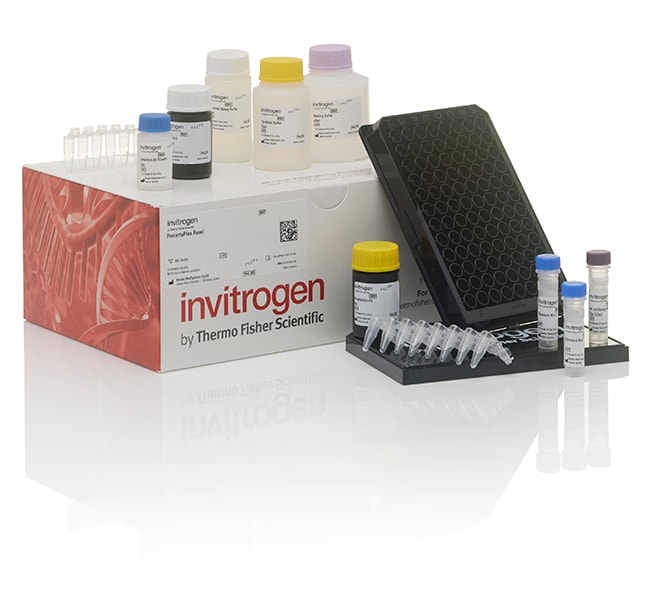
• 2 flacons de mélange standard de souris A (lyophilisé)
• 2 flacons de mélange standard de souris du pnael de cytokine de souris 1B (lyophilisé)
• 1 flacon de mélange de microbilles de capture B (1X)
• 1 flacon de mélange de microbilles de capture C (1X)
• 1 flacon de mélange de microbilles de capture D (1X)
• 1 flacon de mélange d’anticorps de détection biotinylés B (50X)
• 1 flacon de mélange d’anticorps de détection biotinylés C (50X)
• 1 flacon de mélange d’anticorps de détection biotinylés D (50X)
• 1 flacon de tampon de lecture (1X)
• 1 flacon de tampon de lavage (10x)
• 1 flacon de streptavidine-PE (1X)
• 1 flacon de tampon de dosage universel (1X)
• 1 flacon de diluant d’anticorps de détection (1X)
• Barrette de 8 tubes
• Film adhésif
• Plaque de 96 puits à fond plat, noire
• 2 flacons de mélange standard de souris du pnael de cytokine de souris 1B (lyophilisé)
• 1 flacon de mélange de microbilles de capture B (1X)
• 1 flacon de mélange de microbilles de capture C (1X)
• 1 flacon de mélange de microbilles de capture D (1X)
• 1 flacon de mélange d’anticorps de détection biotinylés B (50X)
• 1 flacon de mélange d’anticorps de détection biotinylés C (50X)
• 1 flacon de mélange d’anticorps de détection biotinylés D (50X)
• 1 flacon de tampon de lecture (1X)
• 1 flacon de tampon de lavage (10x)
• 1 flacon de streptavidine-PE (1X)
• 1 flacon de tampon de dosage universel (1X)
• 1 flacon de diluant d’anticorps de détection (1X)
• Barrette de 8 tubes
• Film adhésif
• Plaque de 96 puits à fond plat, noire
Foire aux questions (FAQ)
What is the size of the Luminex beads you currently use?
I am interested in performing Luminex assays using BioSource kits, and I have a Luminex xMAP system. Besides the kits and system, what other reagents and equipment will I need?
Do the Luminex beads require special care in handling?
Why would the Luminex acquisition software display "Sample Empty" messages during analysis?
What are the Luminex beads made of?
Citations et références (21)
Citations et références
Abstract
Effector and Activated T Cells Induce Preterm Labor and Birth That Is Prevented by Treatment with Progesterone.
Journal:J Immunol
PubMed ID:30918041
'Preterm labor commonly precedes preterm birth, the leading cause of perinatal morbidity and mortality worldwide. Most research has focused on establishing a causal link between innate immune activation and pathological inflammation leading to preterm labor and birth. However, the role of maternal effector/activated T cells in the pathogenesis of preterm
Plasmodium co-infection protects against chikungunya virus-induced pathologies.
Journal:Nat Commun
PubMed ID:30254309
'Co-infection with Plasmodium and chikungunya virus (CHIKV) has been reported in humans, but the impact of co-infection on pathogenesis remains unclear. Here, we show that prior exposure to Plasmodium suppresses CHIKV-associated pathologies in mice. Mechanistically, Plasmodium infection induces IFN?, which reduces viraemia of a subsequent CHIKV infection and suppresses tissue viral
Genetic Inactivation of ZCCHC6 Suppresses Interleukin-6 Expression and Reduces the Severity of Experimental Osteoarthritis in Mice.
Journal:Arthritis Rheumatol
PubMed ID:30302948
'Cytokine expression is tightly regulated posttranscriptionally, but high levels of interleukin-6 (IL-6) in patients with osteoarthritis (OA) indicate that regulatory mechanisms are disrupted in this disorder. The enzyme ZCCHC6 (zinc-finger CCHC domain-containing protein 6; TUT-7) has been implicated in posttranscriptional regulation of inflammatory cytokine expression, but its role in OA
MYC oncogene is associated with suppression of tumor immunity and targeting Myc induces tumor cell immunogenicity for therapeutic whole cell vaccination.
Journal:J Immunother Cancer
PubMed ID:33757986
'MYC oncogene is deregulated in 70% of all human cancers and is associated with multiple oncogenic functions including immunosuppression in the tumor microenvironment. The role of MYC in the immune microenvironment of neuroblastoma and melanoma is investigated and the effect of targeting Myc on immunogenicity of cancer cells is evaluated.'
Administration of nucleoside-modified mRNA encoding broadly neutralizing antibody protects humanized mice from HIV-1 challenge.
Journal:Nat Commun
PubMed ID:28251988
'Monoclonal antibodies are one of the fastest growing classes of pharmaceutical products, however, their potential is limited by the high cost of development and manufacturing. Here we present a safe and cost-effective platform for in vivo expression of therapeutic antibodies using nucleoside-modified mRNA. To demonstrate feasibility and protective efficacy, nucleoside-modified