Search


Citations et références (16)
Invitrogen™
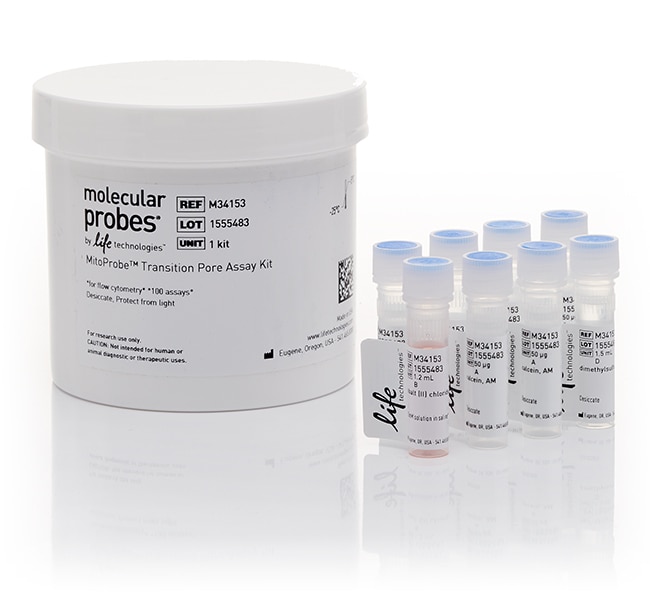
MitoProbe™ Transition Pore Assay Kit, for flow cytometry
Le kit de dosage de pore de transition MitoProbe™ offre une méthode éprouvée (Petronilli V. et al. 1989, 1999) pourAfficher plus
| Référence | Quantité |
|---|---|
| M34153 | 1 kit |
Référence M34153
Prix (EUR)
761,65
Online Exclusive
1 016,00Économisez 254,35 (25%)
Each
Quantité:
1 kit
Prix (EUR)
761,65
Online Exclusive
1 016,00Économisez 254,35 (25%)
Each
Le kit de dosage de pore de transition MitoProbe™ offre une méthode éprouvée (Petronilli V. et al. 1989, 1999) pour mesurer l’ouverture du pore de transition de perméabilité mitochondriale. Le kit comprend un colorant et un extincteur qui sont facilement chargés dans les cellules. Dans les cellules saines, le colorant, mais pas l’extincteur, pénètre dans les mitochondries. Les mitochondries restent fortement fluorescentes jusqu’à ce que l’activation des pores mitochondriaux permette l’extinction de la fluorescence.
Consultez un guide de sélection de tous les dosages d’apoptose pour la cytométrie en flux.
Consultez un guide de sélection de tous les dosages d’apoptose pour la cytométrie en flux.
Usage exclusivement réservé à la recherche. Ne pas utiliser pour des procédures de diagnostic.
Spécifications
Excitation / émission488
Nbre de réactions100 Reactions
Gamme de produitsMitoProbe
Type de produitKit de dosage de pore de transition
Quantité1 kit
Conditions d’expéditionTempérature ambiante
ConjuguéCalcéine AM
FormatTube
Unit SizeEach
Contenu et stockage
Contient 5 flacons de calcéine, AM (50 µg de poudre sèche/flacon), 1 flacon de cobalt (II) chlorure hexahydraté (1,2 ml, 80 mM dans une solution saline), 1 flacon d’ionomycine (55 µg), sel de calcium, et 1 flacon de DMSO (1,5 ml).
Conserver au congélateur (-5 et -30°C).
Conserver au congélateur (-5 et -30°C).
Foire aux questions (FAQ)
What are the advantages of flow cytometry?
What kinds of applications can I run on a flow cytometer?
Citations et références (16)
Citations et références
Abstract
Cysteine 203 of cyclophilin D is critical for cyclophilin D activation of the mitochondrial permeability transition pore.
Journal:J Biol Chem
PubMed ID:21930693
The mitochondrial permeability transition pore (mPTP) opening plays a critical role in mediating cell death during ischemia/reperfusion (I/R) injury. Our previous studies have shown that cysteine 203 of cyclophilin D (CypD), a critical mPTP mediator, undergoes protein S-nitrosylation (SNO). To investigate the role of cysteine 203 in mPTP activation, we
Transient and long-lasting openings of the mitochondrial permeability transition pore can be monitored directly in intact cells by changes in mitochondrial calcein fluorescence.
Journal:Biophys J
PubMed ID:9929477
'The occurrence and the mode of opening of the mitochondrial permeability transition pore (MTP) were investigated directly in intact cells by monitoring the fluorescence of mitochondrial entrapped calcein. When MH1C1 cells and hepatocytes were loaded with calcein AM, calcein was also present within mitochondria, because (i) its mitochondrial signal was
Calpain and caspase orchestrated death signal to accomplish apoptosis induced by resveratrol and its novel analog hydroxystilbene-1 [correction of hydroxstilbene-1] in cancer cells.
Journal:J Pharmacol Exp Ther
PubMed ID:20484155
'Stomach ulceration is a major side effect of most chemopreventive drugs. We have established that although resveratrol is a promising chemopreventive compound, it delays the ulcer healing process. However, its analog hydroxystilbene-1 (HST-1) was devoid of such an ulcerogenic side effect. Consequently, here we tried to explore the chemopreventive efficacy
Secondary coenzyme Q10 deficiency triggers mitochondria degradation by mitophagy in MELAS fibroblasts.
Journal:FASEB J
PubMed ID:21551238
Mitochondrial encephalomyopathy, lactic acidosis, and stroke-like episodes (MELAS) is a mitochondrial disease most usually caused by point mutations in tRNA genes encoded by mtDNA. Here, we report on how this mutation affects mitochondrial function in primary fibroblast cultures established from 2 patients with MELAS who harbored the A3243G mutation. Both
Imaging the mitochondrial permeability transition pore in intact cells.
Journal:Biofactors
PubMed ID:9914828
The involvement of mitochondrial permeability transition pore (MTP) in cellular processes is generally investigated by indirect means, such as changes in mitochondrial membrane potential or pharmacological inhibition. However, such effects could not be related univocally to MTP. In addition, source of errors could be represented by the increased retention of