Search


Citations et références (262)
Invitrogen™
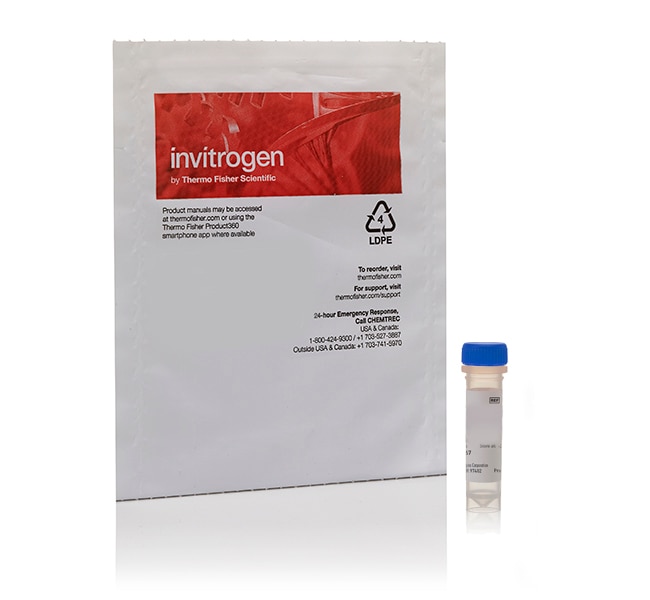
Coloration d’acides nucléiques SYTOX™ Green - Solution de 5 mM dans du DMSO
Le colorant d’acides nucléiques vert SYTOX® est un excellent contre-colorant vert fluorescent des noyaux et des chromosomes qui est imperméantAfficher plus
| Référence | Quantité |
|---|---|
| S7020 | 250 μl |
Référence S7020
Prix (EUR)
448,65
Online Exclusive
516,00Économisez 67,35 (13%)
Each
Quantité:
250 μl
Prix (EUR)
448,65
Online Exclusive
516,00Économisez 67,35 (13%)
Each
Le colorant d’acides nucléiques vert SYTOX® est un excellent contre-colorant vert fluorescent des noyaux et des chromosomes qui est imperméant aux cellules vivantes, ce qui en fait un indicateur utile des cellules mortes au sein d’une population.
Également disponible en tant que solution à température ambiante stable et prête à l’emploi : Réactif NucGreen Dead 488 ReadyProbes.
Voir d’autres accessoires et réactifs d’imagerie ReadyProbes prêts à l’emploi ›
• Imperméant aux cellules vivantes
• Excitation/émission : 504 / 523 nm
• À utiliser avec le laser à d’ions argon 488
• Fonctionne avec les cellules de mammifères et les bactéries gram-positif et gram-négatif
Simple détermination de la viabilité
Le colorant vert SYTOX® permet de déterminer rapidement la viabilité cellulaire lors de l’utilisation de cytomètres en flux, de microscopes à fluorescence, de fluoromètres ou de lecteurs de microplaques à fluorescence. Il ne traverse pas les membranes intactes mais pénètre facilement les membranes compromises typiques des cellules mortes. Du fait qu’il présente une fluorescence 500 fois plus forte lors de la liaison aux acides nucléiques, l’utilisation du colorant vert SYTOX® pour une incubation brève des cellules mortes entraîne une vive fluorescence verte avec un pic d’émission de 523 nm lorsqu’il est excité par un laser d’ions argon de 488 nm ou par toute autre source comprise entre 450–490 nm. La luminosité exceptionnelle du signal produit dans les cellules mortes rend le colorant vert SYTOX® particulièrement utile pour déterminer la viabilité non seulement des cellules de mammifères, mais aussi des bactéries gram-positif et gram-négatif.
Appartient à la famille des colorants et des dosages de viabilité cellulaire Invitrogen
Les colorants SYTOX® pour les cellules mortes sont disponibles dans une variété de couleurs, y compris en rouge, en bleu et en orange. En outre, Invitrogen a intégré les colorations SYTOX® dans certains dosages de l’apoptose, de la viabilité cellulaire et du métabolisme.
Usage exclusivement réservé à la recherche. Non destiné à des fins thérapeutiques ou diagnostiques humaines ou animales.
Lien connexe
• Pour en savoir plus sur tous les produits SYTOX®.
Également disponible en tant que solution à température ambiante stable et prête à l’emploi : Réactif NucGreen Dead 488 ReadyProbes.
Voir d’autres accessoires et réactifs d’imagerie ReadyProbes prêts à l’emploi ›
• Imperméant aux cellules vivantes
• Excitation/émission : 504 / 523 nm
• À utiliser avec le laser à d’ions argon 488
• Fonctionne avec les cellules de mammifères et les bactéries gram-positif et gram-négatif
Simple détermination de la viabilité
Le colorant vert SYTOX® permet de déterminer rapidement la viabilité cellulaire lors de l’utilisation de cytomètres en flux, de microscopes à fluorescence, de fluoromètres ou de lecteurs de microplaques à fluorescence. Il ne traverse pas les membranes intactes mais pénètre facilement les membranes compromises typiques des cellules mortes. Du fait qu’il présente une fluorescence 500 fois plus forte lors de la liaison aux acides nucléiques, l’utilisation du colorant vert SYTOX® pour une incubation brève des cellules mortes entraîne une vive fluorescence verte avec un pic d’émission de 523 nm lorsqu’il est excité par un laser d’ions argon de 488 nm ou par toute autre source comprise entre 450–490 nm. La luminosité exceptionnelle du signal produit dans les cellules mortes rend le colorant vert SYTOX® particulièrement utile pour déterminer la viabilité non seulement des cellules de mammifères, mais aussi des bactéries gram-positif et gram-négatif.
Appartient à la famille des colorants et des dosages de viabilité cellulaire Invitrogen
Les colorants SYTOX® pour les cellules mortes sont disponibles dans une variété de couleurs, y compris en rouge, en bleu et en orange. En outre, Invitrogen a intégré les colorations SYTOX® dans certains dosages de l’apoptose, de la viabilité cellulaire et du métabolisme.
Usage exclusivement réservé à la recherche. Non destiné à des fins thérapeutiques ou diagnostiques humaines ou animales.
Lien connexe
• Pour en savoir plus sur tous les produits SYTOX®.
Usage exclusivement réservé à la recherche. Ne pas utiliser pour des procédures de diagnostic.
Spécifications
CouleurVert
Méthode de détectionFluorescence, Fluorescent
Type de colorantPerméant aux cellules
Émission523 nm
Gamme de longueur d’onde d’excitation504 nm
À utiliser avec (équipement)Cytomètre en flux, Cytomètre en flux
FormeSolution
FormatTube(s), Tube(s)
Gamme de produitsSYTOX
Quantité250 μl
Conditions d’expéditionTempérature ambiante
Volume (métrique)250 μl
Type d’étiquetteFluorescent
Type de produitColoration d’acide nucléique
SubCellular LocalizationNoyau, acides nucléiques, Nucleus
Unit SizeEach
Contenu et stockage
Conserver au congélateur (entre -5°C et -30°C) et à l’abri de la lumière.
Foire aux questions (FAQ)
How do SYTO dyes bind to DNA?
I need to mount my Qdot secondary-labeled tissue samples in HistoMount mounting medium, but my Qdot 705 conjugate overlaps with your Qnuclear Deep Red nuclear label. What other nuclear label would you recommend, that is compatible with HistoMount mounting medium?
I am using SYTOX AAdvanced as a dead cell stain, but all of my cells are labeling even though I am certain that they are supposed to be alive. These are adherent cells that I have trypsinized. Why am I getting false-dead signals?
Citations et références (262)
Citations et références
Abstract
Use of SYTOX green dye in the flow cytometric analysis of bacterial phagocytosis.
Journal:Cytometry
PubMed ID:12116370
BACKGROUND: Fluorescein isothiocyanate (FITC) is used widely to label the targets used in flow cytometric phagocytosis assays. Unfortunately, the fluorescence intensity of phagocytosed FITC-labeled targets is influenced by changes in intracellular pH level, making quantitative measurements with this fluorophore problematic. We describe the use of SYTOX green nucleic acid stain
Identification and characterization of two subpopulations of Encephalitozoon intestinalis.
Journal:Appl Environ Microbiol
PubMed ID:12902292
Microsporidia are obligate intracellular protozoa that have been shown to be pathogenic to most living creatures. The development of in vitro cell culture propagation methods has provided researchers with large numbers of spores and facilitated the study of these organisms. Here, we describe heterogeneity within cell culture-propagated Encephalitozoon intestinalis suspensions.
Unique catabolic pathway of glycosphingolipids in a hydrozoan, Hydra magnipapillata, involving endoglycoceramidase.
Journal:J Biol Chem
PubMed ID:15320336
Endoglycoceramidase (EGCase; EC 3.2.1.123) is an enzyme capable of cleaving the glycosidic linkage between oligosaccharides and ceramides of various glycosphingolipids. We detected strong EGCase activity in animals belonging to Cnidaria, Mollusca, and Annelida and cloned the enzyme from a hydra, Hydra magnipapillata. The hydra EGCase, consisting of 517 amino acid
Cell death during ischemia: relationship to mitochondrial depolarization and ROS generation.
Journal:Am J Physiol Heart Circ Physiol
PubMed ID:12388276
Ischemia-reperfusion injury induces cell death, but the responsible mechanisms are not understood. This study examined mitochondrial depolarization and cell death during ischemia and reperfusion. Contracting cardiomyocytes were subjected to 60-min ischemia followed by 3-h reperfusion. Mitochondrial membrane potential (DeltaPsi(m)) was assessed with tetramethylrhodamine methyl ester. During ischemia, DeltaPsi(m) decreased to
Up-regulation of cyclooxygenase-2 and apoptosis resistance by p38 MAPK in hypericin-mediated photodynamic therapy of human cancer cells.
Journal:J Biol Chem
PubMed ID:14557269
Photodynamic Therapy (PDT) is an approved anticancer therapy that kills cancer cells by the photochemical generation of reactive oxygen species following absorption of visible light by a photosensitizer, which selectively accumulates in tumors. We report that hypericin-mediated PDT of human cancer cells leads to up-regulation of the inducible cyclooxygenase-2 (COX-2)