Search


Citations et références (340)
Invitrogen™
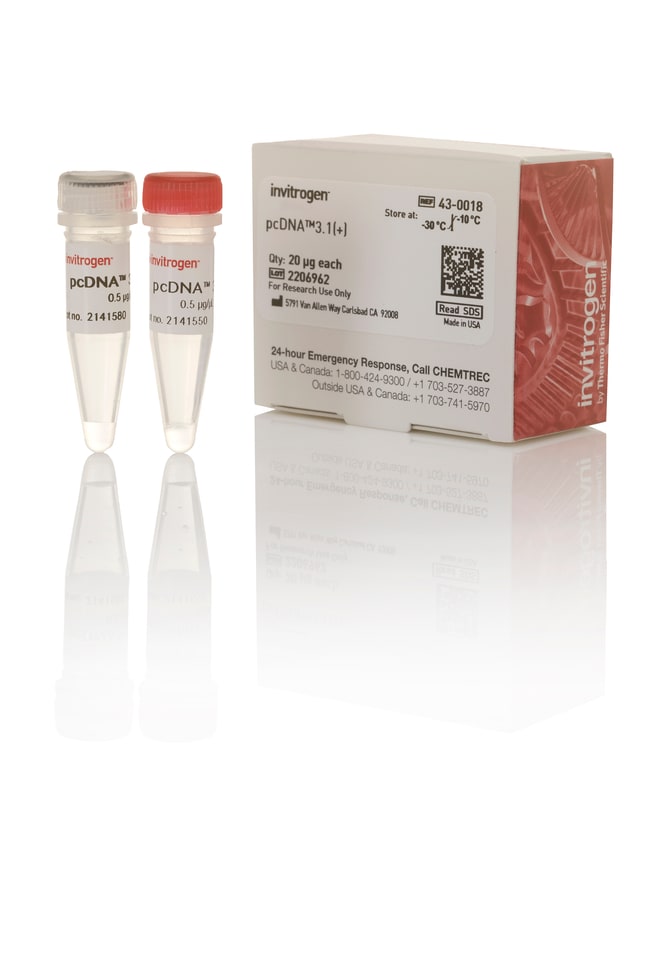
pcDNA™3.1 (+) Mammalian Expression Vector
Ce vecteur d’ADNpc™3.1(+) est conçu pour l’expression constitutive de haut niveau dans une variété de lignées de cellules de mammifères.Afficher plus
| Référence | Quantité |
|---|---|
| V79020 | 20 μg |
Référence V79020
Prix (EUR)
1 172,00
20 µg
Quantité:
20 μg
Prix (EUR)
1 172,00
20 µg
Ce vecteur d’ADNpc™3.1(+) est conçu pour l’expression constitutive de haut niveau dans une variété de lignées de cellules de mammifères. Il contient un marqueur sélectionnable Geneticin™ et un site de clonage multiple à orientation vers l’avant.
La famille de vecteurs d’expression pcDNA™3.1
Trois versions non étiquetées de pcDNA™3.1 (disponibles séparément), chacune dotée d’un marqueur sélectionnable différent (Geneticin™, Zeocin™ ou hygromycine), sont destinées à une utilisation seule ou en co-transfections. Les trois vecteurs présentent les caractéristiques suivantes :
• Stimulateur-promoteur de cytomégalovirus (CMV) pour une expression de haut niveau
• Grand site de clonage multiple dans les orientations avant (+) ou inverse (-)
• Signal de polyadénylation de l’hormone de croissance bovine (BGH) et séquence de terminaison de transcription pour une stabilité accrue de l’ARNm
• Origine SV40 pour la réplication épisomique et le sauvetage de vecteur simple dans les lignées cellulaires exprimant l’antigène grand T (c.-à-d.COS-1 et COS-7)
• Gène de résistance à l’ampicilline et origine de la pUC pour sélection et maintenance dans E. coli
La famille de vecteurs d’expression pcDNA™3.1
Trois versions non étiquetées de pcDNA™3.1 (disponibles séparément), chacune dotée d’un marqueur sélectionnable différent (Geneticin™, Zeocin™ ou hygromycine), sont destinées à une utilisation seule ou en co-transfections. Les trois vecteurs présentent les caractéristiques suivantes :
• Stimulateur-promoteur de cytomégalovirus (CMV) pour une expression de haut niveau
• Grand site de clonage multiple dans les orientations avant (+) ou inverse (-)
• Signal de polyadénylation de l’hormone de croissance bovine (BGH) et séquence de terminaison de transcription pour une stabilité accrue de l’ARNm
• Origine SV40 pour la réplication épisomique et le sauvetage de vecteur simple dans les lignées cellulaires exprimant l’antigène grand T (c.-à-d.COS-1 et COS-7)
• Gène de résistance à l’ampicilline et origine de la pUC pour sélection et maintenance dans E. coli
Usage exclusivement réservé à la recherche. Ne pas utiliser pour des procédures de diagnostic.
Spécifications
Type de livraisonTransfection
À utiliser avec (application)Expression constitutive
Type de produitVecteur d’expression de cellules de mammifères
Quantité20 μg
Agent de sélection (eucaryotique)Geneticin™ (G-418)
VecteurpcDNA
Méthode de clonageEnzyme de restriction / MCS
Gamme de produitspcDNA
AccélérateurCMV
Marqueur de protéineNon étiqueté
Unit Size20 µg
Contenu et stockage
20 µg de ce vecteur pcDNA™3.1(+), ainsi qu’un contrôle d’expression sont superenroulés et lyophilisés. Conserver à -20°C. La stabilité des vecteurs est garantie pendant 6 mois lorsqu’ils sont correctement conservés.
Foire aux questions (FAQ)
I performed stable selection but my antibiotic-resistant clones do not express my gene of interest. What could have gone wrong?
I used a mammalian expression vector but do not get any expression of my protein. Can you help me troubleshoot?
I am using a mammalian expression vector that has the neomycin resistance gene. Can I use neomycin for stable selection in mammalian cells?
Is it okay if my construct has an ATG that is upstream of the ATG in my gene of interest? Will it interfere with translation of my gene?
What is the difference between pcDNA3.1 vectors and the pcDNA3.3-TOPO vector?
Citations et références (340)
Citations et références
Abstract
Two murine homologs of the Drosophila single-minded protein that interact with the mouse aryl hydrocarbon receptor nuclear translocator protein.
Journal:The Journal of biological chemistry
PubMed ID:9020169
Evaluation of VP22 spread in tissue culture.
Journal:Journal of virology
PubMed ID:10623773
We compare methods of detection of intercellular transport of the herpes simplex virus protein VP22 and of a green fluorescent protein (GFP)-VP22 fusion protein. Spread of both proteins was observed by immunofluorescence (IF) using organic fixatives. Spread of both proteins was also detected by IF after paraformaldehyde (PFA) fixation and
A kinase-regulated PDZ-domain interaction controls endocytic sorting of the beta2-adrenergic receptor.
Journal:Nature
PubMed ID:10499588
A
Journal:J Biol Chem
PubMed ID:11973330
The large size (six membrane-spanning repeats in each of four domains) and asymmetric architecture of the voltage-dependent Na+ channel has hindered determination of its structure. With the goal of determining the minimum structure of the Na+ channel permeation pathway, we created two stable cell lines expressing the voltage-dependent rat skeletal
Molecular cloning and biological activity of a novel lysyl oxidase-related gene expressed in cartilage.
Journal:J Biol Chem
PubMed ID:11292829
We cloned a cDNA encoding a novel lysyl oxidase-related protein, named LOXC, by suppression subtractive hybridization between differentiated and calcified ATDC5 cells, a clonal mouse chondrogenic EC cell line. The deduced amino acid sequence of mouse LOXC consists of 757 amino acids and shows 50% identity with that of mouse