Search



인용 및 참조 문헌 (3)
Invitrogen™
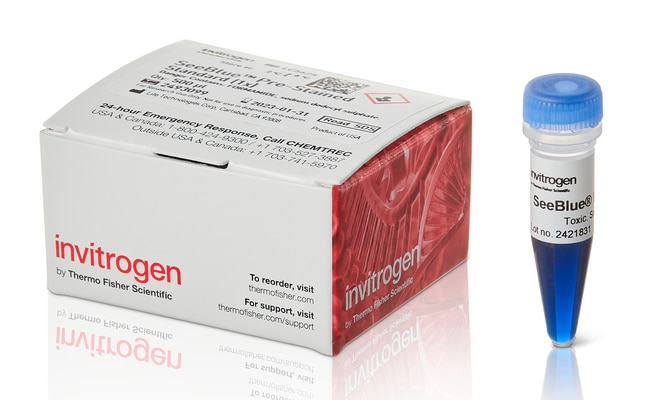
SeeBlue™ Pre-stained Protein Standard
SeeBlue Pre-Stained Standard consists of nine polypeptides that resolve into sharp, tight blue bands in the range of range of자세히 알아보기
| 카탈로그 번호 | 수량 |
|---|---|
| LC5625 | 500 μL |
카탈로그 번호 LC5625
제품 가격(KRW)
182,000
Online offer
Ends: 31-Dec-2026
207,000할인액 25,000 (12%)
Each
수량:
500 μL
제품 가격(KRW)
182,000
Online offer
Ends: 31-Dec-2026
207,000할인액 25,000 (12%)
Each
SeeBlue Pre-Stained Standard consists of nine polypeptides that resolve into sharp, tight blue bands in the range of range of 4–200 kDa allowing you to easily monitor protein electrophoresis and western transfer efficiency. The protein standard is supplied in a ready-to-use format for direct loading onto gels; no need to heat, reduce, or add sample buffer prior to use.
Compare and view all other protein standards and ladders ›
Applications
• Monitoring protein migration during SDS-polyacrylamide gel electrophoresis.
• Monitoring protein transfer onto membranes after western blotting
• Sizing of proteins on SDS-polyacrylamide gels and western blots
Compare and view all other protein standards and ladders ›
Applications
• Monitoring protein migration during SDS-polyacrylamide gel electrophoresis.
• Monitoring protein transfer onto membranes after western blotting
• Sizing of proteins on SDS-polyacrylamide gels and western blots
For Research Use Only. Not for use in diagnostic procedures.
사양
검출 방법Colorimetric
젤 호환성Bolt™ Bis-Tris Plus Gels, Novex™ Tricine Gels, Novex™ Tris-Glycine Gels, NuPAGE™ Bis-Tris Gels
분자량198, 62, 49, 38, 28, 18, 14, 6, 3 kDa
수량500 μL
로드 준비Yes
배송 조건Wet Ice
색상Blue
Number of Markers9
제품라인SeeBlue
제품 유형Protein Ladder
크기 범위4 to 200 kDa
System TypeWestern Blotting, SDS-PAGE
Unit SizeEach
구성 및 보관
500 μL (50 applications of 10 μl each) provided in a plastic vial. Loading Buffer consists of Tris-HCl, Formamide, SDS, and Phenol Red.
Store at 4°C.
Store at 4°C.
자주 묻는 질문(FAQ)
How can I obtain the date of manufacture for SeeBlue Pre-Stained Standard from the lot number?
How should the SeeBlue Pre-Stained protein standard appear after silver or Coomassie staining?
What is the expected Western transfer efficiency of the SeeBlue Prestained Standard?
Can I store the SeeBlue and SeeBlue Plus2 Pre-stained standards in the freezer to increase their shelf-life?
Why are the molecular weight values for the proteins in your prestained standards such as SeeBlue and SeeBlue Plus2 different in different gel types?
인용 및 참조 문헌 (3)
인용 및 참조 문헌
Abstract
The specificity loop of T7 RNA polymerase interacts first with the promoter and then with the elongating transcript, suggesting a mechanism for promoter clearance
Journal:Proc Natl Acad Sci U S A
PubMed ID:11095736
During the early stages of transcription, T7 RNA polymerase forms an unstable initiation complex that synthesizes and releases transcripts 2-8 nt in length before disengaging from the promoter and isomerizing to a stable elongation complex. In this study, we used RNA small middle dotprotein and RNA small middle dotDNA crosslinking
Genome-scale cloning and expression of individual open reading frames using topoisomerase I-mediated ligation.
Journal:Genome Res
PubMed ID:10207160
The in vitro cloning of DNA molecules traditionally uses PCR amplification or site-specific restriction endonucleases to generate linear DNA inserts with defined termini and requires DNA ligase to covalently join those inserts to vectors with the corresponding ends. We have used the properties of Vaccinia DNA topoisomerase I to develop
beta -Glucoside Kinase (BglK) from Klebsiella pneumoniae. PURIFICATION, PROPERTIES, AND PREPARATIVE SYNTHESIS OF 6-PHOSPHO-beta -D-GLUCOSIDES.
Journal:J Biol Chem
PubMed ID:12110692
ATP-dependent beta-glucoside kinase (BglK) has been purified from cellobiose-grown cells of Klebsiella pneumoniae. In solution, the enzyme (EC ) exists as a homotetramer composed of non-covalently linked subunits of M(r) approximately 33,000. Determination of the first 28 residues from the N terminus of the protein allowed the identification and cloning