Search


Citas y referencias (5)
Gibco™
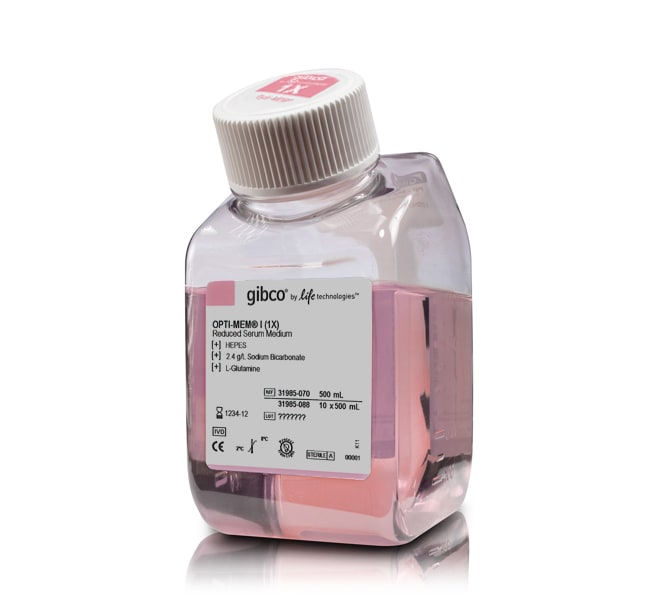
Medio de suero reducido Opti-MEM™ I
El medio de suero reducido Opti-MEM™ I es un medio esencial mínimo (MEM) mejorado que permite una reducción de laMás información
Have Questions?
Cambiar vista

| Número de catálogo | Cantidad |
|---|---|
| 31985088 | 10 x 500 mL |
| 31985070 | 500 mL |
| 31985062 | 100 mL |
Número de catálogo 31985088
Precio (MXN)
-
Cantidad:
10 x 500 mL
El medio de suero reducido Opti-MEM™ I es un medio esencial mínimo (MEM) mejorado que permite una reducción de la suplementación de suero bovino fetal, por lo menos en un 50 %, sin ningún cambio en la tasa de crecimiento o la morfología. El medio Opti-MEM™ I también se recomienda cuando se van a usar reactivos de transfección de lípidos catiónicos, como el reactivo Lipofectamine™. El medio Opti-MEM™ I se puede emplear con diversas células de mamíferos adherentes y en suspensión, incluidos SP2, AE-1, CHO, BHK-21, HEK y fibroblastos primarios. Ofrecemos diversas modificaciones de Opti-MEM™ I para diferentes aplicaciones de cultivos celulares.
Esta versión de Opti-MEM™ I se ha modificado del modo siguiente:
La formulación completa es confidencial. Si desea obtener más información, póngase en contacto con el servicio técnico.
Uso del medio Opti-MEM™ I
El medio de suero reducido Opti-MEM™ I es un medio único que contiene insulina, transferrina, hipoxantina, timidina y oligoelementos. Estos componentes adicionales permiten una reducción en la suplementación sérica de al menos un 50 %. El medio Opti-MEM™ I utiliza un sistema de tampones de bicarbonato sódico (2,4 g/l) y, por tanto, requiere un ambiente con un 5–10 % de CO2 para mantener el pH fisiológico.
Sistema cGMP de elaboración y calidad
Opti-MEM™ I se elabora en unas instalaciones que cumplen con las buenas prácticas de fabricación actuales ubicadas en Grand Island, Nueva York (EE. UU.). Las instalaciones se han registrado en la Agencia estadounidense de alimentos y medicamentos (FDA) como fabricante de dispositivos médicos y tienen la certificación según la norma ISO 13485. Para mantener la continuidad de la cadena de suministro, ofrecemos un producto Opti-MEM™ I idéntico fabricado en nuestras instalaciones de Escocia (31985-047). Estas instalaciones también se han registrado en la FDA como fabricante de dispositivos médicos y tienen la certificación según la norma ISO 13485.
Esta versión de Opti-MEM™ I se ha modificado del modo siguiente:
| Con |
| • L-glutamina |
| • Rojo de fenol |
La formulación completa es confidencial. Si desea obtener más información, póngase en contacto con el servicio técnico.
Uso del medio Opti-MEM™ I
El medio de suero reducido Opti-MEM™ I es un medio único que contiene insulina, transferrina, hipoxantina, timidina y oligoelementos. Estos componentes adicionales permiten una reducción en la suplementación sérica de al menos un 50 %. El medio Opti-MEM™ I utiliza un sistema de tampones de bicarbonato sódico (2,4 g/l) y, por tanto, requiere un ambiente con un 5–10 % de CO2 para mantener el pH fisiológico.
Sistema cGMP de elaboración y calidad
Opti-MEM™ I se elabora en unas instalaciones que cumplen con las buenas prácticas de fabricación actuales ubicadas en Grand Island, Nueva York (EE. UU.). Las instalaciones se han registrado en la Agencia estadounidense de alimentos y medicamentos (FDA) como fabricante de dispositivos médicos y tienen la certificación según la norma ISO 13485. Para mantener la continuidad de la cadena de suministro, ofrecemos un producto Opti-MEM™ I idéntico fabricado en nuestras instalaciones de Escocia (31985-047). Estas instalaciones también se han registrado en la FDA como fabricante de dispositivos médicos y tienen la certificación según la norma ISO 13485.
Para su uso en investigación o procesos de fabricación posteriores. No apto para uso diagnóstico ni para la administración directa en seres humanos ni en animales.
Especificaciones
Línea de célulasSp2, AE-1, CHO, BHK-21, and HEK
Tipo de célulaMammalian Cells
Concentración1X
Entorno de cultivoCO2
Para utilizar con (aplicación)Mammalian Cell Culture, Lipid-Based Transfection
FormatoBottles
Calidad de fabricacióncGMP-compliant under the ISO 13485 standard
Línea de productosGibco, Opti-MEM
Tipo de productoOpti-MEM I
Cantidad10 x 500 mL
Duración de almacenamiento18 Months From Date of Manufacture
Condiciones de envíoTemperatura ambiente
ClasificaciónHuman Origin
Culture TypeMammalian Cell Culture
FormularioLíquido
Serum LevelReduced Serum
EsterilidadEstéril con filtro
Sterilization MethodSterile-filtered
Con aditivosGlutamine, Phenol Red
Sin aditivosNo FBS
Unit SizeEach
Contenido y almacenamiento
Storage conditions: 2°C to 8°C (protect from light)
Shipping conditions: Ambient
Shelf life: 18 months from date of manufacture
Shipping conditions: Ambient
Shelf life: 18 months from date of manufacture
Preguntas frecuentes
What should I use to dilute my RNAi duplexes and Lipofectamine RNAiMAX before complexing?
Do you offer an alternative for Opti-MEM I Reduced Serum Medium (Cat. No. 31985070)?
My OpitMEM Reduced Serum Medium (Cat. No. 31985070) was accidentally frozen. Can I still use it?
Is there any other difference between Opti-MEM I Reduced Serum Medium and Opti-MEM I Reduced Serum Medium, no phenol red besides the presence/absence of phenol red?
Where can I find the osmolality for my lot of Opti-MEM I Reduced Serum Medium?
Citations & References (5)
Citations & References
Abstract
Regulation of cortical dendrite development by Slit-Robo interactions.
Journal:Neuron
PubMed ID:11779471
Slit proteins have previously been shown to regulate axon guidance, branching, and neural migration. Here we report that, in addition to acting as a chemorepellant for cortical axons, Slit1 regulates dendritic development. Slit1 is expressed in the developing cortex, and exposure to Slit1 leads to increased dendritic growth and branching.
Identification of a novel redox-sensitive gene, Id3, which mediates angiotensin II-induced cell growth.
Journal:Circulation
PubMed ID:12021231
BACKGROUND: Reactive oxygen species, such as superoxide (O(2)(-)), are involved in the abnormal growth of various cell types. Angiotensin II (Ang II) is one of the most potent inducers of oxidative stress in the vasculature. The molecular events involved in Ang II-induced proliferation of vascular smooth muscle cells (VSMCs) are
Cloning and characterization of freac-9 (FKHL17), a novel kidney-expressed human forkhead gene that maps to chromosome 1p32-p34.
Journal:Genomics
PubMed ID:9403061
'We describe the cloning of a near full-length cDNA of 4258 nucleotides encoding freac-9 (HGMW-approved symbol FKHL17), a novel human forkhead gene. The 5'' untranslated region is unusual since it is very long, 2127 nucleotides, and contains 15 upstream AUG codons. Hybridization to a panel consisting of RNA derived from
Noninfectious virus-like particles produced by Moloney murine leukemia virus-based retrovirus packaging cells deficient in viral envelope become infectious in the presence of lipofection reagents.
Journal:Proc Natl Acad Sci U S A
PubMed ID:9380714
Retrovirus packaging cell lines expressing the Moloney murine leukemia virus gag and pol genes but lacking virus envelope genes produce virus-like particles constitutively, whether or not they express a transcript from an integrated retroviral provirus. In the absence of a proviral transcript, the assembled particles contain processed gag and reverse
Human T-cell leukemia virus type I Tax protein transactivates RNA polymerase III promoter in vitro and in vivo.
Journal:J Biol Chem
PubMed ID:8702791
Tax protein of the human T-cell lymphotropic virus type 1 (HTLV-I) is critical for viral replication and is a potent transcriptional activator of viral and cellular polymerase II (pol II) genes. We report here that Tax is able to transactivate a classical pol III promoter, VA-I. In cotransfection experiments, Tax