Search


Citas y referencias (3)
Invitrogen™
ProcartaPlex™ Human Th1/Th2 Cytokine Panel 1C, 18plex
El panel 1C ProcartaPlex 18-Plex de citocina Th1/Th2 humana permite la exploración de la respuesta Th1/Th2 mediante el análisis deMás información
| Número de catálogo | Cantidad |
|---|---|
| EPX180-12172-901 | 96 pruebas |
Número de catálogo EPX180-12172-901
Precio (MXN)
-
Cantidad:
96 pruebas
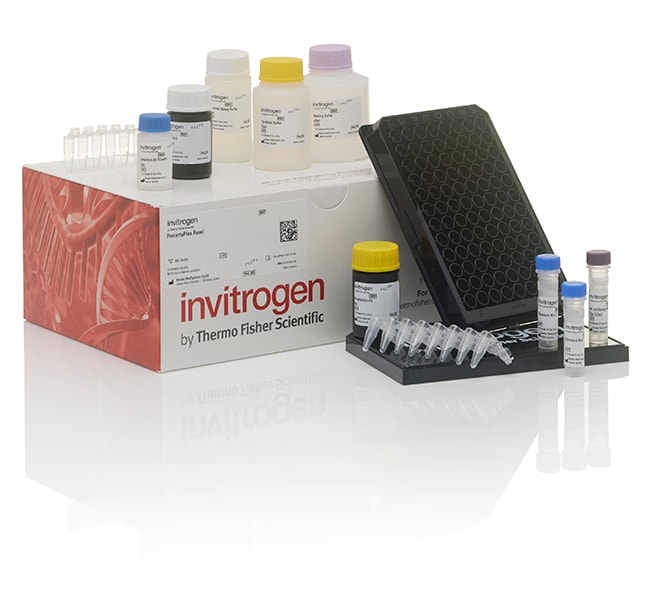
El panel 1C ProcartaPlex 18-Plex de citocina Th1/Th2 humana permite la exploración de la respuesta Th1/Th2 mediante el análisis de 18 objetivos proteicos en un solo pocillo a través de la tecnología Luminex xMAP. El panel se compone de dos subpaneles modulares que son un subconjunto del panel 1 ProcartaPlex 45-Plex de citocina/quimiocina/factores de crecimiento (n.º de ref. EPX450-12171-901). Este kit es totalmente combinable con los otros subpaneles o ensayos individuales simples correspondientes a los objetivos del panel de 45 plex.
Los paneles preconfigurados ProcartaPlex se han probado exhaustivamente para determinar la capacidad combinatoria, la interferencia y la reactividad cruzada de los analitos con el fin de proporcionar el mayor nivel de validación y precisión. Todos los paneles ProcartaPlex se suministran con los reactivos necesarios para realizar el ensayo.
Los paneles multiplex ProcartaPlex están disponibles en múltiples formatos en seis especies (humano, ratón, rata, primate no humano, porcino y canino). Visite nuestra página de inmunoensayos ProcartaPlex para obtener más información y consultar los productos disponibles.
Lista de objetivos [región de gránulos]:
Th1/Th2: GM-CSF [44], IFN gamma [43], IL-1 beta [18], IL-2 [19], IL-4 [20], IL-5 [21], IL-6 [25], IL-12p70 [34], IL-13 [35], IL-18 [66], TNF alfa [45]
Citocinas inflamatorias: IFN alfa [48], IL-1 alfa [62], IL-1RA [38], IL-7 [26], IL-15 [65], IL-31 [37], TNF beta [54]
Acerca de los ensayos ProcartaPlex para la plataforma Luminex
Los inmunoensayos ProcartaPlex se basan en los principios de un ELISA tipo sándwich y utilizan dos anticuerpos altamente específicos que se enlazan a los diferentes epítopos de una proteína para cuantificar todas las proteínas diana simultáneamente mediante un instrumento Luminex. Para los ensayos multiplex ProcartaPlex se requieren tan solo 25 µl de plasma o suero, o 50 µl de sobrenadante del cultivo celular, y solo se necesitan cuatro horas para obtener los resultados analizados.
Las características incluyen:
• Resultados reproducibles y fiables: validados como panel según el estándar más alto del sector, incluidas las pruebas de combinación de proteínas diana y reactividad cruzada
• Más resultados por muestra: permite medir múltiples proteínas diana simultáneamente en una única muestra de 25–50 µL
• Tecnología Luminex consolidada: plataforma de multiplexing de referencia para detección y cuantificación de proteínas
Los ensayos ProcartaPlex utilizan la tecnología Luminex xMAP (método multianálito) para la detección y cuantificación simultáneas de hasta 65 proteínas diana en una única muestra de 25–50 µL de plasma, suero, sobrenadantes del cultivo celular y otros fluidos corporales.
Las microesferas de Luminex del ensayo de ProcartaPlex se tiñen internamente con proporciones precisas de fluoróforos rojos e infrarrojos para crear firmas específicas que pueden ser identificadas por los sistemas de detección Luminex xMAP (por ejemplo, Luminex 200, FLEXMAP 3D y MAGPIX). El ensayo ProcartaPlex, similar a un ELISA tipo sándwich, utiliza pares de anticuerpos emparejados para identificar la proteína de interés. En un ensayo multiplex, cada gránulo espectralmente único se etiqueta con anticuerpos específicos para una sola proteína diana, y las proteínas vinculadas se identifican con anticuerpos biotinilados y estreptavidina-R-ficoeritrina (RPE). La conjugación de anticuerpos específicos de proteínas en un gránulo distinto permite el análisis de varios elementos diana en un solo pocillo.
La diferencia más significativa entre un ensayo ProcartaPlex y uno ELISA es que el anticuerpo de captura del ensayo ProcartaPlex se conjuga en un gránulo y no se adsorbe en el pocillo de la microplaca, por lo que los reactivos del ensayo ProcartaPlex flotan en la solución. Para la detección, el instrumento Luminex 200, por ejemplo, contiene dos láseres, uno para distinguir la firma espectral de cada partícula y el segundo para cuantificar la cantidad de fluorescencia RPE, que es proporcional a la cantidad de proteína presente en la muestra. Los ensayos multiplex ProcartaPlex pueden determinar el perfil de más proteínas diana con mucha menos muestra en el mismo tiempo que se tarda en realizar un ELISA tipo sándwich tradicional.
Los paneles multiplex ProcartaPlex están disponibles en múltiples formatos en seis especies (humano, ratón, rata, primate no humano, porcino y canino). Visite thermofisher.com/procartaplex para obtener más información y consultar los productos disponibles.
Los paneles preconfigurados ProcartaPlex se han probado exhaustivamente para determinar la capacidad combinatoria, la interferencia y la reactividad cruzada de los analitos con el fin de proporcionar el mayor nivel de validación y precisión. Todos los paneles ProcartaPlex se suministran con los reactivos necesarios para realizar el ensayo.
Los paneles multiplex ProcartaPlex están disponibles en múltiples formatos en seis especies (humano, ratón, rata, primate no humano, porcino y canino). Visite nuestra página de inmunoensayos ProcartaPlex para obtener más información y consultar los productos disponibles.
Lista de objetivos [región de gránulos]:
Th1/Th2: GM-CSF [44], IFN gamma [43], IL-1 beta [18], IL-2 [19], IL-4 [20], IL-5 [21], IL-6 [25], IL-12p70 [34], IL-13 [35], IL-18 [66], TNF alfa [45]
Citocinas inflamatorias: IFN alfa [48], IL-1 alfa [62], IL-1RA [38], IL-7 [26], IL-15 [65], IL-31 [37], TNF beta [54]
Acerca de los ensayos ProcartaPlex para la plataforma Luminex
Los inmunoensayos ProcartaPlex se basan en los principios de un ELISA tipo sándwich y utilizan dos anticuerpos altamente específicos que se enlazan a los diferentes epítopos de una proteína para cuantificar todas las proteínas diana simultáneamente mediante un instrumento Luminex. Para los ensayos multiplex ProcartaPlex se requieren tan solo 25 µl de plasma o suero, o 50 µl de sobrenadante del cultivo celular, y solo se necesitan cuatro horas para obtener los resultados analizados.
Las características incluyen:
• Resultados reproducibles y fiables: validados como panel según el estándar más alto del sector, incluidas las pruebas de combinación de proteínas diana y reactividad cruzada
• Más resultados por muestra: permite medir múltiples proteínas diana simultáneamente en una única muestra de 25–50 µL
• Tecnología Luminex consolidada: plataforma de multiplexing de referencia para detección y cuantificación de proteínas
Los ensayos ProcartaPlex utilizan la tecnología Luminex xMAP (método multianálito) para la detección y cuantificación simultáneas de hasta 65 proteínas diana en una única muestra de 25–50 µL de plasma, suero, sobrenadantes del cultivo celular y otros fluidos corporales.
Las microesferas de Luminex del ensayo de ProcartaPlex se tiñen internamente con proporciones precisas de fluoróforos rojos e infrarrojos para crear firmas específicas que pueden ser identificadas por los sistemas de detección Luminex xMAP (por ejemplo, Luminex 200, FLEXMAP 3D y MAGPIX). El ensayo ProcartaPlex, similar a un ELISA tipo sándwich, utiliza pares de anticuerpos emparejados para identificar la proteína de interés. En un ensayo multiplex, cada gránulo espectralmente único se etiqueta con anticuerpos específicos para una sola proteína diana, y las proteínas vinculadas se identifican con anticuerpos biotinilados y estreptavidina-R-ficoeritrina (RPE). La conjugación de anticuerpos específicos de proteínas en un gránulo distinto permite el análisis de varios elementos diana en un solo pocillo.
La diferencia más significativa entre un ensayo ProcartaPlex y uno ELISA es que el anticuerpo de captura del ensayo ProcartaPlex se conjuga en un gránulo y no se adsorbe en el pocillo de la microplaca, por lo que los reactivos del ensayo ProcartaPlex flotan en la solución. Para la detección, el instrumento Luminex 200, por ejemplo, contiene dos láseres, uno para distinguir la firma espectral de cada partícula y el segundo para cuantificar la cantidad de fluorescencia RPE, que es proporcional a la cantidad de proteína presente en la muestra. Los ensayos multiplex ProcartaPlex pueden determinar el perfil de más proteínas diana con mucha menos muestra en el mismo tiempo que se tarda en realizar un ELISA tipo sándwich tradicional.
Los paneles multiplex ProcartaPlex están disponibles en múltiples formatos en seis especies (humano, ratón, rata, primate no humano, porcino y canino). Visite thermofisher.com/procartaplex para obtener más información y consultar los productos disponibles.
Para uso exclusivo en investigación. No apto para uso en procedimientos diagnósticos.
Especificaciones
Intervalo del ensayoVer certificado de análisis
Sensibilidad del ensayoMenos del 15 %
Para utilizar con (equipo)Instrumentos Luminex™
FormatoKit multiplex
Línea de productosProcartaPlex
Tipo de muestraSobrenadantes de cultivo celular, suero y plasma, Plasma, Cell Culture Supernatants
Volumen de muestraSuero, plasma: 25 μl; CCS: 50 μl
Condiciones de envíoHielo húmedo
CombinabilityCombinable
Tipo de productoPanel
Cantidad96 pruebas
Research AreaImmunology, Cytokines
EspecieHumano
Unit SizeEach
Contenido y almacenamiento
- 2 viales de mezcla estándar humana A (liofilizada)
- 2 viales de mezcla estándar humana B (liofilizada)
- 1 vial de mezcla de gránulos de captura B (1X)
- 1 vial de mezcla de gránulos de captura D (1X)
- 1 vial de mezcla de anticuerpos de detección biotinilada B (50X)
- 1 vial de mezcla de anticuerpos de detección biotinilada D (50X)
- 1 frasco de tampón de lectura (1X)
- 1 frasco de tampón de lavado (10x)
- 1 frasco de estreptavidina-PE (1X)
- 1 frasco de tampón de ensayo universal (1 X)
- 1 frasco de diluyente de anticuerpos de detección (1X)
- Tira de 8 tubos
- Película adhesiva
- Placa de 96 pocillos de fondo plano, negra
- Almacenar entre 2 °C y 8 °C
Preguntas frecuentes
What is the size of the Luminex beads you currently use?
I am interested in performing Luminex assays using BioSource kits, and I have a Luminex xMAP system. Besides the kits and system, what other reagents and equipment will I need?
Do the Luminex beads require special care in handling?
Why would the Luminex acquisition software display "Sample Empty" messages during analysis?
What are the Luminex beads made of?
Citations & References (3)
Citations & References
Abstract
Direct antiviral properties of TLR ligands against HBV replication in immune-competent hepatocytes.
Journal:Sci Rep
PubMed ID:29599452
Current therapies for chronic hepatitis B virus (HBV) infections are effective at decreasing the viral load in serum, but do not lead to viral eradication. Recent studies highlighted the therapeutic or "adjuvant" potential of immune-modulators. Our aim was to explore the direct anti-HBV effect of Toll-Like-Receptors (TLR) agonists in hepatocytes.
Effect of atorvastatin on humoral immune response to 23-valent pneumococcal polysaccharide vaccination in healthy volunteers: The StatVax randomized clinical trial.
Journal:Vaccine
PubMed ID:30686636
The immunomodulatory effects of statins on vaccine response remain uncertain. Therefore, the objective of this study was to determine if atorvastatin enhances pneumococcal-specific antibody titer following 23-valent pneumococcal polysaccharide vaccination.
NK Cells Activated through Antibody-Dependent Cell Cytotoxicity and Armed with Degranulation/IFN-? Production Suppress Antibody-dependent Enhancement of Dengue Viral Infection.
Journal:Sci Rep
PubMed ID:30710094
Antibody (Ab)-dependent enhancement (ADE) is a hypothesized mechanism of increased disease severity during secondary dengue virus (DENV) infection. This study investigates Ab-dependent cell cytotoxicity (ADCC) in counteracting ADE. In our system, DENV and DENV-immune sera were added to peripheral blood mononuclear cells (PBMCs), and ADE and NK cell activation were