Search


Citas y referencias (6)
Invitrogen™
ProcartaPlex™ Human Inflammation Panel, 20plex
El panel ProcartaPlex 20-Plex de inflamación humana permite la exploración de la función inmunitaria mediante el análisis de 20 proteínasMás información
| Número de catálogo | Cantidad |
|---|---|
| EPX200-12185-901 | 96 pruebas |
Número de catálogo EPX200-12185-901
Precio (MXN)
-
Cantidad:
96 pruebas
El panel ProcartaPlex 20-Plex de inflamación humana permite la exploración de la función inmunitaria mediante el análisis de 20 proteínas diana en un solo pocillo a través de la tecnología Luminex xMAP. El efecto general de una respuesta inflamatoria lo indica el equilibrio entre mediadores proinflamatorios y antiinflamatorios. Las citocinas proinflamatorias, como la IL-1 beta, la IL-6 y la TNF alfa, son responsables de las respuestas tempranas y amplifican las reacciones inflamatorias, mientras que las citocinas antiinflamatorias, entre las que se incluyen la IL-4, la IL-10 y la IL-13, tienen el efecto opuesto, es decir, que limitan las reacciones inflamatorias. Un estado hiperinflamatorio no regulado puede conducir a un aluvión de citocinas, también llamado «síndrome de liberación de citocinas», (CRS). La creciente complejidad de las redes de citocina y quimiocina proinflamatoria y antiinflamatoria ha hecho que sea fundamental examinarlas en grupos funcionales relevantes en lugar de individualmente.
Los paneles preconfigurados ProcartaPlex se han probado exhaustivamente para determinar la capacidad combinatoria, la interferencia y la reactividad cruzada de los analitos con el fin de proporcionar el mayor nivel de validación y precisión. Todos los paneles ProcartaPlex se suministran con los reactivos necesarios para realizar el ensayo.
Los paneles multiplex ProcartaPlex están disponibles en múltiples formatos en seis especies (humano, ratón, rata, primate no humano, porcino y canino). Visite nuestra página de inmunoensayos ProcartaPlex para obtener más información y consultar los productos disponibles.
Lista de objetivos [región de gránulos]:
Citocinas: GM-CSF [44], IFN alfa [48], IFN gamma [43], IL-1 alfa [62], IL-1 beta [18], IL-4 [20], IL-6 [25], IL-8 [27], IL-10 [28], IL-12p70 [34], IL-13 [35], IL-17A (CTLA-8) [36], TNF alfa [45]
Quimiocinas: IP-10 (CXCL10) [22], MCP-1 (CCL2) [51], MIP-1 alfa (CCL3) [12], MIP-1 beta (CCL4) [47]
Adhesión celular y respuesta inflamatoria: ICAM-1 [73], CD62E (E-selectin) [77], CD62P (P-Selectin) [55]
Acerca de los ensayos ProcartaPlex para la plataforma Luminex
Los inmunoensayos ProcartaPlex se basan en los principios de un ELISA tipo sándwich y utilizan dos anticuerpos altamente específicos que se enlazan a los diferentes epítopos de una proteína para cuantificar todas las proteínas diana simultáneamente mediante un instrumento Luminex. Para los ensayos multiplex ProcartaPlex se requieren tan solo 25 µl de plasma o suero, o 50 µl de sobrenadante del cultivo celular, y solo se necesitan cuatro horas para obtener los resultados analizados.
Las características incluyen:
• Resultados reproducibles y fiables: validados como panel según el estándar más alto del sector, incluidas las pruebas de combinación de proteínas diana y reactividad cruzada
• Más resultados por muestra: permite medir múltiples proteínas diana simultáneamente en una única muestra de 25–50 µL
• Tecnología Luminex consolidada: plataforma de multiplexing de referencia para detección y cuantificación de proteínas
Los ensayos ProcartaPlex utilizan la tecnología Luminex xMAP (método multianálito) para la detección y cuantificación simultáneas de hasta 65 proteínas diana en una única muestra de 25–50 µL de plasma, suero, sobrenadantes del cultivo celular y otros fluidos corporales.
Las microesferas de Luminex del ensayo de ProcartaPlex se tiñen internamente con proporciones precisas de fluoróforos rojos e infrarrojos para crear firmas específicas que pueden ser identificadas por los sistemas de detección Luminex xMAP (por ejemplo, Luminex 200, FLEXMAP 3D y MAGPIX). El ensayo ProcartaPlex, similar a un ELISA tipo sándwich, utiliza pares de anticuerpos emparejados para identificar la proteína de interés. En un ensayo multiplex, cada gránulo espectralmente único se etiqueta con anticuerpos específicos para una sola proteína diana, y las proteínas vinculadas se identifican con anticuerpos biotinilados y estreptavidina-R-ficoeritrina (RPE). La conjugación de anticuerpos específicos de proteínas en un gránulo distinto permite el análisis de varios elementos diana en un solo pocillo.
La diferencia más significativa entre un ensayo ProcartaPlex y uno ELISA es que el anticuerpo de captura del ensayo ProcartaPlex se conjuga en un gránulo y no se adsorbe en el pocillo de la microplaca, por lo que los reactivos del ensayo ProcartaPlex flotan en la solución. Para la detección, el instrumento Luminex 200, por ejemplo, contiene dos láseres, uno para distinguir la firma espectral de cada partícula y el segundo para cuantificar la cantidad de fluorescencia RPE, que es proporcional a la cantidad de proteína presente en la muestra. Los ensayos multiplex ProcartaPlex pueden determinar el perfil de más proteínas diana con mucha menos muestra en el mismo tiempo que se tarda en realizar un ELISA tipo sándwich tradicional.
Los paneles multiplex ProcartaPlex están disponibles en múltiples formatos en seis especies (humano, ratón, rata, primate no humano, porcino y canino). Visite thermofisher.com/procartaplex para obtener más información y consultar los productos disponibles.
Los paneles preconfigurados ProcartaPlex se han probado exhaustivamente para determinar la capacidad combinatoria, la interferencia y la reactividad cruzada de los analitos con el fin de proporcionar el mayor nivel de validación y precisión. Todos los paneles ProcartaPlex se suministran con los reactivos necesarios para realizar el ensayo.
Los paneles multiplex ProcartaPlex están disponibles en múltiples formatos en seis especies (humano, ratón, rata, primate no humano, porcino y canino). Visite nuestra página de inmunoensayos ProcartaPlex para obtener más información y consultar los productos disponibles.
Lista de objetivos [región de gránulos]:
Citocinas: GM-CSF [44], IFN alfa [48], IFN gamma [43], IL-1 alfa [62], IL-1 beta [18], IL-4 [20], IL-6 [25], IL-8 [27], IL-10 [28], IL-12p70 [34], IL-13 [35], IL-17A (CTLA-8) [36], TNF alfa [45]
Quimiocinas: IP-10 (CXCL10) [22], MCP-1 (CCL2) [51], MIP-1 alfa (CCL3) [12], MIP-1 beta (CCL4) [47]
Adhesión celular y respuesta inflamatoria: ICAM-1 [73], CD62E (E-selectin) [77], CD62P (P-Selectin) [55]
Acerca de los ensayos ProcartaPlex para la plataforma Luminex
Los inmunoensayos ProcartaPlex se basan en los principios de un ELISA tipo sándwich y utilizan dos anticuerpos altamente específicos que se enlazan a los diferentes epítopos de una proteína para cuantificar todas las proteínas diana simultáneamente mediante un instrumento Luminex. Para los ensayos multiplex ProcartaPlex se requieren tan solo 25 µl de plasma o suero, o 50 µl de sobrenadante del cultivo celular, y solo se necesitan cuatro horas para obtener los resultados analizados.
Las características incluyen:
• Resultados reproducibles y fiables: validados como panel según el estándar más alto del sector, incluidas las pruebas de combinación de proteínas diana y reactividad cruzada
• Más resultados por muestra: permite medir múltiples proteínas diana simultáneamente en una única muestra de 25–50 µL
• Tecnología Luminex consolidada: plataforma de multiplexing de referencia para detección y cuantificación de proteínas
Los ensayos ProcartaPlex utilizan la tecnología Luminex xMAP (método multianálito) para la detección y cuantificación simultáneas de hasta 65 proteínas diana en una única muestra de 25–50 µL de plasma, suero, sobrenadantes del cultivo celular y otros fluidos corporales.
Las microesferas de Luminex del ensayo de ProcartaPlex se tiñen internamente con proporciones precisas de fluoróforos rojos e infrarrojos para crear firmas específicas que pueden ser identificadas por los sistemas de detección Luminex xMAP (por ejemplo, Luminex 200, FLEXMAP 3D y MAGPIX). El ensayo ProcartaPlex, similar a un ELISA tipo sándwich, utiliza pares de anticuerpos emparejados para identificar la proteína de interés. En un ensayo multiplex, cada gránulo espectralmente único se etiqueta con anticuerpos específicos para una sola proteína diana, y las proteínas vinculadas se identifican con anticuerpos biotinilados y estreptavidina-R-ficoeritrina (RPE). La conjugación de anticuerpos específicos de proteínas en un gránulo distinto permite el análisis de varios elementos diana en un solo pocillo.
La diferencia más significativa entre un ensayo ProcartaPlex y uno ELISA es que el anticuerpo de captura del ensayo ProcartaPlex se conjuga en un gránulo y no se adsorbe en el pocillo de la microplaca, por lo que los reactivos del ensayo ProcartaPlex flotan en la solución. Para la detección, el instrumento Luminex 200, por ejemplo, contiene dos láseres, uno para distinguir la firma espectral de cada partícula y el segundo para cuantificar la cantidad de fluorescencia RPE, que es proporcional a la cantidad de proteína presente en la muestra. Los ensayos multiplex ProcartaPlex pueden determinar el perfil de más proteínas diana con mucha menos muestra en el mismo tiempo que se tarda en realizar un ELISA tipo sándwich tradicional.
Los paneles multiplex ProcartaPlex están disponibles en múltiples formatos en seis especies (humano, ratón, rata, primate no humano, porcino y canino). Visite thermofisher.com/procartaplex para obtener más información y consultar los productos disponibles.
Para uso exclusivo en investigación. No apto para uso en procedimientos diagnósticos.
Especificaciones
Intervalo del ensayoVer certificado de análisis
Sensibilidad del ensayoMenos del 15 %
Para utilizar con (equipo)Instrumentos Luminex™
FormatoKit multiplex
Línea de productosProcartaPlex
Tipo de muestraSobrenadantes de cultivo celular, suero y plasma, Plasma, Cell Culture Supernatants
Volumen de muestraSuero, plasma: 25 μl; CCS: 50 μl
Condiciones de envíoHielo húmedo
CombinabilityCombinable
Tipo de productoPanel
Cantidad96 pruebas
Research AreaImmunology
EspecieHumano
Unit SizeEach
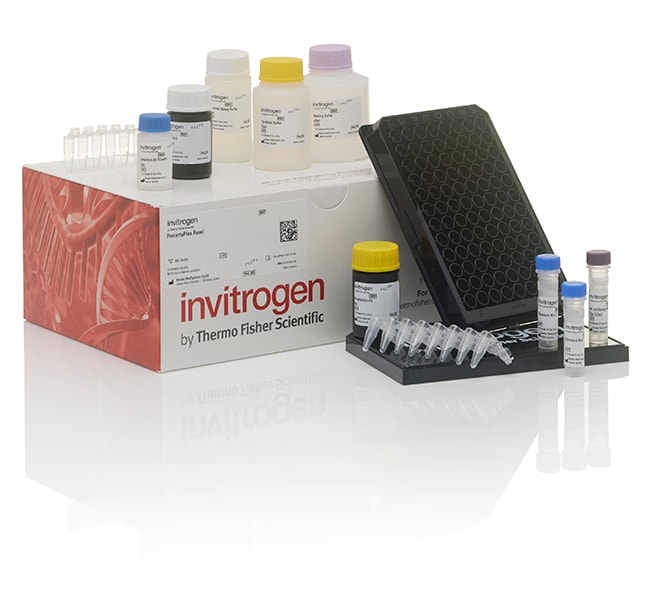
Contenido y almacenamiento
- 2 viales de mezcla estándar humana A (liofilizada)
- 2 viales de mezcla estándar humana B (liofilizada)
- 2 viales de mezcla estándar humana F (liofilizada)
- 1 vial de mezcla de gránulos de captura (1X)
- 1 vial de mezcla de anticuerpos de detección biotinilada (50X)
- 1 frasco de tampón de lectura (1X)
- 1 frasco de tampón de lavado (10x)
- 1 frasco de estreptavidina-PE (1X)
- 1 frasco de tampón de ensayo universal (1 X)
- 1 frasco de diluyente de anticuerpos de detección (1X)
- Tira de 8 tubos
- Película adhesiva
- Placa de 96 pocillos de fondo plano, negra
- Almacenar entre 2 °C y 8 °C
Preguntas frecuentes
What is the size of the Luminex beads you currently use?
I am interested in performing Luminex assays using BioSource kits, and I have a Luminex xMAP system. Besides the kits and system, what other reagents and equipment will I need?
Do the Luminex beads require special care in handling?
Why would the Luminex acquisition software display "Sample Empty" messages during analysis?
What are the Luminex beads made of?
Citations & References (6)
Citations & References
Abstract
Anisakis pegreffii impacts differentiation and function of human dendritic cells.
Journal:Parasite Immunol
PubMed ID:29569735
'Human dendritic cells (DCs) show remarkable phenotypic changes when matured in the presence of helminth-derived products. These modifications frequently elicited a polarization towards Th2 cells and regulatory T cells thus contributing to immunological tolerance against these pathogens. In this study, the interaction between DCs and larvae of the zoonotic anisakid
Characterization of Microvesicles in Septic Shock Using High-Sensitivity Flow Cytometry.
Journal:Shock
PubMed ID:27206273
Endothelial pathology is considered to play a key role in septic shock. Since endothelial-derived microvesicles (MV) are elevated in various diseases associated with endothelial pathology, they are considered surrogate markers of the endothelial state. By analyzing the signature of circulating MV with high-sensitivity flow cytometry (hsFC), we wanted to test
Myxoma Virus Optimizes Cisplatin for the Treatment of Ovarian Cancer In Vitro and in a Syngeneic Murine Dissemination Model.
Journal:Mol Ther Oncolytics
PubMed ID:28875159
A therapeutic approach to improve treatment outcome of ovarian cancer (OC) in patients is urgently needed. Myxoma virus (MYXV) is a candidate oncolytic virus that infects to eliminate OC cells. We found that in vitro MYXV treatment enhances cisplatin or gemcitabine treatment by allowing lower doses than the corresponding IC
TK Inhibitor Pazopanib Primes DCs by Downregulation of the ß-Catenin Pathway.
Journal:Cancer Immunol Res
PubMed ID:29700053
Tyrosine kinase inhibitors (TKIs) target angiogenesis by affecting, for example, the VEGF receptors in tumors and have improved outcomes for patients with metastatic renal cell carcinoma (mRCC). Immune checkpoint inhibitors (ICIs) have also been proposed for treatment of mRCC with encouraging results. A better understanding of the activity of immune
Platelet activity and hypercoagulation in type 2 diabetes.
Journal:Cardiovasc Diabetol
PubMed ID:30388964
A strong correlation exists between type 2 diabetes mellitus (T2DM) and cardiovascular disease (CVD), with CVD and the presence of atherosclerosis being the prevailing cause of morbidity and mortality in diabetic populations. T2DM is accompanied by various coagulopathies, including anomalous clot formation or amyloid fibrin(ogen), the presence of dysregulated inflammatory