Search


Citations & References (2)
Thermo Scientific™
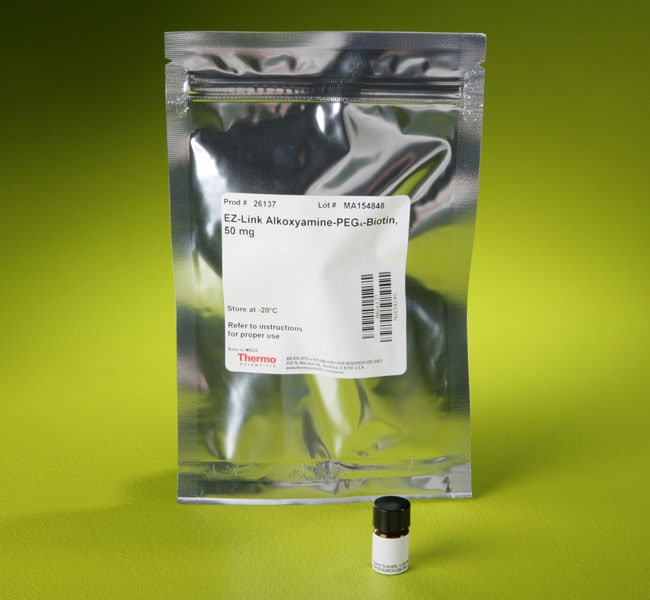
EZ-Link™ Alkoxyamine-PEG4-Biotin
Thermo Scientific EZ-Link Alkoxyamine-PEG4-Biotin is a biotinylation reagent containing a four-unit polyethylene glycol (PEG) spacer for biotinylating macromolecules at carbohydrateRead more
| Catalog Number | Quantity |
|---|---|
| 26137 | 50 mg |
Catalog number 26137
Price (TWD)
***
Quantity:
50 mg
Price (TWD)
***
Thermo Scientific EZ-Link Alkoxyamine-PEG4-Biotin is a biotinylation reagent containing a four-unit polyethylene glycol (PEG) spacer for biotinylating macromolecules at carbohydrate groups that have been oxidized to form aldehydes.
Features of EZ-Link Alkoxyamine-PEG4-Biotin:
• Glycoprotein labeling—biotinylate glycosylated proteins at sialic acid residues for detection or purification using streptavidin probes or resins
• Cell surface labeling—biotinylate and isolate cell surface glycoproteins; reagent does not permeate membranes of whole cells
• Aldehyde-reactive—reacts with aldehydes formed by periodate-oxidation of sugar groups
• Alkoxyamine-activated—aminooxy group forms more stable linkages than hydrazide reagents
• Pegylated – spacer arm contains a hydrophilic, 4-unit, polyethylene glycol (PEG) group
• Enhances solubility – pegylation imparts water solubility to the biotinylated molecule, helping to prevent aggregation of biotinylated antibodies stored in solution
• Irreversible—forms stable (permanent) oxime bonds; spacer arm cannot be cleaved
• Solubility—usually dissolved in DMSO to make concentrated stock solution
• Medium length—spacer arm (total length added to target) is 27.0 angstroms, sufficient to minimize steric hindrance for binding
Aminooxy-biotin reagents such as this one are useful for biotinylating glycoproteins and other molecules that have oxidizable polysaccharides groups. The alkoxyamine group (also called an aminooxy or aminoxy group) conjugates to aldehydes of oxidized sugars. EZ-Link Alkoxyamine-PEG-Biotin reagents contain a multi-functional extended spacer arm that is a flexible, non-immunogenic hydrophilic polyethylene glycol (PEG), which imparts water solubility to labeled molecules. Consequently, antibodies labeled with pegylated biotin reagents exhibit less aggregation when stored in solution compared to antibodies labeled with reagents having only hydrocarbon spacers.
We manufacture biotin reagents to ensure the highest possible overall product integrity, consistency and performance for the intended research applications.
Biotinylation reagents differ in reactivity, length, solubility, cell permeability and cleavability. Hydrazides and alkoxyamines are two types of carbonyl-reactive groups. Alkoxyamines (—O-NH2) react specifically with aldehyde groups in near-neutral conditions to form stable oxime linkages. The reaction is more efficient in the presence of aniline (Part No. 88944). Alternatively, alkoxyamines can be conjugated to carboxylic acids using EDC carbodiimide chemistry.
Reactive aldehyde groups can be generated in glycoproteins and other polysaccharide compounds by oxidation of constituent sugar diols using sodium periodiate (Part No. 20504). Sialic acid residues are common components of protein glycosylation and are easily converted to aldehydes with 1 mM NaIO4.
Features of EZ-Link Alkoxyamine-PEG4-Biotin:
• Glycoprotein labeling—biotinylate glycosylated proteins at sialic acid residues for detection or purification using streptavidin probes or resins
• Cell surface labeling—biotinylate and isolate cell surface glycoproteins; reagent does not permeate membranes of whole cells
• Aldehyde-reactive—reacts with aldehydes formed by periodate-oxidation of sugar groups
• Alkoxyamine-activated—aminooxy group forms more stable linkages than hydrazide reagents
• Pegylated – spacer arm contains a hydrophilic, 4-unit, polyethylene glycol (PEG) group
• Enhances solubility – pegylation imparts water solubility to the biotinylated molecule, helping to prevent aggregation of biotinylated antibodies stored in solution
• Irreversible—forms stable (permanent) oxime bonds; spacer arm cannot be cleaved
• Solubility—usually dissolved in DMSO to make concentrated stock solution
• Medium length—spacer arm (total length added to target) is 27.0 angstroms, sufficient to minimize steric hindrance for binding
Aminooxy-biotin reagents such as this one are useful for biotinylating glycoproteins and other molecules that have oxidizable polysaccharides groups. The alkoxyamine group (also called an aminooxy or aminoxy group) conjugates to aldehydes of oxidized sugars. EZ-Link Alkoxyamine-PEG-Biotin reagents contain a multi-functional extended spacer arm that is a flexible, non-immunogenic hydrophilic polyethylene glycol (PEG), which imparts water solubility to labeled molecules. Consequently, antibodies labeled with pegylated biotin reagents exhibit less aggregation when stored in solution compared to antibodies labeled with reagents having only hydrocarbon spacers.
We manufacture biotin reagents to ensure the highest possible overall product integrity, consistency and performance for the intended research applications.
Biotinylation reagents differ in reactivity, length, solubility, cell permeability and cleavability. Hydrazides and alkoxyamines are two types of carbonyl-reactive groups. Alkoxyamines (—O-NH2) react specifically with aldehyde groups in near-neutral conditions to form stable oxime linkages. The reaction is more efficient in the presence of aniline (Part No. 88944). Alternatively, alkoxyamines can be conjugated to carboxylic acids using EDC carbodiimide chemistry.
Reactive aldehyde groups can be generated in glycoproteins and other polysaccharide compounds by oxidation of constituent sugar diols using sodium periodiate (Part No. 20504). Sialic acid residues are common components of protein glycosylation and are easily converted to aldehydes with 1 mM NaIO4.
For Research Use Only. Not for use in diagnostic procedures.
Specifications
Cell PermeabilityCell-Impermeant
Label TypeBiotin & Analogs
Product LineEZ-Link
Product TypeAlkoxyamine-PEG4-Biotin
Quantity50 mg
Reactive MoietyAlkoxyamine
Chemical ReactivityKetone, Aldehyde
Label or DyeBiotin
SolubilityDMF (Dimethylformamide), DMSO (Dimethylsulfoxide), Water
SpacerLong, Pegylated
Unit SizeEach
Contents & Storage
Store at -20°C. Shipped at ambient temperature.
Citations & References (2)
Citations & References
Abstract
Reduced sialylation impacts ventricular repolarization by modulating specific K+ channel isoforms distinctly.
Journal:
PubMed ID:25525262
'Voltage-gated K(+) channels (Kv) are responsible for repolarizing excitable cells and can be heavily glycosylated. Cardiac Kv activity is indispensable where even minimal reductions in function can extend action potential duration, prolong QT intervals, and ultimately contribute to life-threatening arrhythmias. Diseases such as congenital disorders of glycosylation often cause significant
Interactions of p53 with poly(ADP-ribose) and DNA induce distinct changes in protein structure as revealed by ATR-FTIR spectroscopy.
Journal:Nucleic Acids Res
PubMed ID:30892621
'Due to multiple domains and in part intrinsically disordered regions, structural analyses of p53 remain a challenging task, particularly in complex with DNA and other macromolecules. Here, we applied a novel attenuated total reflection Fourier transform infrared (ATR-FTIR) spectroscopic approach to investigate changes in secondary structure of full-length p53 induced