Search


Citations & References (9)
Invitrogen™
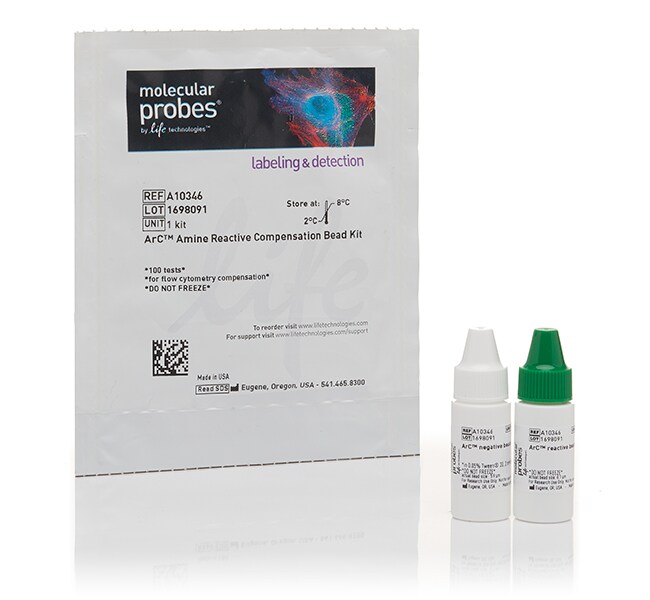
ArC™ Amine Reactive Compensation Bead Kit (for use with LIVE/DEAD™ Fixable dead cell stain kits)
ArC™ Amine Reactive Compensation Bead Kit is a bead-based compensation tool specifically optimized for use with LIVE/DEAD™ Fixable dead cellRead more
Have Questions?
Change view

| Catalog Number | No. of Tests |
|---|---|
| A10346 | 100 |
| A10628 | 20 |
Catalog number A10346
Price (TWD)
***
No. of Tests:
100
Price (TWD)
***
ArC™ Amine Reactive Compensation Bead Kit is a bead-based compensation tool specifically optimized for use with LIVE/DEAD™ Fixable dead cell stain kits.
• Ready-to-use control
• Eliminates the hassle of heat-treating cells as a control, saving precious sample
• Enables accurate and consistent results
View a selection guide for all fixable viability dyes for flow cytometry.
Ready-to-use control
Unlike other methods that require sample preparation to make compensation controls using cellular material, the ArC Amine Reactive Compensation Bead Kit is ready to use out of the dropper bottle. The kit includes two types of specially modified polystyrene microspheres that have been optimized to react with the amine-reactive dye in the LIVE/DEAD Fixable dead cell stain kits. The ArC reactive beads (Component A) bind any of the amine-reactive dyes and provide a positive signal; the ArC negative beads (Component B) have no reactivity and provide a negative compensation control. This ready-to-use product preserves the original sample material for experiments; precious sample is not used for the creation of compensation controls.
Accurate and consistent results
Unlike biological controls, which can have variable expression levels depending upon disease or development state, the Arc beads provide a bright, consistent signal (see figure below). Consistency in the staining pattern of compensation controls is important for obtaining the right compensation value. If the signal varies with the control material used, the compensation value can be affected, leading to erroneous results.
How it works
One drop of beads is added to a test tube containing LIVE/DEAD Fixable dead cell stain. After incubation with amine-reactive dye, the beads are washed in staining buffer, a drop of negative control beads is added (if required), and the beads are resuspended and analyzed by flow cytometry. The two components provide a distinct positive bead that is at least 50-fold brighter than the negative beads, which can be used to set compensation.
Other compensation products
Besides the ArC Amine Reactive Compensation Beads, AbC™ Anti-Mouse Bead Kit is also available for capture of mouse anti-human antibodies, as well as the AbC™ Anti-Rat/Hamster Bead Kit for capture of rat anti-mouse or hamster anti-mouse antibodies.
• Ready-to-use control
• Eliminates the hassle of heat-treating cells as a control, saving precious sample
• Enables accurate and consistent results
View a selection guide for all fixable viability dyes for flow cytometry.
Ready-to-use control
Unlike other methods that require sample preparation to make compensation controls using cellular material, the ArC Amine Reactive Compensation Bead Kit is ready to use out of the dropper bottle. The kit includes two types of specially modified polystyrene microspheres that have been optimized to react with the amine-reactive dye in the LIVE/DEAD Fixable dead cell stain kits. The ArC reactive beads (Component A) bind any of the amine-reactive dyes and provide a positive signal; the ArC negative beads (Component B) have no reactivity and provide a negative compensation control. This ready-to-use product preserves the original sample material for experiments; precious sample is not used for the creation of compensation controls.
Accurate and consistent results
Unlike biological controls, which can have variable expression levels depending upon disease or development state, the Arc beads provide a bright, consistent signal (see figure below). Consistency in the staining pattern of compensation controls is important for obtaining the right compensation value. If the signal varies with the control material used, the compensation value can be affected, leading to erroneous results.
How it works
One drop of beads is added to a test tube containing LIVE/DEAD Fixable dead cell stain. After incubation with amine-reactive dye, the beads are washed in staining buffer, a drop of negative control beads is added (if required), and the beads are resuspended and analyzed by flow cytometry. The two components provide a distinct positive bead that is at least 50-fold brighter than the negative beads, which can be used to set compensation.
Other compensation products
Besides the ArC Amine Reactive Compensation Beads, AbC™ Anti-Mouse Bead Kit is also available for capture of mouse anti-human antibodies, as well as the AbC™ Anti-Rat/Hamster Bead Kit for capture of rat anti-mouse or hamster anti-mouse antibodies.
For Research Use Only. Not for use in diagnostic procedures.
Specifications
Detection MethodFluorescence
Diameter (Metric)6 μm
Excitation Wavelength Rangeany lasers (UV to 633/635)
For Use With (Equipment)Flow Cytometer
FormatTube
No. of Tests100
Quantity1 Kit
Shipping ConditionRoom Temperature
Stain ConfigurationSurface
Product LineCompenFlow, Molecular Probes
Product TypeCompensation Beads
Unit SizeEach
Contents & Storage
Contains 1 vial ArC™ amine reactive beads and 1 vial of negative beads.Store at 2°C to 8°C
Frequently asked questions (FAQs)
Are the vials of ArC Amine Reactive Compensation Bead Kit (for use with LIVE/DEAD Fixable dead cell stain kits) (Cat. No. A10346, A10648) compatible with Vaporized Hydrogen Peroxide (VHP) sterilization?
What is the stability for the ArC Amine Reactive Compensation Bead Kit (for use with LIVE/DEAD Fixable dead cell stain kits)?
My ArC Amine Reactive Compensation beads are excessively clumped and cannot be resuspended by vortexing or sonication. What may have caused this?
For the ArC Amine Reactive Compensation Bead Kit, why must I use freshly prepared amine-reactive dye?
Besides the Live/Dead Fixable Dead Cell stain, may I conjugate other amine-reactive dyes to the beads in the ArC Amine Reactive Compensation Bead Kit?
Citations & References (9)
Citations & References
Abstract
IL-1 family members IL-18 and IL-33 upregulate the inflammatory potential of differentiated human Th1 and Th2 cultures.
Journal:J Immunol
PubMed ID:23028054
'The IL-1 family members IL-1ß, IL-18, and IL-33 are potent cytokines in relationship to amplifying the CD4(+) T cell cytokine production. To evaluate their impact on in vitro-differentiated human Th1 and Th2 cultures, such cultures were established from naive T cells, purified from healthy blood donors, and reactivated in the
Multiparameter flow cytometry and bioanalytics for B cell profiling in systemic lupus erythematosus.
Journal:Methods Mol Biol
PubMed ID:22933067
B lymphocyte involvement in systemic lupus erythematosus has been recognized for several decades, mainly in the context of autoantibody production. Both mouse and human studies reveal that different types of antibody responses, as well as antibody-independent effector functions can be ascribed to distinct subpopulations (subsets) of circulating B cells. Characterizing
Evaluation of pneumonia virus of mice as a possible human pathogen.
Journal:J Virol
PubMed ID:22438539
Pneumonia virus of mice (PVM), a relative of human respiratory syncytial virus (RSV), causes respiratory disease in mice. There is serologic evidence suggesting widespread exposure of humans to PVM. To investigate replication in primates, African green monkeys (AGM) and rhesus macaques (n = 4) were inoculated with PVM by the
A novel aldehyde dehydrogenase-3 activator leads to adult salivary stem cell enrichment in vivo.
Journal:Clin Cancer Res
PubMed ID:21998334
To assess aldehyde dehydrogenase (ALDH) expression in adult human and murine submandibular gland (SMG) stem cells and to determine the effect of ALDH3 activation in SMG stem cell enrichment. Adult human and murine SMG stem cells were selected by cell surface markers (CD34 for human and c-Kit for mouse) and
Targeting GLUT1 and the Warburg effect in renal cell carcinoma by chemical synthetic lethality.
Journal:Sci Transl Med
PubMed ID:21813754
Identifying new targeted therapies that kill tumor cells while sparing normal tissue is a major challenge of cancer research. Using a high-throughput chemical synthetic lethal screen, we sought to identify compounds that exploit the loss of the von Hippel-Lindau (VHL) tumor suppressor gene, which occurs in about 80% of renal