Search
{{$ctrl.translations['antibody.pdp.skuNotes.additionalInformation']}}:

FIGURE: 1 / 17
SMAD2 Antibody (700048) in ICC/IF
Immunofluorescence analysis of SMAD2 was done on 70% confluent log phase TGF- beta treated HeLa cells (serum starved for 16 hours followed by treatment with 20 ng/mL TGF-beta for 1 hour). The cells were fixed with 4% paraformaldehyde for 15 minutes, permeabilized with 0.25% Triton X-100 for 10 minutes, and blocked with 5% BSA for 1 hour at room temperature. The cells were labeled with SMAD2 Recombinant Rabbit Monoclonal Antibody (Product # 700048) at 1 µg/mL in 1% BSA and incubated for 3 hours at room temperature and then labeled with Alex... View More


Please note: We are reviewing Western blot images included in the antibody testing data in our catalog, including those provided by third parties. Unless expressly labeled or annotated as “raw-unedited”, Western blot images included in the antibody testing data in our catalog may have been edited, optimized or otherwise adjusted for presentation.




Product Details
700048
Applications
Tested Dilution
Publications
Product Specifications
Species Reactivity
Human
Published species
Human
Host/Isotype
Rabbit
/ IgG
Expression System
Expi293
Class
Recombinant Monoclonal
Type
Antibody
Clone
31H15L4
Immunogen
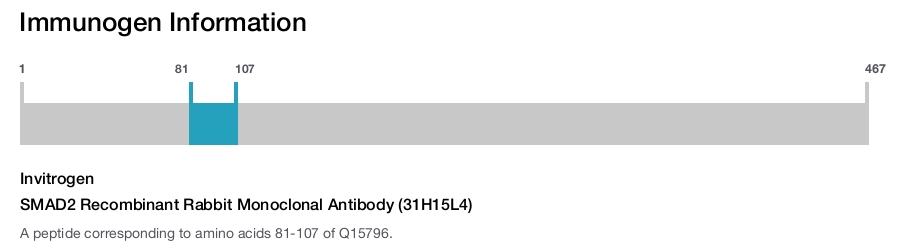
A peptide corresponding to amino acids 81-107 of Q15796.
Conjugate
Unconjugated
Unconjugated
Unconjugated
Form
Liquid
Concentration
0.5 mg/mL
Amount
100 µg
Purification
Protein A
Storage buffer
PBS, pH 7.2-7.4
Contains
0.09% sodium azide
Storage conditions
Store at 4°C short term. For long term storage, store at -20°C, avoiding freeze/thaw cycles.
Shipping conditions
Wet ice
RRID
Product Specific Information
This antibody is predicted to react with bovine, carp, chicken, goldfish, mouse, opossum, orangutan, rat, Xenopus and zebrafish based on sequence homology.
Intact IgG appears on a non-reducing gel as ~150 kDa band and upon reduction generating a ~25 kDa light chain band and a ~50 kDa heavy chain.
Recombinant rabbit monoclonal antibodies are produced using in vitro expression systems. The expression systems are developed by cloning in the specific antibody DNA sequences from immunoreactive rabbits. Then, individual clones are screened to select the best candidates for production. The advantages of using recombinant rabbit monoclonal antibodies include: better specificity and sensitivity, lot-to-lot consistency, animal origin-free formulations, and broader immunoreactivity to diverse targets due to larger rabbit immune repertoire.
Target Information
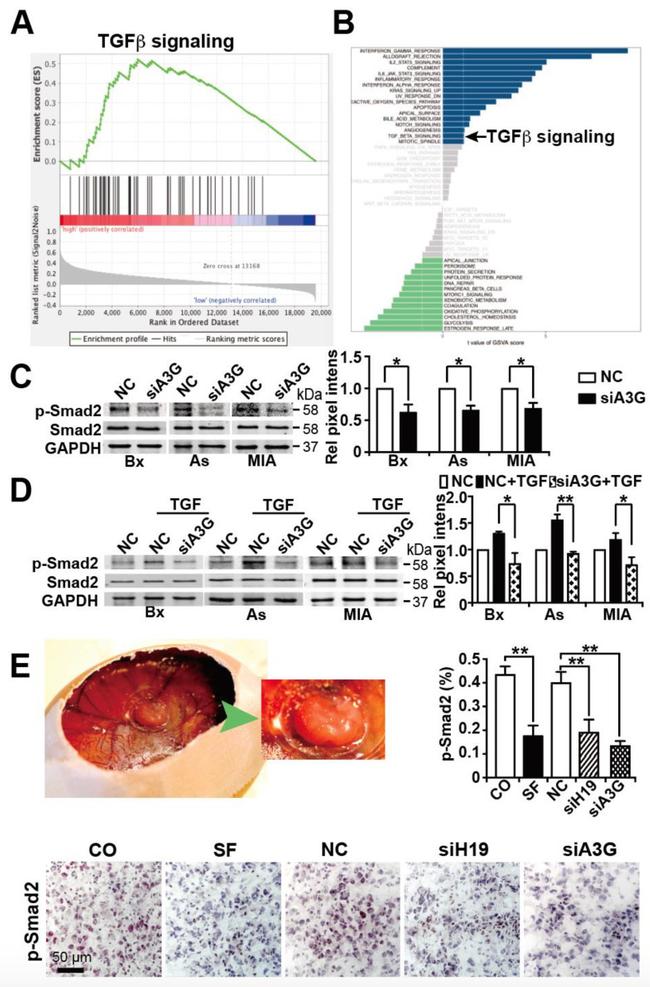
SMAD2 (MADH2, MAD2) regulates multiple cellular processes, such as cell proliferation, apoptosis, and differentiation. SMAD2 interacts with the TGF-beta receptors through its interaction with the SMAD anchor for receptor activation into the nucleus is a central event in TGF beta signaling. Phosphorylation of threonine 8 in the calmodulin-binding region of the MH1 domain by extracellular signal regulated kinase 1 (ERK1) enhances SMAD2 transcriptional activity, which is negatively regulated by calmodulin. In response to the TGF-beta signal, SMAD2 is phosphorylated by the TGF-beta receptors. The phosphorylation induces the dissociation of this protein with SARA and the association with the family member SMAD4. The association with SMAD4 is important for the translocation of this protein into the nucleus, where it binds to target promoters and forms a transcription repressor complex with other cofactors. SMAD2 can also be phosphorylated by activin type 1 receptor kinase, and mediates the signal from the activin. Alternatively spliced transcript variants encoding the SMAD2 protein have been observed.
For Research Use Only. Not for use in diagnostic procedures. Not for resale without express authorization.
Bioinformatics
Protein Aliases: MAD; MAD homolog 2; Mad protein homolog; MGC22139; MGC34440; mother against DPP homolog 2; mothers against decapentaplegic homolog 2; Sma- and Mad-related protein 2; SMAD; SMAD, mothers against DPP homolog 2; Smad2Deltaexon3; unnamed protein product
Gene Aliases: CHTD8; hMAD-2; hSMAD2; JV18; JV18-1; LDS6; MADH2; MADR2
UniProt ID: (Human) Q15796
Entrez Gene ID: (Human) 4087
RNA polymerase II core promoter proximal region sequence-specific DNA binding
RNA polymerase II transcription factor activity, sequence-specific DNA binding
core promoter proximal region sequence-specific DNA binding
transcriptional activator activity, RNA polymerase II transcription regulatory region sequence-specific binding
DNA binding
chromatin binding
double-stranded DNA binding
transcription factor activity, sequence-specific DNA binding
transforming growth factor beta receptor binding
protein binding
phosphatase binding
ubiquitin protein ligase binding
type I transforming growth factor beta receptor binding
identical protein binding
SMAD binding
tau protein binding
RNA polymerase II sequence-specific DNA binding transcription factor binding
co-SMAD binding
I-SMAD binding
R-SMAD binding
disordered domain specific binding
DNA-binding transcription factor binding
ureteric bud development
mesoderm formation
regionalization
determination of left/right asymmetry in lateral mesoderm
aortic valve morphogenesis
pulmonary valve morphogenesis
endocardial cushion morphogenesis
transcription, DNA-templated
regulation of transcription, DNA-templated
transforming growth factor beta receptor signaling pathway
zygotic specification of dorsal/ventral axis
gastrulation
mesoderm development
anatomical structure morphogenesis
embryonic pattern specification
anterior/posterior pattern specification
negative regulation of gene expression
positive regulation of epithelial to mesenchymal transition
regulation of transforming growth factor beta receptor signaling pathway
cell differentiation
negative regulation of ossification
positive regulation of BMP signaling pathway
primary miRNA processing
activin receptor signaling pathway
intracellular signal transduction
nodal signaling pathway
cell fate commitment
negative regulation of cell differentiation
negative regulation of transcription, DNA-templated
positive regulation of transcription, DNA-templated
positive regulation of transcription from RNA polymerase II promoter
paraxial mesoderm morphogenesis
regulation of multicellular organismal process
SMAD protein signal transduction
mesenchyme development
trophoblast cell migration
secondary palate development
response to cholesterol
odontoblast differentiation
Disclaimer

Clicking the images or links will redirect you to a website hosted by BenchSci that provides third-party scientific content. Neither the content nor the BenchSci technology and processes for selection have been evaluated by us; we are providing them as-is and without warranty of any kind, including for use or application of the Thermo Fisher Scientific products presented.

Performance Guarantee
If an Invitrogen™ antibody doesn't perform as described on our website or datasheet,we'll replace the product at no cost to you, or provide you with a credit for a future purchase.*
Learn more
We're here to help
Get expert recommendations for common problems or connect directly with an on staff expert for technical assistance related to applications, equipment and general product use.
Contact tech support