
Wastewater (i.e., sewage) testing for SARS-CoV-2 (the virus that causes COVID-19) can be helpful to public health agencies and government officials as a novel complement to existing COVID-19 surveillance systems. Monitoring wastewater is used for early detection of COVID-19 within a community. By testing the amount of the virus in sewage water can serve as an early warning of COVID-19 in communities. The fluctuation of virus levels in the sewage water can help communities see how well preventive measures are working. Wastewater-based epidemiology (WBE) programs can be an invaluable additional predictive tool for addressing the COVID-19 pandemic.
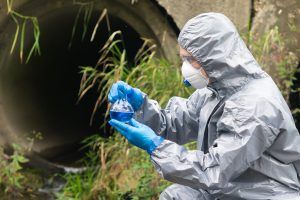
The data generated by National Wastewater Surveillance System (NWSS) will help public health officials to better understand the extent of COVID-19 infections in communities1. Multiple testing methods and laboratory workflows are used to quantify SARS-CoV-2 in wastewater2. Total nitrogen, phosphorus, biological oxygen demand and ammonium, have also been proposed as population biomarkers3. The survival period of coronavirus in water environments strongly depends on temperature, property of water, concentration of suspended solids and organic matter, solution pH, and dose of disinfectant used4.
Population Biomarkers Analysis
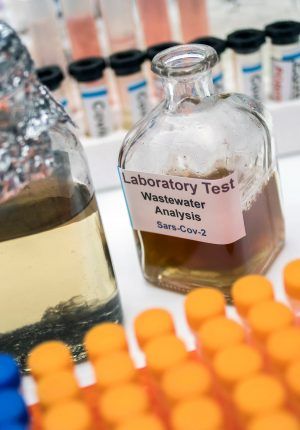
RT-PCR are commonly used for the SARS-CoV-2 quantification in wastewater.Fluctuations in ammonium (NH4+), measured as NH4-N loads in sewage treatment plants showed a distinctive pattern which was associated to weekly (i.e., commuters) and seasonal (i.e., holidays) fluctuations of the population5. Virus quantification by RT-PCR, together with other biomarkers like phosphorus, total nitrogen and pH play an important role in sewage water analysis in WBE programs, and sewage water treatment.
Traditional water testing involves multiple wet chemical analyses for multiple parameters such asammonia, total nitrogen, pH, conductivity, phosphorous and other nutrients.Each test requires a separate sample and often multiple sequential steps which extends the testing process. With slow processes and the need for specialist staff to run and monitor equipment, water quality testing is labor-intensive, time-consuming and inefficient. Routine sewage water testing can be costly and time consuming for a laboratory that performs sewage water testing and sewage water treatment.
Consolidated Sewage Water Analysis for Population Biomarkers
Automated discrete analysis is a technique that utilizes colorimetric andenzymatic measurements of several analytes simultaneously from a single sample through photometric analysis. Optional modules for some discrete analyzerscan also conduct electrochemicalanalysis forpH and conductivity in sewage water samples. The option to perform simultaneous and parallel measurements of pH, conductivity considerably improves the lab’s throughput. Consolidated multiparameter discrete analysis now offers a solution to these difficulties and offers high throughput wet chemical analysis workflow. Discrete analyzers consolidate and simultaneously test for up to 20 parameters using a single instrument with a single operator.

The high throughput discrete analyzer platforms together with ready-to-use system reagents simplifies the wet chemical analysis and offers the highest flexibility with walkaway efficiency. Population biomarkers in sewage water can be determined as per US EPA methods and other international regulatory methods. Ammonia in sewage water is determined by EPA 325.1. The applicable range is 0.01-2.0 mg/L NH3 as N. Higher concentrations can be determined by sample dilution and approximately 60 samples per hour can be analyzed. pH and conductivity in sewage water is determined as per US EPA methods 150.2, and EPA 120.1 respectively. Ortho phosphate and total phosphorus are determined as per US EPA 365.1 and EPA 365.4 respectively. Total oxidizable nitrogen is determined by highly selective enzymatic nitrate reductase method as per NECi Method N07-003. Beyond the analytes discussed, Gallery discrete analyzers can perform other methods, such as alkalinity, calcium, chromium (VI), fluoride, ferrous iron, magnesium, total hardness, and urea.
High-throughput Sewage and Waste Water Analysis Workflow
These integrated Gallery discrete analyzersprovide two measurement techniques for photometric (colorimetric and enzymatic) and electrochemical (pH and conductivity) analysis, which can be run simultaneously. pH is a critical parameter for sewage water and wastewater analysis and directly influences the virus stability. The electrochemistry unit (ECM) is capable of measuring up to 67 samples per hour for pH and conductivity, parallelly, and simultaneously with other photometric measurements. The Gallery Plus discrete analyzer can accommodate 108 samples and 42 reagents in separate sample and reagent disks, with the capability to run up to 350 tests/hour.
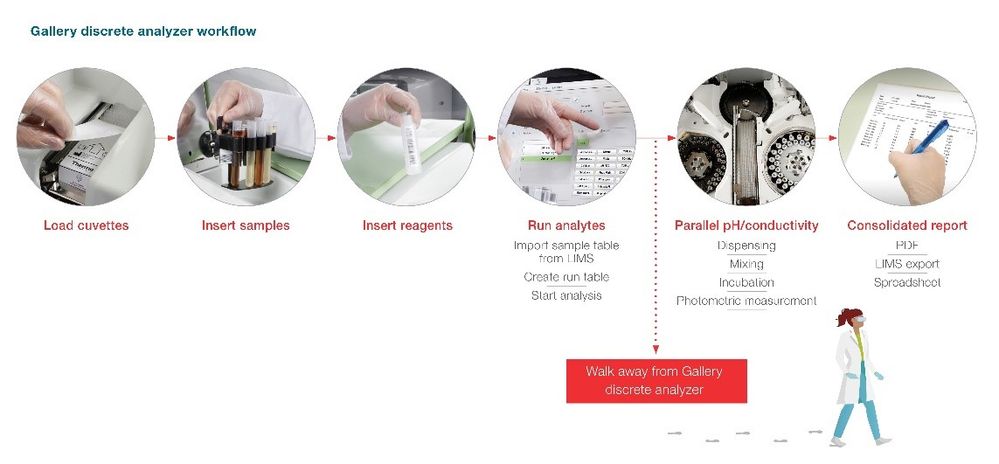
Gallery and Gallery Plus discrete analyzers are easy-to-use, automated systems that allow laboratories to simplify the sewage water and wastewater surveillance for Covid-19 testing with dual benefits: time and cost savings. All necessary analysis steps are automated, providing true walkaway time for the operator. Parallel determination of multiple analytes from a single sample as well as the presence of several automated features ensures analytical efficiency. Thermo Scientific water analysis system reagents kits offers:
-
- Accurate and reproducible results
-
- Requires less reagent usage
-
- Reduces preparation errors
-
- Reduces hands-on time
-
- Ease of use
We are happy to help your wastewater and sewage water surveillance program for covid-19 testing. Contact our specialists to discuss your application needs.
References
1.https://www.cdc.gov/coronavirus/2019-ncov/cases-updates/wastewater-surveillance.html
2.https://www.cdc.gov/coronavirus/2019-ncov/cases-updates/wastewater-surveillance/testing-methods.html
3. Making waves: Wastewater-based epidemiology for COVID-19 – approaches and challenges for surveillance and prediction- https://www.ncbi.nlm.nih.gov/pmc/articles/PMC7480445/
4. SARS-CoV-2 coronavirus in water and wastewater: A critical review about presence and concern – https://pubmed.ncbi.nlm.nih.gov/33011225/
5. Been F., Rossi L., Ort C., Rudaz S., Delémont O., Essevia P. Population normalization with ammonium in wastewater-based epidemiology: application to illicit drug monitoring.Environmental Science and Technology.2014;48:8162–8169. doi: 10.1021/es5008388.
6. Automated nutrient analysis and water quality monitoring
7. USEPA 40 CFR part 136
8. https://analyteguru.com/automated-wet-chemical-analysis-2-what-is-automated-discrete-analyzer/

From Targeted Testing to Unknown Discovery: Creating Comprehensive “Food Intelligence” With GC Orbitrap Technology
Food safety testing is evolving, regulatory requirements are... by Monica Driscoll / 04.15.2026
Read More
VOC Analysis in Drinking Water: Achieving ppt-Level Sensitivity with ITEX Dynamic Headspace GC-MS
The quality of drinking water is under closer scrutiny than ... by Petra Gerhards / 03.10.2026
Read More
Hexane in Food: When Processing Chemistry Meets Public Health
Hexane is one of the most widely used extraction solvents in... by Petra Gerhards / 02.04.2026
Read More
From the Ocean to the Laboratory: How Scalable Pyrolysis-GC/MS Reveals the Hidden Story of Microplastics
Plastics have become part of everything we touch — from th... by Dr. Daniela Cavagnino / 12.11.2025
Read More