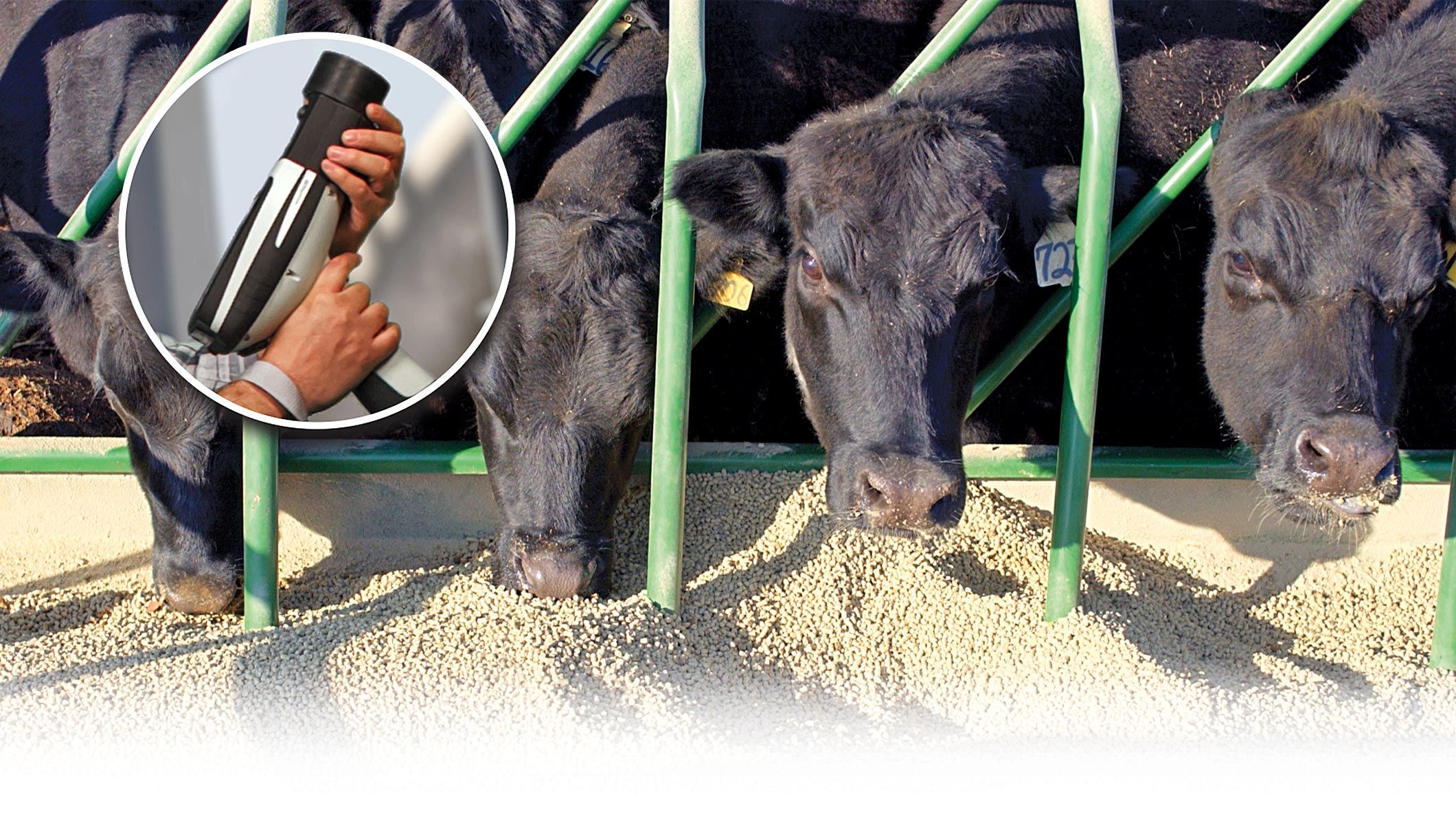
 Global population increases, urbanization and a growing middle class in emerging economies are driving demand for more meat. “Worldwide meat production has tripled over the last four decades and increased 20 percent in just the last 10 years.”1 To support increased meat production, producers of animal feed and feed ingredients must respond by boosting production and processing efficiencies. As is often the case, the application of a new portable technology is helping them accomplish this task. In the animal feed industry, a variety of nutritional values are measured to ensure ingredient quality and to accurately mix finished feed products. Historically, this work has been done in a laboratory using a benchtop Near-Infrared (NIR) spectrometer. NIR systems illuminate a feed sample with light and measure the wavelengths that are absorbed by the sample. Based on the specific wavelengths that are absorbed, the spectrometer creates an absorbance spectrum, which is similar to a “fingerprint” of the sample. Using onboard calibrations, the system analyzes the spectrum and the material can be identified and certain parameters can be measured quantitatively. The process is similar to comparing a new fingerprint to a database of known fingerprints. In recent years, there has been a general trend across many industries of traditional laboratory analyses moving into the field, which increases the number of problems that customers can solve away from the bench. Instruments that used to be large, expensive, and complicated have been modified to be small, affordable, and easy-to-use. In line with this trend, Thermo Fisher Scientific developed the Thermo Scientific™ microPHAZIR AG, the first handheld NIR instrument for feed analysis. The instrument incorporates a representative library of ready-to-use calibrations so users don’t need to develop their own. Portable analysis with ready-for-use calibrations means that non-scientific personnel can expand test protocols outside of the lab. The result is more frequent testing and better control of critical parameters such as protein and moisture. The microPHAZIR AG addresses the specific needs of the feed industry by incorporating Aunir INGOT calibrations. These calibrations are built on a database of thousands of finished feed and ingredient spectra collected from diverse geographic regions over the course of many growing seasons. The calibrations capture broad variations due to geography and weather, resulting in a robust calibration set that is ready for use right out of the box. Another benefit of portability is that measurements are provided at the point of need, making data more actionable. In the manufacturing setting, measurements can be made in the production facility, with results available within two minutes. Portable instruments can also be taken outside the production facility to perform supplier evaluations or address customer complaints. A portable NIR instrument can be a valuable addition to the overall quality assurance process, augmenting the testing capabilities of traditional benchtop systems. The handheld instrument extends the testing protocol to the point of need while reducing reliance on and time delay of traditional laboratory results. It’s not just the livestock feed industry that has benefited from the advantages of portable instruments. Pet food manufacturers use onboard ingredient calibrations for measurement of nutrition parameters for labeling accuracy, and dietary supplement manufacturers and botanical ingredient processors use the technology for material identification. No matter what is being produced, traceability from the source of raw ingredients to the finished product is becoming increasingly important. Portable technologies will continue to offer easier and more convenient solutions to customers in a variety of industries. Additional details and specifications for the range of portable microPHAZIR models can be found here. Are there other areas of the food chain that you think would benefit from portable solutions? Please share your opinion with us. References 1http://www.worldwatch.org/global-meat-production-and-consumption-continue-rise-1

Can Culture Be Measured by Food Science?
Can culture as expressed through food be ... Keith Cornell
Read More
Keeping Candy Safe
For those who celebrate Halloween, thoughts often turn to fu... Margot Hannable
Read More
When Chocolate Flows: From Childhood Treats to the Science of Melt
I’ll never forget the way my father used to make a dessert... Keith Cornell
Read More
Natural Colorants: Unlocking the Future Through Fungal Innovation and Mass Spectrometry
As consumer demand continues to shift toward clean-label, pl... Daniel Merriman
Read More

Leave a Reply