
by Halina Zakowicz, PhD
A guide and decision tree to help you choose between protein purification methods
Table of Contents
Introduction to protein purification methods
What is protein sample desalting?
Pros of protein desalting
Cons of protein desalting
What is protein sample dialysis?
Pros of protein dialysis
Cons of protein dialysis
When to use desalting for protein analysis
When to use dialysis for protein analysis
More tools and resources about protein purification methods
Protein sample desalting and protein sample dialysis are two common protein purification methods used for sample preparation. While they both aim to remove small molecules or unwanted substances from the target protein sample, they differ in their mechanisms and principles of operation.
Deciding when to use desalting versus dialysis depends on several factors, including time, sample size, desired level of purity, method of sample purification, type of protein, and the size and molecular weight of the undesired molecules.
What is protein desalting?
Protein desalting is a common technique used to remove salts and other small molecules from protein samples. This technique is typically performed using size-exclusion chromatography (SEC) columns or desalting spin columns packed with resin. The sample is loaded onto the chromatography column, and the salt molecules are separated from the protein due to their different molecular weights and sizes as they progress through the resin. The protein of interest is collected in a separate fraction, free from salts and other small molecules.

Figure 1. A desalting column
A desalting column (Figure 1) relies on gel filtration chromatography, also called size exclusion chromatography (SEC), where different molecular weight cut-off (MWCO) limits exclude molecules based on size. This process is akin to a molecular sieve. When matched correctly, the macromolecules of interest are too large to enter the pores of the resin and quickly pass through the column.
In contrast, buffer salts and other small molecules enter the pores of the resin, and this slows their rate of migration through the resin bed. The faster macromolecules become separated from the slower, smaller molecules. Separate fractions are collected as they emerge from the column, and the macromolecule of interest can be recovered separately from the small molecules that exit the column later. This video shows how protein desalting works in a resin-based desalting column.
Pros and cons of protein desalting
Pros of protein desalting:
- Removal of unwanted salts
- Compatibility with various sample volumes
- Simple and quick procedure
- Compatibility with organic and other solvents
- Concentrates contaminating material down to relatively small volumes (useful for work with toxic/radioactive substances)
Cons of protein desalting:
- Limited sample input volume
- Potential alteration of protein properties
What is protein dialysis?
Protein sample dialysis is a technique used to exchange the buffer or remove unwanted molecules from the protein sample. Dialysis involves placing the protein sample in a selectively permeable membrane or dialysis tubing and immersing it in a buffer solution. The dialysis membrane allows the small molecules, such as salts or contaminants, to diffuse out of the sample while retaining the protein. This process allows for the exchange of the buffer and removal of unwanted substances, resulting in a purified protein sample.
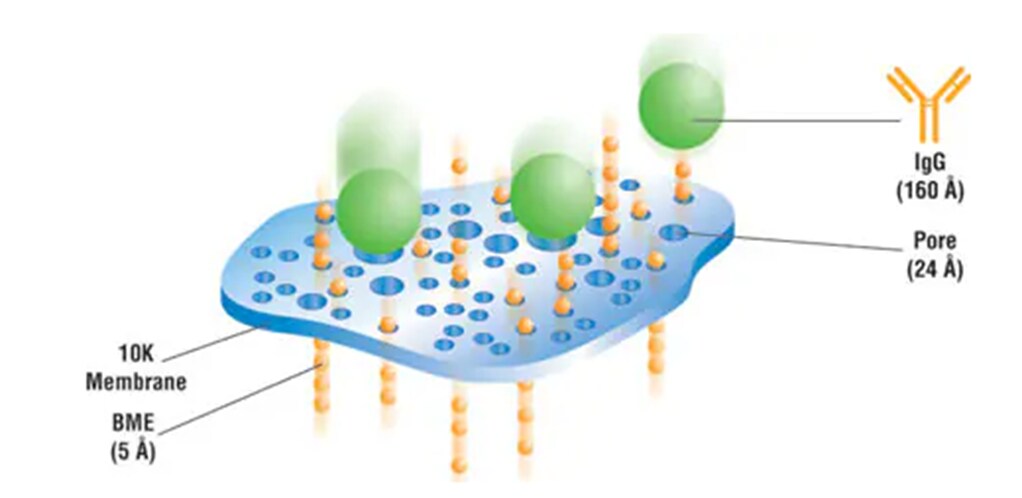
Figure 2. How dialysis membranes work. A dialysis membrane is a semi-permeable film (usually a sheet of regenerated cellulose) containing various sized pores. Molecules larger than the pores cannot pass through the membrane but small molecules can do so freely. In this manner, dialysis may be used to perform purification or buffer exchange for samples containing macromolecules.
Pros and cons of protein dialysis
Pros of protein dialysis:
- Efficient removal of small molecules.
- Preservation of protein integrity.
- Versatility in sample volumes.
- Compatibility with a wide range of buffer systems
Cons of protein dialysis:
- Time-consuming process.
- Risk of protein loss.
- Potential for membrane clogging with reuse of membrane
When to use desalting for protein purification and analysis
Primary use: Removal of interfering salts
If your protein sample contains high concentrations of salts that can interfere with downstream protein analysis techniques such as protein quantification, gel electrophoresis, mass spectrometry, or enzymatic assays, desalting can be performed to remove these salts and improve the accuracy and reliability of your analysis.
Secondary use: Buffer exchange
If your protein sample is in a buffer that is incompatible with your desired analysis method, desalting can be used to remove salts and small molecules before addition of a more suitable buffering system.
Choose the right desalting product for your experiment ›
When to use dialysis for protein purification and analysis
Primary use: Removal of small molecules
Dialysis is effective in removing small molecules, such as detergents or low molecular weight contaminants, from protein samples. If these molecules interfere with downstream protein analysis techniques like protein quantification, gel electrophoresis, mass spectrometry, or enzymatic assays, then protein dialysis can help eliminate them and improve the accuracy of the analysis.
Secondary use: Buffer exchange
If the protein sample is in a buffer that is incompatible with the desired analysis method, dialysis can be employed to purify the protein of the undesired salts and detergents before the replacement buffer is added. This is particularly useful when transitioning between different experimental protocols or when preparing samples for specific assays or experiments.
Tertiary use: Compatibility with sensitive proteins
Dialysis is a gentle method that helps preserve the native structure, stability, and functionality of proteins. It is particularly beneficial for sensitive proteins that are prone to denaturation or aggregation under harsh conditions.
Choose the right dialysis device for your experiment ›
In summary, protein sample desalting focuses on the removal of salts and low molecular weight substances, while protein sample dialysis is used for buffer exchange and the removal of unwanted and often larger molecules from the protein sample. Desalting is usually a simpler and faster process, while dialysis takes longer but offers more thorough protein cleanup and protein recovery. These factors help differentiate the two techniques and offer reasons for choosing one versus the other.
Dialysis versus desalting decision tree

Here’s a decision tree comparing protein desalting and protein dialysis based on considerations such as time, salt removal, small molecule removal, protein denaturation, and sample volume:
1. Consider the time available for the process:
- If time is limited and a rapid buffer exchange is required, choose protein desalting.
- If time is not a constraint, proceed to the next step.
2. Assess the sample volume:
- If working with a larger sample volume, protein dialysis may be more suitable as it can hold up to 250mL of sample.
- If working with a smaller sample volume (<10 mL), both protein desalting and protein dialysis can be considered, depending on personal preference.
3. Assess the extent of salt removal needed:
- If high salt removal is crucial, protein desalting is a suitable choice.
- If moderate or low salt removal is sufficient, proceed to the next step.
4. Evaluate the requirement for small molecule removal:
- If the removal of small molecules is necessary, protein dialysis is recommended. Depending on the type of small molecule, you may also consider using a detergent removal resin, or the Zeba Dye and Biotin Removal Columns/Filter Plates.
- If small molecule removal is not a priority, proceed to the next step.
5. Consider the susceptibility of the protein to denaturation:
- If the protein is sensitive to denaturation, protein dialysis is preferable as it is a gentle method that helps maintain protein stability.
- If protein denaturation is not a concern, proceed to desalting.
This decision tree provides a general guideline to choose between protein desalting and protein dialysis based on the given considerations. However, it is important to note that the final decision for your protein purification method should consider the specific requirements of the experiment, the characteristics of the protein sample, and the compatibility of the chosen method with downstream analysis techniques.
More tools and resources about protein purification methods >
- Protein Desalting
- Protein Dialysis
- Zeba Desalting Handbook ›
- Protein Clean-up technical handbook
- Overview of dialysis, desalting, buffer exchange and protein concentration
- Protein Sample Preparation eLearning Course
- Explore the Protein Analysis Learning Center
Want to read more stories like this? Subscribe to Connect to Science, your portal for life science news
##
For Research Use Only. Not for use in diagnostic procedures.
© 2024 Thermo Fisher Scientific Inc. All rights reserved. All trademarks are the property of Thermo Fisher Scientific and its subsidiaries unless otherwise specified.

Thermo Fisher Scientific Partners with AIM Biotech on Development of Microphysiological Systems
The adoption of New Approach Methodologies (NAMs) in drug di...
Read More
5 Solutions for Overcoming Research Challenges in Vaccine Development
What are the main challenges in vaccine development? The mai...
Read More
Deoxyribonuclease I in Advanced Molecular Biology Applications
Deoxyribonuclease I (DNase I) is a vital enzyme that acts as...
Read More
Spatial Omics Meets Neuroscience: Dual ISH-IHC Brain Mapping Case Study
Spatial omics biology is reshaping how researchers study com... Dana D'Amico
Read More
Leave a Reply