To fully characterize their materials, today’s materials scientists need to examine samples at different scales, while combining information obtained using different imaging techniques. Yet manually acquiring and assembling all these images can be time-consuming. What’s more, it can be difficult to correlate different types of data to obtain the needed high-quality information.
To address these challenges, researchers turn to Thermo Scientific Maps Software, an automation and correlative workflow software suite that makes it easy to examine electron microscopy images. Just as navigational software simplifies our ability to explore our surroundings, Maps Software transforms the way users visualize their data. Using this software, researchers can zoom out to see their entire sample and then easily zoom back in to explore specific areas of interest. They can also turn various layers of information on and off to home in on the exact information they need and correlate different types of data.
Maps Software enables users to visualize many types of images captured using different imaging techniques. The software can work with most standard image formats. It can also accept images from many instruments, including our full line of scanning electron microscopes (SEMs), transmission electron microscopes (TEMs) and DualBeam focused ion beam scanning electron microscopes (FIB-SEMs)—as well as many third-party platforms.
Here are three ways Maps Software help materials scientists accelerate their research:
- Automate image acquisition. Maps Software comes with an intuitive user interface that allows users to set up the automatic acquisition of images. Users can automatically acquire large-scale images—improving productivity by collecting images from multiple samples at the same time. They can also locate regions of interest and then set the system to automatically collect higher-resolution images at select areas. In addition, by automating image acquisition, researchers can offload routine imaging tasks to overnight and weekend runs, optimizing the productivity of their system without sacrificing quality results.
A geologic sample merging data from SEM-EDS, EDS, and a standalone Raman microscope. Maps Software makes it easy to combine all of your imagery into a single environment for simultaneous viewing and interpretation.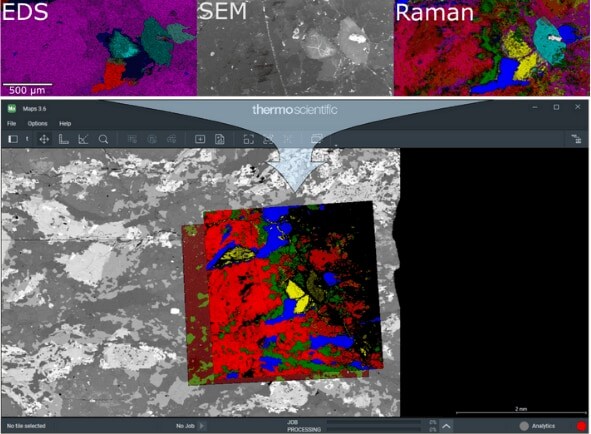
- Easily correlate different data. One of the major benefits of Maps is the ability to correlate data from multiple sources. No single imaging technique provides all the information needed for complete materials characterization. Maps Software addresses this issue by allowing the user to bring together data obtained from multiple imaging platforms and displaying it all in one place. The ability to easily correlate data enables researchers to obtain an accurate and complete understanding of the materials they’re exploring. Users can then use insights based on complete data when deciding where to obtain the next dataset.
- Explore data away from the microscope. Once the data has been collected, Maps Software lets users explore it away from the microscope—giving them the flexibility to analyze their data from their laptop anytime, anywhere. Researchers can review and annotate information away from the SEM. They can also share data and collaborate with colleagues, increasing productivity and accelerating their discoveries.
Today’s advanced research requires that scientists combine multiple types of data to characterize their materials—and Maps Software provides a robust tool to meet this need. Not only does Maps Software save time and labor, but it gives users the complete, high-quality data they need to develop the innovative materials that power our lives. To learn more, please see our Maps Software video.
Eric Goergen is a product marketing manager in the Analytical Instrument Group at Thermo Fisher Scientific.
///
Subscribe now to receive Accelerating Microscopy updates straight to your inbox.
Speak with an expert: https://www.thermofisher.com/blog/microscopy/speak-with-an-expert/
The Essential Guide to Raman Microscopy
What is Raman spectroscopy? With Raman spectroscopy, researc...
Read More
Particle Analysis for Micro Machining
With the need for small, precisely crafted parts in products...
Read More
You Need an Efficient and Intuitive SEM Experience
Researchers at today’s industrial labs typically work unde...
Read More
Is Your SEM Flexible Enough to Handle All Your Samples?
As industrial labs strive to maintain the quality of their p...
Read More
Leave a Reply