Editor’s Note: This is the third of a five-part webinar series on general extruders and mixers for characterizing and formulating your polymer materials using rheology, viscometry, mixing and extrusion technologies. Watch for a webinar every Tuesday in March.
Proven single-screw laboratory extruders deliver reliable data captured during the extrusion process to verify process parameters (speed, energy, temperature) for unknown materials or to manufacture smaller quantities of a new polymer (as strands, sheets, pellets, blown films) during research and development. Typical twin-screw extruder investigations include compounding of polymers with additives, and reinforcing fibers and fillers.
The handling of the still hot and formable extruded material is a crucial part of the polymer manufacturing process; it significantly influences the material properties and surface finish. To ensure that material requirements are met, a range of dedicated Downstream Options are available. Downstream equipment is used to prepare the extruded material for further tests. Besides the defined and reproducible handling of the polymer, the Downstream Process also allows mimicking full scale processes, and can thus be used for small scale production. This is helpful, especially when alterations to the polymer formulation and processing parameters are necessary.
We’ve recorded an hour-long, free webinar for scientists, engineers and staff members from polymer R&D and process development that explains:
- Influence on process parameters on the downstream process
- Strand granulation
- Chill-rolling
- Injection molding as possibilities for downstreaming
- Alternative processes for melt processing
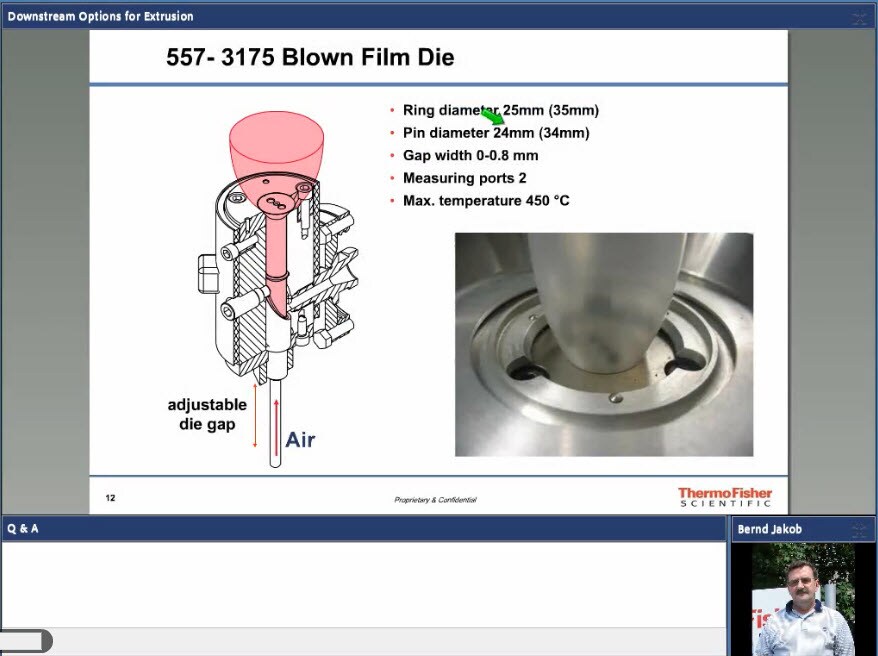
The webinar discusses the several applications, including small production of films (sheet and cast film and blown film), compounding, rubber extrusion – as well as testing the processability, testing of additives, and testing of optimization of processing conditions, using single or twin screw extruders. In addition, fish-eye testing, pigment distribution, surface quality, tensile testing, and weathering will be explained. You will see the actual instruments being used and illustrations of how they work.
Watch the hour-long webinar: Downstream Options for Extrusion
Here are links to the full series:
- Extrusion Rheology – Usage of the Torque Rheometer
- Twin Screw Compounding – Introduction and Scale-Up
- Downstream Options for Extrusion
- Mixer Test – A Versatile Tool for Polymer Processing
- MIM/PIM Application – Mixer, Compounding, Rheology

Maximizing ROI Through Uptime in Labs and Production Lines
Uptime Optimization is the New ROI Metric In today’s h... Germain Siraudin
Read More
K 2025: Showcasing the Future of Sustainable, Smart, and Responsible Plastics Production
This week, more than 3,000 exhibitors and 177,000 visitors f... Keith Cornell Nimesh Khadka, PhD
Read More
The Principles and Capabilities of Powder Rheology
Powder rheology is a critical analytical technique for sever...
Read More
More Than a Wig: How Science Is Restoring Dignity, Not Just Hair
Hair is more than appearance. It carries culture, memory, an... Keith Cornell
Read More
The video is not playable