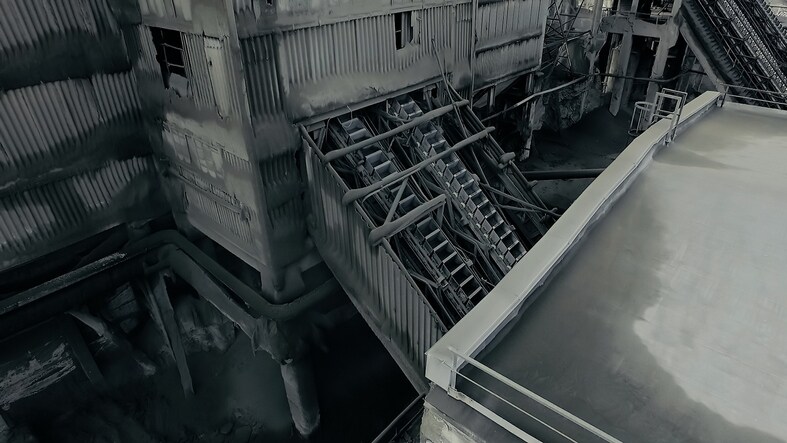
 Cement kilns are large furnaces used to grind and heat a mixture of raw materials (like limestone, clay, and iron ore) to produce cement. As you can imagine, that process takes a lot of energy – as can be seen by the large smokestacks that tower over the plants. As the various fuels are burned and the materials heated, air toxics are emitted. One of those pollutants can be mercury.
There are multiple potential sources of mercury emissions from cement kilns. The primary source is limestone, the main constituent of the raw material. Other smaller sources of mercury emissions include sand and iron ore. Coal, which is often used to heat the raw material, contains mercury which becomes a part of the plant’s emissions. Mercury is also a part of dust captured in the Air Pollution Control Device, which is reintroduced to the cement kiln. Because the cement process is a harsh operating environment for stack monitoring, with high temperatures, moisture and dust in the flue gas, sudden changes in the process can cause large variations in mercury emissions.
Most cement plants use various types of coal and petroleum coke as a main fuel. Secondary fuels include various solid and liquid wastes, plastics and biomass fuels. The operations of the cement plant are hugely cost-sensitive, so it is not uncommon to see fuels being switched or combined during cement production for economic reasons. The levels and species (elemental or ionic) of mercury can vary greatly depending upon the nature of fuel used.
The U.S. EPA Portland Cement Maximum Achievable Control Technology (MACT) rule requires all cement plants in the United States to continuously monitor mercury. Mercury emissions monitoring systems, originally designed to meet the emissions requirements for coal-fired power plants, are installed in cement plants due to their ability to keep up with the changing process flow conditions of the kiln. This helps ensure complete regulatory compliance with U.S. EPA 40 CFR Part 75 with unattended, truly continuous monitoring.
These systems are capable of continuously monitoring elemental, ionic and total mercury in exhaust stacks through a process called speciation. The analyzer makes use of Cold Vapor Atomic Fluorescence technology which measures only elemental mercury species. The sample stream is then switched from the sample pulled directly from the stack, and another sample line which is ran through a high temperature (725oC) converter. The converter reacts with the ionic mercury, Hg molecules bonded with other elements, like Chlorine or Sulphur, and releases the Hg to be elemental. The direct measurement sample is representative of the elemental mercury in the stack, and the converted sample measures the total mercury in the stack. By simply subtracting the elemental sample from the total sample, the instrument reports the ionic mercury concentration along with the other two concentrations.
Some mercury emissions monitoring systems consist of a sampling probe at the stack, a heated umbilical line for sample transport, and a rack of instruments that include the analyzer, mercury calibrator, permeation source and probe controller. The rack, which is placed in an accessible temperature-controlled location, also contains a zero-air generator and a sample pump.
The system extracts the sample using an inertial probe. The probe contains a fast loop with a glass-coated inertial filter that prevents particulate clogging and requires less frequent maintenance. The sample is diluted with instrument-generated zero air or nitrogen before it is transported to the analyzer, which detects elemental mercury (Hg0), not oxidized mercury (Hg2+). In order to detect all (total) mercury, oxidized mercury needs to be converted into elemental mercury. The probe splits the sample into two flow paths. One uses a dry converter to convert the oxidized mercury into elemental mercury. This way, one of the sample tubes carries elemental mercury and the other tube carries total mercury, which includes the converted oxidized mercury. Converting the oxidized mercury at the stack minimizes the loss of mercury in the sample line, and consequently removes the need for high temperature in the umbilical line.
The diluted sample from the probe is transported through the optical chamber, where is it subjected to a high intensity UV light source. Mercury in the sample is excited by 253.7 nm wavelength light, which causes it to fluoresce; the fluorescent intensity is directly proportional to the amount of mercury in the sample. The fluorescence is measured by a photomultiplier tube (PMT). Because only mercury is excited by the chosen wavelength, interference from other pollutants is eliminated.
The probe controller controls probe parameters such as pressure and temperature, and also controls automated blowback and secondary valve functions. A clean dilution gas is then delivered to both the calibrator and the probe. The calibrator generates mercury vapor used to calibrate the Continuous Emissions Monitoring Systems (CEMS). It uses a Peltier Cooler and mass flow controllers to generate precise amounts of elemental mercury. Mercury span gas is transported through the sample line to the probe. During a calibration cycle, the calibration gas floods the probe and is drawn through the inertial filter back into the analyzer for measurement.
The analyzer displays Elemental Hg, Oxidized Hg, and Total Hg concentrations. The analyzer is totally self-contained, linear through all ranges and uses atomic fluorescence detection technology for fast response time and high sensitivity. The permeation assembly generates a specific and consistent concentration of mercury. The generated mercury concentration, as measured by the analyzer, is used to confirm the reliability of the calibrator output in accordance with U.S. EPA Interim Elemental Mercury Traceability Protocol requirements.
To read additional details, including seeing results from a field installation, read the application note: Mercury Monitoring in a Cement Kiln.


What Is Ambient Air?
Learn about ambient air, its significance, pollutants, and m... Marlene Gasdia-Cochrane, Editor
Read More
PGNAA Improves Process and Quality Control in Cement Production
In the world of cement production, precision is key. Getting... Darrell Leetham
Read More
Don’t Abandon the Treasures: Fill Your Trick-or-Treat Bags with Free eBooks for Mining and Cement Operations
Ghost towns have more to do with the abandonment of mining t... Marlene Gasdia-Cochrane, Editor
Read More
Making Sure Green Cement is Clean Cement
Alternative Fuels (AFs) are being increasingly used in cemen... Jill Staggert
Read More


Leave a Reply