Search
 Element Search
 Structure Search


Thermo Scientific Chemicals
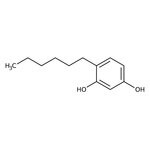
4-n-Hexylresorcinol, 99%
CAS: 136-77-6 | C12H18O2 | 194.27 g/mol
Change view


Catalog number A12552.22
also known as A12552-22
Price (JPY)
-
Quantity:
100 g
Chemical Identifiers
CAS136-77-6
Specifications Specification Sheet
Specification SheetMelting Point (clear melt)63.5-69.5?C
Appearance (Color)White to pale brown
Identification (FTIR)Conforms
Assay (GC)≥98.5%
FormPowder
4-Hexylresorcinol is an inhibitor of transglutaminase-2 in KB cells. Studies indicate that 4-Hexylresorcinol reduces DNA oxidative damage in human lymphocytes. is a substituted dihydroxybenzene used topically as an antiseptic for the treatment of minor skin infections. is a substituted phenol with bactericidal, antihelminthic and potential antineoplastic activities. The combination of 4-Hexylresorcinol and Cisplatin has been shown to inhibit tumor growth, cell growth, and KB cell viability.
This Thermo Scientific Chemicals brand product was originally part of the Alfa Aesar product portfolio. Some documentation and label information may refer to the legacy brand. The original Alfa Aesar product / item code or SKU reference has not changed as a part of the brand transition to Thermo Scientific Chemicals.
Applications
4-Hexylresorcinol is an inhibitor of transglutaminase-2 in KB cells. Studies indicate that 4-Hexylresorcinol reduces DNA oxidative damage in human lymphocytes. is a substituted dihydroxybenzene used topically as an antiseptic for the treatment of minor skin infections. is a substituted phenol with bactericidal, antihelminthic and potential antineoplastic activities. The combination of 4-Hexylresorcinol and Cisplatin has been shown to inhibit tumor growth, cell growth, and KB cell viability.
Solubility
Soluble in water. 0.05 g/100 mL (18°C)
Notes
Incompatible with acid chlorides, acid anhydrides, oxidizing agents. Store at room temperature.
4-Hexylresorcinol is an inhibitor of transglutaminase-2 in KB cells. Studies indicate that 4-Hexylresorcinol reduces DNA oxidative damage in human lymphocytes. is a substituted dihydroxybenzene used topically as an antiseptic for the treatment of minor skin infections. is a substituted phenol with bactericidal, antihelminthic and potential antineoplastic activities. The combination of 4-Hexylresorcinol and Cisplatin has been shown to inhibit tumor growth, cell growth, and KB cell viability.
Solubility
Soluble in water. 0.05 g/100 mL (18°C)
Notes
Incompatible with acid chlorides, acid anhydrides, oxidizing agents. Store at room temperature.
RUO – Research Use Only
General References:
- A. L. Mulyukin.; E. V. Demkina.; A. N. Kozlova.; V. S. Soina.; G. I. El'-Registan. Synthesis of Anabiosis Autoinducers by Non-Spore-Forming Bacteria as a Mechanism Regulating Their Activity in Soil and Subsoil Sedimentary Rocks. Microbiology. 2001, 70 (5),535-541.
- Harold Baer.; Roy C. Watkins.; Robert T. Bowser. Delayed contact sensitivity to catechols and resorcinols. The relationship of structure and immunization procedure to sensitizing capacity. Immunochemistry. 1966, 3 (6),479-485.