Search


Citations & References (13)
Invitrogen™
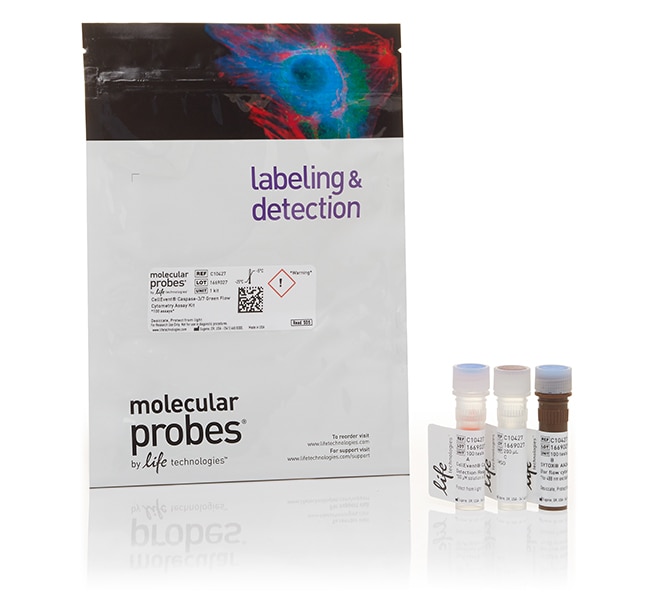
CellEvent™ Caspase-3/7 Green Flow Cytometry Assay Kit
The CellEvent™ Caspase-3/7 Green Flow Cytometry Assay Kit enables the flow cytometric detection of activated caspase-3 and caspase-7 in apoptoticRead more
Have Questions?
Change view

| Catalog Number | Quantity |
|---|---|
| C10427 | 100 Assays |
| C10740 | 20 Assays |
Catalog number C10427
Price (USD)
552.00
Each
Quantity:
100 Assays
Price (USD)
552.00
Each
The CellEvent™ Caspase-3/7 Green Flow Cytometry Assay Kit enables the flow cytometric detection of activated caspase-3 and caspase-7 in apoptotic cells. The kit includes the novel fluorogenic substrate CellEvent™ Caspase-3/7 Green Detection Reagent, as well as SYTOX™ AADvanced™ Dead Cell Stain.
• Caspase-3/7 specific—includes the recognition sequence for activated caspase-3 and caspase-7
• Easy identification—clearly identify live, dead, and apoptotic cell populations
• Quick analysis—washing and fixation is not required
• Multicolor compatibility—combine with other dyes excitable by the 488 nm laser or other lasers
CellEvent™ Caspase-3/7 Green Detection Reagent is a cell-permeant reagent that consists of a four-amino acid peptide (DEVD) conjugated to a nucleic acid-binding dye. During apoptosis, caspase-3 and caspase-7 proteins are activated and able to cleave the caspase 3/7 recognition sequence encoded in the DEVD peptide. Cleavage of the recognition sequence and binding of DNA by the reagent labels the apoptotic cells with a bright, fluorogenic signal that has absorption/emission maxima of ∼511/533 nm. When used together with the SYTOX™ AADvanced™ Dead Cell Stain, apoptotic cells can be easily discriminated from live and necrotic cells.
Because no single parameter defines apoptosis in all systems, we strongly suggest using a combination of different measurements for reliable detection of apoptosis.
For Research Use Only. Not for use in diagnostic procedures.
Specifications
Excitation/EmissionSYTOX AADvanced: 546/647
CellEvent Caspase 3/7 Green Detection Reagent: 511/533
CellEvent Caspase 3/7 Green Detection Reagent: 511/533
Flow Cytometer Laser Lines488
For Use With (Application)Flow Cytometry
For Use With (Equipment)Attune™ Acoustic Focusing Cytometer, Flow Cytometer
Label TypeOther Label(s) or Dye(s)
Label or DyeCellEvent™ Caspase 3/7 Green Detection Reagent, SYTOX AADvanced dead cell stain
Product LineCellEvent
Product TypeCaspase Assay Kit
Quantity100 Assays
Shipping ConditionWet Ice
SolubilityDMSO (Dimethylsulfoxide)
Detection MethodFluorescence
FormatKit
Unit SizeEach
Contents & Storage
Contains 1 vial CellEvent™ Caspase 3/7 Green Detection Reagent, 1 vial SYTOX AADvanced dead cell stain, and 1 vial of DMSO.
Store all vials in the kit upright, at or below -20deg;C, desiccated, and protected from light.
Store all vials in the kit upright, at or below -20deg;C, desiccated, and protected from light.
Frequently asked questions (FAQs)
I want to study apoptosis using an Annexin V conjugate, but with adherent cells via microscopy instead of flow cytometry. Can this be done?
Can I use CellEvent Caspase-3/7 Green Detection Reagent with fixed samples?
With the CellEvent Caspase-3/7 Green Detection Reagent, may I stain cells with nucleic acid stains?
With the CellEvent Caspase-3/7 Green Detection Reagent, may I multiplex with fluorescent immunolabeling?
Is the CellEvent Caspase-3/7 Green Detection Reagent fixable?
Citations & References (13)
Citations & References
Abstract
Counteracting autophagy overcomes resistance to everolimus in mantle cell lymphoma.
Journal:Clin Cancer Res
PubMed ID:22879389
'Mantle cell lymphoma (MCL) is an aggressive B-lymphoid neoplasm with poor response to conventional chemotherapy and short survival. The phosphatidylinositol 3-kinase/Akt/mTOR survival pathway is constitutively activated in MCL cells, thereby making the mTOR inhibition an attractive therapeutic strategy. The first clinical studies of everolimus (RAD001), an mTOR inhibitor, in relapsed
The cytotoxicity of bupivacaine, ropivacaine, and mepivacaine on human chondrocytes and cartilage.
Journal:
PubMed ID:23749443
'Intraarticular injections of local anesthetics are frequently used as part of multimodal pain regimens. However, recent data suggest that local anesthetics affect chondrocyte viability. In this study, we assessed the chondrotoxic effects of mepivacaine, ropivacaine, and bupivacaine. We hypothesized that specific cytotoxic potencies directly correlate with analgesic potencies, and that
Proteomic analysis reveals that pardaxin triggers apoptotic signaling pathways in human cervical carcinoma HeLa cells: cross talk among the UPR, c-Jun and ROS.
Journal:Carcinogenesis
PubMed ID:23615400
Pardaxin, an antimicrobial peptide secreted by the Red Sea flatfish Pardachirus marmoratus, inhibits proliferation and induces apoptosis of human cancer cell lines. However, the underlying molecular mechanisms are only partially understood at present. In this study, we used proteomic approaches and network reconstruction to clarify the mechanism of pardaxin-induced apoptosis
Salinomycin inhibits breast cancer progression via targeting HIF-1a/VEGF mediated tumor angiogenesis in vitro and in vivo.
Journal:Biochem Pharmacol
PubMed ID:31028743
'Cancer is a complex disease wherein cells begin to divideabnormally and spread into surrounding tissues. Angiogenesis plays a crucial role in tumor progression as it is required for sustained growth and metastasis, therefore targeting angiogenesis is a promising therapeutic approach for breast cancer management. Salinomycin (SAL) has been reported to
Gel-based cell manipulation method for isolation and genotyping of single-adherent cells.
Journal:Analyst
PubMed ID:30302469
'Genetic analysis of single-cells is widely recognized as a powerful tool for understanding cellular heterogeneity and obtaining genetic information from rare populations. Recently, many kinds of single-cell isolation systems have been developed to facilitate single-cell genetic analysis. However, these systems mainly target non-adherent cells or cells in a cell suspension.