Search

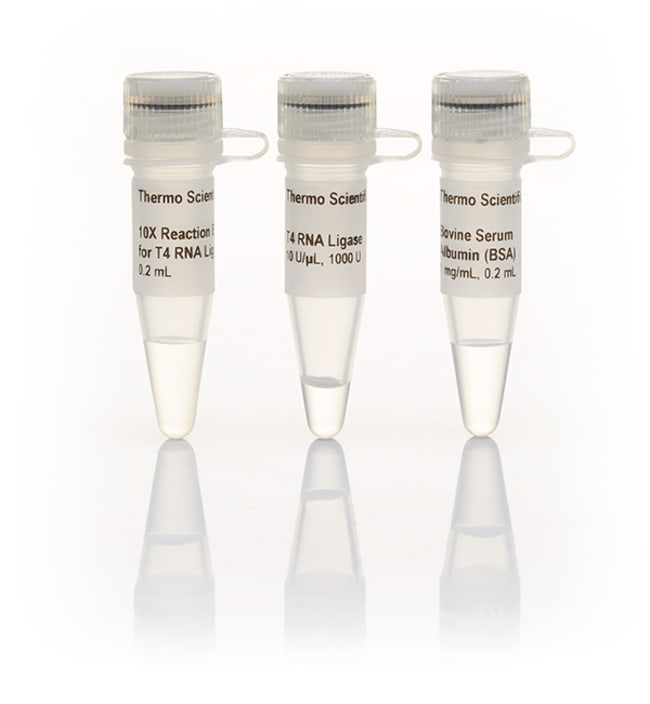
Thermo Scientific™
T4 RNA Ligase (10 U/μL)
Thermo Scientific T4 RNA Ligase catalyzes the ATP-dependent intra- and intermolecular formation of phosphodiester bonds between 5'-phosphate and 3'-hydroxyl terminiRead more
| Catalog Number | Quantity |
|---|---|
| EL0021 | 1,000 units |
Catalog number EL0021
Price (MXN)
-
Quantity:
1,000 units
Thermo Scientific T4 RNA Ligase catalyzes the ATP-dependent intra- and intermolecular formation of phosphodiester bonds between 5'-phosphate and 3'-hydroxyl termini of oligonucleotides, single-stranded RNA and DNA.
The minimal substrate is a nucleoside 3',5'-biphosphate in intermolecular reaction and oligonucleotide of 8bases in intramolecular reaction.
Applications
• RNA 3'-end labeling with cytidine 3',5'-bis [alpha-32P] phosphate
• Joining RNA to RNA
• Synthesis of oligoribonucleotides and oligodeoxyribonucleotides
• Specific modifications of tRNAs
• Oligodeoxyribonucleotide ligation to single-stranded cDNAs for 5' RACE (Rapid Amplification of cDNA Ends)
• Site-specific generation of composite primers for PCR
Note
The recommended BSA concentration in the reaction mixture is 0.1mg/mL.
The minimal substrate is a nucleoside 3',5'-biphosphate in intermolecular reaction and oligonucleotide of 8bases in intramolecular reaction.
Applications
• RNA 3'-end labeling with cytidine 3',5'-bis [alpha-32P] phosphate
• Joining RNA to RNA
• Synthesis of oligoribonucleotides and oligodeoxyribonucleotides
• Specific modifications of tRNAs
• Oligodeoxyribonucleotide ligation to single-stranded cDNAs for 5' RACE (Rapid Amplification of cDNA Ends)
• Site-specific generation of composite primers for PCR
Note
The recommended BSA concentration in the reaction mixture is 0.1mg/mL.
For Research Use Only. Not for use in diagnostic procedures.
Specifications
Compatible Buffer10X Reaction Buffer
Product TypeT4 RNA Ligase
Quantity1,000 units
Concentration10 U/μL
EnzymeT4 RNA Ligase
Unit SizeEach