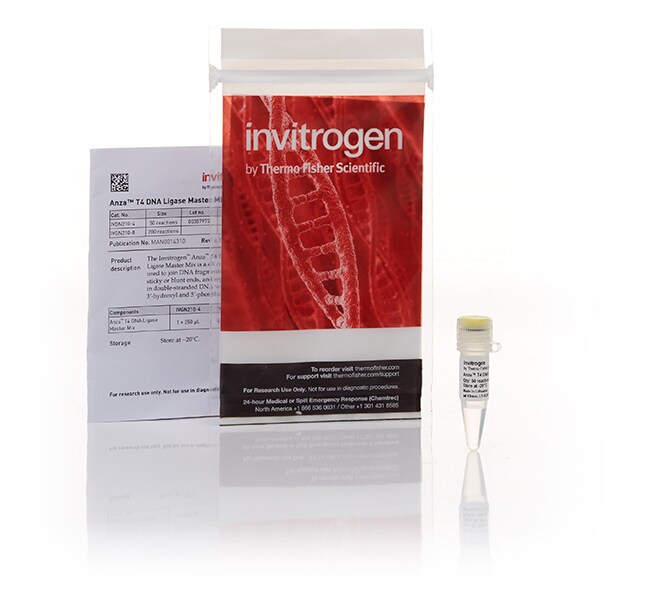
Mezcla maestra de ligasa de ADN T4 Anza™
Invitrogen™

Mezcla maestra de ligasa de ADN T4 Anza™

La mezcla maestra de ligasa de ADN T4 Invitrogen Anza™ facilita la unión de los extremos 5’-fosfato y 3’-hidroxilo contiguosMás información
Have Questions?
Cambiar vistabuttonViewtableView
Número de catálogoCantidad
IVGN2108200 reacciones
IVGN210450 reacciones
Número de catálogo IVGN2108
Precio (CLP)
-
Cantidad:
200 reacciones
La mezcla maestra de ligasa de ADN T4 Invitrogen Anza™ facilita la unión de los extremos 5’-fosfato y 3’-hidroxilo contiguos en el ADN bicatenario mediante la formación de un enlace fosfodiéster. Se puede utilizar para unir fragmentos de ADN con extremos cohesivos y romos, y para reparar cortes en el ADN bicatenario con extremos 3'-hidroxilo y 5'-fosfato. La Ligasa de ADN T4 Anza se formula como una mezcla maestra concentrada de 4X. La ligadura se puede realizar con ADN en agua, TE, tampón de elución o tampones 1X Anza™.

Ventajas:
• Ligadura completa en 15 minutos a temperatura ambiente
• Una ligasa para mezclas maestras de extremos cohesivos y romos
• El formato de mezcla maestra listo para usar reduce los pasos de pipeteo
• La concentración de 4X permite utilizar ADN más diluido en la reacción de ligadura sin concentración

La mezcla maestra de ligasa de ADN T4 es parte del sistema de clonación de enzimas de restricción Anza™, con lo cual se unifican los procesos de clonación tradicionales. Otras enzimas modificadoras de ADN Anza incluyen el kit de polinucleótido cinasa T4 (PNK T4) Anza, el kit de extremos romos de ADN Anzay el kit de reparación final de ADN Anza.
Para uso exclusivo en investigación. No apto para uso en procedimientos diagnósticos.
Especificaciones
Tampón compatibleTampón de elución, tampón Anza 1X
Tipo de productoMezcla maestra de ligasa de ADN T4
Cantidad200 reacciones
Condiciones de envíoAprobado para su envío en hielo húmedo o seco
Concentración4X
EnzimaT4 DNA Ligase
Línea de productosAnza
Unit SizeEach
Contenido y almacenamiento
Mezcla maestra de ligasa de ADN T4 Anza de 1 ml

Almacenar a entre - 5 y - 30 °C.

Preguntas frecuentes

What are the recommended conditions for blunt-ended ligations?

Generally, ligations are done in a 20 µL volume. Use a total of 100 to 1000 ng of DNA with an insert to vector ratio of 3:1. Add 1.0 units (Weiss) ligase to the reaction. Incubate at room temperature for 4 h or overnight at 14-16 degrees C.

Ideally, assemble several reactions with varying ratios of vector:insert (i.e. 3:1, 5:1, 10:1, 20:1, etc.) to determine the optimal ratio for ligation.

Thermo Fisher Scientific offers T4 DNA ligase at two concentrations: 1 U/µL (Cat. No. 15224-017) and 5 U/µL (Cat. No. 15224-041). When performing blunt or TA cloning ligations, the higher concentration of ligase is generally preferred since ligating a blunt or single base overhang requires more enzyme.

What are the recommended conditions for cohesive-end ligations?

Generally, ligations are done in a 20 µL volume. Use a total of 10 to 100 ng of DNA per reaction with an insert to vector ratio of 3:1. Add 0.1 units (Weiss) ligase to the reaction. Incubate at room temperature for 30-60 minutes.

Optimal ligation may occur at other ratios (e.g. 1:5, 1:10). If possible, assemble several ligation reactions of varying insert to vector ratios in order to reveal the optimal ligation conditions.

Thermo Fisher Scientific offers T4 DNA ligase at two concentrations: 1 U/µL (Cat. No. 15224-017) and 5 U/µL (Cat. No. 15224-041). When performing blunt or TA cloning ligations, the higher concentration of ligase is generally preferred since ligating a blunt or single base overhang requires more enzyme.

Which is better to use, T4 or E. coli DNA ligase?

It depends on your application. For ligation of dsDNA fragments with cohesive ends, either enzyme can be used. E. coli DNA ligase requires the presence of beta-NAD, while T4 DNA ligase requires ATP. However, only T4 DNA ligase can join blunt-ended DNA fragments - E. coli ligase is unable to join such fragments.

E. coli DNA ligase is generally used to eliminate nicks during second-strand cDNA synthesis. T4 DNA ligase should not be substituted for E. coli DNA ligase in second-strand synthesis because of its capability for blunt end ligation of the ds cDNA fragments, which could result in formation of chimeric inserts.

Why is ATP present in the reaction buffer for T4 DNA Ligase?

ATP is necessary for enzymatic function. It is involved in phosphorylating the ligase prior to the ligation reaction. Ligation efficiency is markedly reduced by removing ATP from the reaction. It is important, therefore, to handle the buffer appropriately in order to minimize degradation of ATP.

What are some of the problems associated with sticky-end cloning?

The amplified DNA needs to be purified from the PCR mixture components prior to cloning. The dNTPs carried over from the PCR are competitive inhibitors for ATP in the ligation reaction.

If during synthesis of the PCR primers their chemical integrity has been compromised by either a base substitution or modification, the enzyme recognition site may in actuality not exist. If this is the case, PCR products will be resistant to digestion with restriction enzymes. It may be necessary to use a higher concentration of the restriction enzyme and to incubate at the appropriate temperature overnight to ensure cutting.