Search

Thermo Scientific™
Pierce™ His Protein Interaction Pull-Down Kit
Das Thermo Fisher Scientific Pierce Pull-Down-Kit für Interaktion mit His-markiertem Protein enthält die notwendigen Komponenten zur Aufnahme und Reinigung vonWeitere Informationen
| Katalognummer | Menge |
|---|---|
| 21277 | 1 Kit |
Katalognummer 21277
Preis (EUR)
590,00
Each
Menge:
1 Kit
Preis (EUR)
590,00
Each
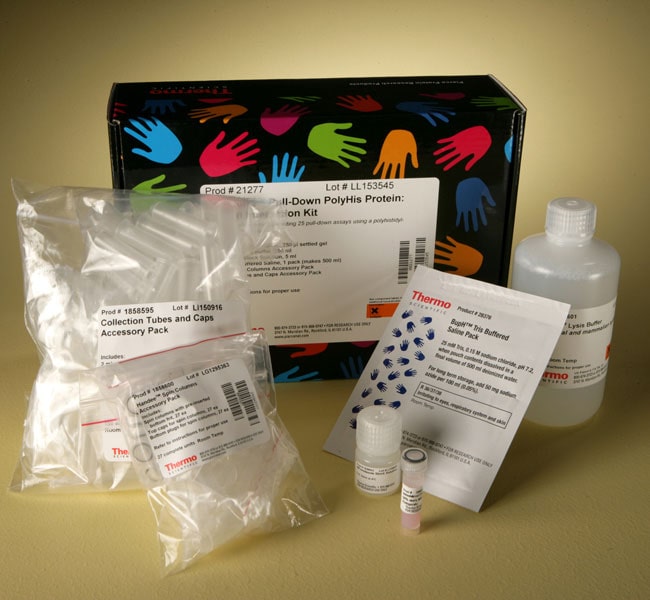
Das Thermo Fisher Scientific Pierce Pull-Down-Kit für Interaktion mit His-markiertem Protein enthält die notwendigen Komponenten zur Aufnahme und Reinigung von Proteinen, die mit His-markierten Fusionsproteinen interagieren.
Merkmale des Pull-Down-Kits für Interaktion mit His-markiertem Protein:
• 6xHis Pull-down (Art.-Nr. 21277)—reinigt Proteininteraktoren von jedem His-markierten Fusionsprotein
• Komplettkit—liefert alle Komponenten und ein detailliertes Protokoll zur Proteinreinigung:Proteininteraktionen
• Keine spezielle Ausrüstung erforderlich—Verwendung gängiger Laborgeräte und Reagenzien (z. B. Mikrozentrifuge)
• Praktisch—Zentrifugensäulen der Mikrozentrifuge erleichtern die einfache und effiziente Manipulation von Agarose-Beads. Einschließlich der einfachen Verarbeitung mehrerer Proben
• Flexibel—Anweisungen enthalten Protokolle für die Verwendung mit Ködern und Beuteproteinen, die aus einer Vielzahl von Probentypen exprimiert werden
• Weniger unspezifische Bindung—Cobalt-Chelatharz ist spezifischer für Histidin-markierte Fusionsproteine als Nickelharze, Ergebnis weniger unspezifischer Bindungen
• Bindung—Bindet 10 bis 25 mg Histidin-markiertes Fusionsprotein pro ml Harz
Anwendungen:
• Entdeckung einer neuen Protein:Protein-Interaktion aus einem Zelllysat;
• Bestätigung einer möglichen Interaktion aus einem Zelllysat oder aus vorher gereinigten Protein
• Extraktion von Informationen über Protein:Protein-Interaktionen aus in-vitro-Transkription/Translation-Lysaten
Sie stellen das markierte Fusionsprotein als “Köder” und die Zellen zur Verfügung, die das vermeintliche Proteininteraktionsziel exprimieren (“Beute”) und die Pull-Down-Kits bieten alles andere: Zelllysepuffer, Mikrozentrifugenspin-Säulen, tag-spezifisches Affinitätsharz (Agarose-Beads) und optimierte Puffer und Protokolle. Die Pull-Down-Kits wurden entwickelt, um Erstbenutzern die Methode zu vermitteln und die Anwenderfreundlichkeit, den Komfort und die Reproduzierbarkeit für erfahrene Forscher zu erhöhen.
Ähnliche Produkte
Pierce™ GST Proteininteraktions-Pull-Down-Kit
Merkmale des Pull-Down-Kits für Interaktion mit His-markiertem Protein:
• 6xHis Pull-down (Art.-Nr. 21277)—reinigt Proteininteraktoren von jedem His-markierten Fusionsprotein
• Komplettkit—liefert alle Komponenten und ein detailliertes Protokoll zur Proteinreinigung:Proteininteraktionen
• Keine spezielle Ausrüstung erforderlich—Verwendung gängiger Laborgeräte und Reagenzien (z. B. Mikrozentrifuge)
• Praktisch—Zentrifugensäulen der Mikrozentrifuge erleichtern die einfache und effiziente Manipulation von Agarose-Beads. Einschließlich der einfachen Verarbeitung mehrerer Proben
• Flexibel—Anweisungen enthalten Protokolle für die Verwendung mit Ködern und Beuteproteinen, die aus einer Vielzahl von Probentypen exprimiert werden
• Weniger unspezifische Bindung—Cobalt-Chelatharz ist spezifischer für Histidin-markierte Fusionsproteine als Nickelharze, Ergebnis weniger unspezifischer Bindungen
• Bindung—Bindet 10 bis 25 mg Histidin-markiertes Fusionsprotein pro ml Harz
Anwendungen:
• Entdeckung einer neuen Protein:Protein-Interaktion aus einem Zelllysat;
• Bestätigung einer möglichen Interaktion aus einem Zelllysat oder aus vorher gereinigten Protein
• Extraktion von Informationen über Protein:Protein-Interaktionen aus in-vitro-Transkription/Translation-Lysaten
Sie stellen das markierte Fusionsprotein als “Köder” und die Zellen zur Verfügung, die das vermeintliche Proteininteraktionsziel exprimieren (“Beute”) und die Pull-Down-Kits bieten alles andere: Zelllysepuffer, Mikrozentrifugenspin-Säulen, tag-spezifisches Affinitätsharz (Agarose-Beads) und optimierte Puffer und Protokolle. Die Pull-Down-Kits wurden entwickelt, um Erstbenutzern die Methode zu vermitteln und die Anwenderfreundlichkeit, den Komfort und die Reproduzierbarkeit für erfahrene Forscher zu erhöhen.
Ähnliche Produkte
Pierce™ GST Proteininteraktions-Pull-Down-Kit
Nur für Forschungszwecke. Nicht zur Verwendung bei diagnostischen Verfahren.
Specifications
AssayAffinitätsreinigung
Zur Verwendung mit (Anwendung)Pull-Down (Tag-basiert)
Zur Verwendung mit (Geräte)Mikrozentrifuge
FormatKit
Menge1 Kit
Ausreichend für25 Reaktionen
ZielNicht zielspezifisch
ProduktliniePierce
TypPull-Down-Kit
Unit SizeEach
Inhalt und Lagerung
Ausreichend für: Mindestens 25 Pulldown-Reaktionen, jeweils mit 25 µl Harzkobalt
• Chelat-Agarose-Harz, 750 µl
• Pull-Down-Lysepuffer, 250 ml
• Imidazol-Lösung (4 m), 5 ml
• TBS-Packung (500 ml), 1 Packung
• Pierce Spin-Säulen und Zubehör, 27 Säulen
• Mikrozentrifugensammelröhrchen, 100 Röhrchen
Pierce Lysepuffer nach Erhalt bei Raumtemperatur lagern. Die restlichen Kit-Komponenten bei 4 °C lagern.
• Chelat-Agarose-Harz, 750 µl
• Pull-Down-Lysepuffer, 250 ml
• Imidazol-Lösung (4 m), 5 ml
• TBS-Packung (500 ml), 1 Packung
• Pierce Spin-Säulen und Zubehör, 27 Säulen
• Mikrozentrifugensammelröhrchen, 100 Röhrchen
Pierce Lysepuffer nach Erhalt bei Raumtemperatur lagern. Die restlichen Kit-Komponenten bei 4 °C lagern.