Search


Zitierungen und Referenzen (3)
Thermo Scientific™
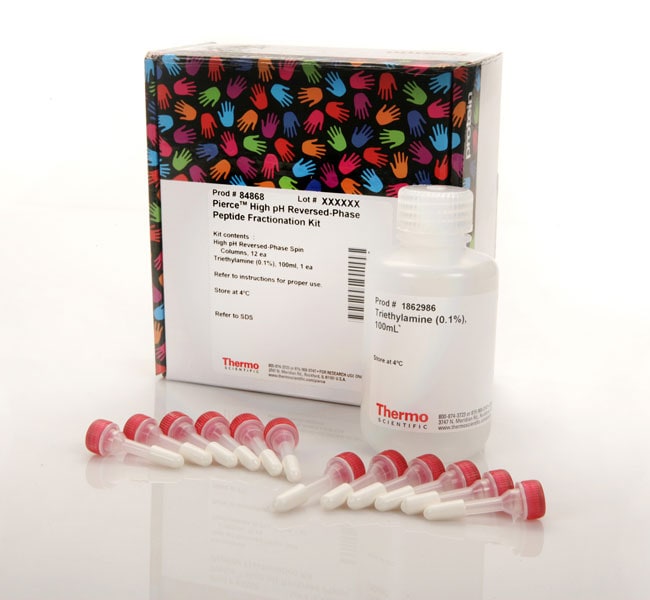
Pierce™-Kit für die Umkehrphase-Peptid-Fraktionierung mit hohem pH-Wert
Das Thermo Scientific™ Pierce™ Umkehrphasen-Peptidfraktionierungskit mit hohem pH-Wert erhöht die Proteinidentifizierung von LC/MS-Analysen durch orthogonale Peptidfraktionierung komplexer Peptidproben.• Anwenderfreundlich—Harz imWeitere Informationen
| Katalognummer | Menge |
|---|---|
| 84868 | 12 Reaktionen |
Katalognummer 84868
Preis (EUR)
374,65
Online Exclusive
407,00Ersparnis 32,35 (8%)
Each
Menge:
12 Reaktionen
Preis (EUR)
374,65
Online Exclusive
407,00Ersparnis 32,35 (8%)
Each
Das Thermo Scientific™ Pierce™ Umkehrphasen-Peptidfraktionierungskit mit hohem pH-Wert erhöht die Proteinidentifizierung von LC/MS-Analysen durch orthogonale Peptidfraktionierung komplexer Peptidproben.
• Anwenderfreundlich—Harz im Einweg-Spin-Säulenformat
• Verbesserte Proteinidentifikationen—Anstieg der Proteinidentifikationen um ≥50 % im Vergleich zu unfraktionierten Proben
• Reproduzierbar—Elutionsprofile und fraktionale Auflösung variieren um weniger als 20 %
• Optimiert—robustes Verfahren zur maximalen Proteinidentifizierung und Peptidrückgewinnung bei minimaler fraktionaler Überlappung
• Kompatibel—Reagenzien, die mit einer Vielzahl komplexer Proben validiert wurden, einschließlich TMT™ markierter Peptide
Um die Deep-Proteom-Sequenzierung zu ermöglichen, ist es oft notwendig, die Probenkomplexität vor der LC/MS-Analyse durch Fraktionierung in einer orthogonalen Dimension zu reduzieren. Das Pierce Umkehrphasen-Peptidfraktionierungskit mit hohem pH-Wert nutzt die Umkehrphasenchromatographie mit hohem pH-Wert zur Trennung von Peptiden durch Hydrophobizität und bietet eine hervorragende Orthogonalität bei LC-MS-Umkehrphasengradienten mit niedrigem pH-Wert.
Das Kit wurde entwickelt, um die Proteinidentifizierung durch die Verwendung eines firmeneigenen Umkehrphasenharzes in einem anwenderfreundlichen Spin-Säulenformat mit einem Protokoll für eine Fraktionierung bei hohem pH-Wert zu verbessern. Im Gegensatz zur starken Kationenaustausch-Fraktionierung (SCX) ist für Umkehrphasenfraktionen mit hohem pH-Wert vor der LC/MS-Analyse kein zusätzlicher Entsalzungsschritt erforderlich.
Das Umkehrphasen-Peptidfraktionierungskit mit hohem pH-Wert enthält einen Puffer mit hohem pH-Wert (0,1 % Triethylamin) und zwölf Spin-Säulen mit pH-resistentem Umkehrphasenharz. Jede Umkehrphasenfraktionierungs-Spin-Säule ermöglicht die Fraktionierung von 10 – 100 µg Peptidprobe mit einer Mikrozentrifuge.
Mit diesem Kit können native, phosphorylierte sowie mit Tandem Mass Tag (TMTTM)-markierte und andere komplexe Peptidmischungen fraktioniert werden. Die Kombination der von den einzelnen Fraktionen generierten Suchergebnisse trägt zur Verbesserung der Proteinsequenzabdeckung bei und erhöht die Anzahl der identifizierten Proteine im Vergleich zu unfraktionierten Proben.
Anwendungen:
• Reduzierung der Probenkomplexität zur Identifizierung von Zielobjekten
• Durchführung von Systembiologiestudien
• Reduzierung der Probenkomplexität zur Verbesserung von Quantifizierungsstudien
• Anwenderfreundlich—Harz im Einweg-Spin-Säulenformat
• Verbesserte Proteinidentifikationen—Anstieg der Proteinidentifikationen um ≥50 % im Vergleich zu unfraktionierten Proben
• Reproduzierbar—Elutionsprofile und fraktionale Auflösung variieren um weniger als 20 %
• Optimiert—robustes Verfahren zur maximalen Proteinidentifizierung und Peptidrückgewinnung bei minimaler fraktionaler Überlappung
• Kompatibel—Reagenzien, die mit einer Vielzahl komplexer Proben validiert wurden, einschließlich TMT™ markierter Peptide
Um die Deep-Proteom-Sequenzierung zu ermöglichen, ist es oft notwendig, die Probenkomplexität vor der LC/MS-Analyse durch Fraktionierung in einer orthogonalen Dimension zu reduzieren. Das Pierce Umkehrphasen-Peptidfraktionierungskit mit hohem pH-Wert nutzt die Umkehrphasenchromatographie mit hohem pH-Wert zur Trennung von Peptiden durch Hydrophobizität und bietet eine hervorragende Orthogonalität bei LC-MS-Umkehrphasengradienten mit niedrigem pH-Wert.
Das Kit wurde entwickelt, um die Proteinidentifizierung durch die Verwendung eines firmeneigenen Umkehrphasenharzes in einem anwenderfreundlichen Spin-Säulenformat mit einem Protokoll für eine Fraktionierung bei hohem pH-Wert zu verbessern. Im Gegensatz zur starken Kationenaustausch-Fraktionierung (SCX) ist für Umkehrphasenfraktionen mit hohem pH-Wert vor der LC/MS-Analyse kein zusätzlicher Entsalzungsschritt erforderlich.
Das Umkehrphasen-Peptidfraktionierungskit mit hohem pH-Wert enthält einen Puffer mit hohem pH-Wert (0,1 % Triethylamin) und zwölf Spin-Säulen mit pH-resistentem Umkehrphasenharz. Jede Umkehrphasenfraktionierungs-Spin-Säule ermöglicht die Fraktionierung von 10 – 100 µg Peptidprobe mit einer Mikrozentrifuge.
Mit diesem Kit können native, phosphorylierte sowie mit Tandem Mass Tag (TMTTM)-markierte und andere komplexe Peptidmischungen fraktioniert werden. Die Kombination der von den einzelnen Fraktionen generierten Suchergebnisse trägt zur Verbesserung der Proteinsequenzabdeckung bei und erhöht die Anzahl der identifizierten Proteine im Vergleich zu unfraktionierten Proben.
Anwendungen:
• Reduzierung der Probenkomplexität zur Identifizierung von Zielobjekten
• Durchführung von Systembiologiestudien
• Reduzierung der Probenkomplexität zur Verbesserung von Quantifizierungsstudien
For Research Use Only. Not for use in diagnostic procedures.
Specifications
EndprodukttypPeptide
Zur Verwendung mit (Geräte)Mikrozentrifuge
Menge12 Reaktionen
ArbeitsablaufschrittFraktionierung
NachweisverfahrenMassenspektrometrie
FormatKit
ProduktliniePierce
ProdukttypPeptid-Fraktionierungskit
AusgangsmaterialPeptide, Protease-verdautes Protein
Unit SizeEach
Inhalt und Lagerung
Umkehrphasenfraktion-Spin-Säulen, 12 Säulen
Triethylamin (0,1 %), 100 ml
Im Kühlschrank lagern (2 – 8 °C).
Triethylamin (0,1 %), 100 ml
Im Kühlschrank lagern (2 – 8 °C).
Häufig gestellte Fragen (FAQ)
Can I purchase the Reversed-Phase Fractionation Spin Columns from the Pierce High pH Reversed-Phase Peptide Fractionation Kit (Cat. No. 84868) separately?
How much starting material is needed to fractionate my samples using the Pierce High pH Reversed Phase Fractionation Kit (Cat. No. 84868)?
I want to fractionate a complex mass spectrometry sample, but my sample is different from the one described in the manual for the Pierce High pH Reversed-Phase Peptide Fractionation Kit. Should I use a customized fractionation gradient?
After running the Pierce TMT11plex Yeast Digest Standard, I observe low signal to noise ratio and poor quantitation accuracy for the Tandem Mass Tag (TMT) reporter ions. What do you recommend?
I have a lower number of peptide/protein identification in my combined TMT-labeled samples compared to the unlabeled sample. What can I do?
Zitierungen und Referenzen (3)
Zitierungen und Referenzen
Abstract
Targeted Protein Degradation through Recruitment of the CUL4 Complex Adaptor Protein DDB1
Journal:ACS Chem Biol
PubMed ID:38192078
Targeted protein degradation has arisen as a powerful therapeutic modality for eliminating proteins. Thus far, most heterobifunctional proteolysis targeting chimeras (PROTACs) have utilized recruiters against substrate receptors of Cullin RING E3 ubiquitin ligases, such as cereblon and VHL. However, previous studies have surprisingly uncovered molecular glue degraders that exploit a
Generating high quality libraries for DIA MS with empirically corrected peptide predictions.
Journal:Nature communications
PubMed ID:32214105
Data-independent acquisition approaches typically rely on experiment-specific spectrum libraries, requiring offline fractionation and tens to hundreds of injections. We demonstrate a library generation workflow that leverages fragmentation and retention time prediction to build libraries containing every peptide in a proteome, and then refines those libraries with empirical data. Our method
Proteomics of prostate cancer serum and plasma using low and high throughput approaches
Journal:Clin Proteomics
PubMed ID:38475692
Despite progress, MS-based proteomics in biofluids, especially blood, faces challenges such as dynamic range and throughput limitations in biomarker and disease studies. In this work, we used cutting-edge proteomics technologies to construct label-based and label-free workflows, capable of quantifying approximately 2,000 proteins in biofluids. With 70µL of blood and a