Search


Zitierungen und Referenzen (2)
Invitrogen™
ProcartaPlex™ NHP Cytokine & Chemokine Panel, 30plex
Das ProcartaPlex 30-Plex-Zytokin- und -Chemokin-Panel (nichtmenschlicher Primat) ermöglicht die Untersuchung der Immunfunktion durch Analyse von 30 Proteinzielen in einem einzigenWeitere Informationen
| Katalognummer | Menge |
|---|---|
| EPX300-40044-901 | 96 Tests |
Katalognummer EPX300-40044-901
Preis (EUR)
6.520,00
Each
Menge:
96 Tests
Preis (EUR)
6.520,00
Each
Das ProcartaPlex 30-Plex-Zytokin- und -Chemokin-Panel (nichtmenschlicher Primat) ermöglicht die Untersuchung der Immunfunktion durch Analyse von 30 Proteinzielen in einem einzigen Well mithilfe der Luminex xMAP Technologie. Das Panel besteht aus drei modularen Unterpanels, die eine Untergruppe des ProcartaPlex 37-Plex-Zytokin/Chemokin/Wachstumsfaktor-Panel (nichtmenschlicher Primat) darstellen (Best.- Nr. EPX370-40045-901). Dieses Kit ist vollständig mit den anderen Unterpanels oder einzelnen Simplex-Assays kombinierbar, die zu den Zielen im 37-Plex-Panel gehören.
ProcartaPlex vorkonfigurierte Panels werden umfassend auf die Kombinierbarkeit, Interferenz und Kreuzreaktivität von Analyten getestet, um ein Höchstmaß an Validierung und Präzision zu gewährleisten. Alle ProcartaPlex Panels werden mit den erforderlichen Reagenzien für den Assay geliefert.
ProcartaPlex Multiplex-Panels sind in verschiedenen Formaten für sechs Spezies erhältlich (Mensch, Maus, Ratte, nicht menschlicher Primat, Schwein und Hund). Weitere Informationen und verfügbare Produkte finden Sie auf unserer ProcartaPlex-Immunoassays-Seite.
Zielliste [Bead-Region]:
T-Helfer: GM-CSF [44], IFN gamma [43], IL-1 beta [18], IL-2 [19], IL-4 [20], IL-5 [21], IL-6 [25], IL-8 (CXCL8) [27], IL-10 [28], IL-12p70 [34], IL-13 [35], IL-17A (CTLA-8) [36], IL-18 [66], IL-23 [63], TNF alpha [45]
Zytokin: CD40L [74], G-CSF (CSF-3) [42], IFN alpha [48], IL-1RA [38], IL-7 [26], IL-15 [65]
Chemokine: BLC (CXCL13) [15], Eotaxin (CCL11) [33], IP-10 (CXCL10) [22], I-TAC (CXCL11) [46], MCP-1 (CCL2) [51], MIG (CXCL9) [54], MIP-1 alpha (CCL3) [12], MIP-1 beta (CCL4) [47], SDF-1 alpha [13]
Über ProcartaPlex Assays für die Luminex Plattform
ProcartaPlex Immunoassays basieren auf den Prinzipien eines Sandwich-ELISA und verwenden zwei hochspezifische Antikörper, die an verschiedene Epitope eines Proteins gebunden sind, um alle Proteinziele gleichzeitig mit einem Luminex Instrument zu quantifizieren. ProcartaPlex Multiplex-Assays benötigen nur 25 µl Plasma oder Serum oder 50 µl Zellkulturüberstand und liefern analysierte Ergebnisse in nur vier Stunden.
Produktmerkmale:
• Reproduzierbare, zuverlässige Ergebnisse – dieses Panel wurde nach dem höchsten Industriestandard validiert und umfasst sowohl die Möglichkeit zur Kombination von Proteinzielen als auch einen Kreuzreaktivitätstest
• Mehr Ergebnisse pro Probe durch gleichzeitige Messung mehrerer Proteinziele in einer einzigen Probe von 25 bis 50 µl
• Bewährte, vielfach referenzierte Multiplexing-Plattform mit Luminex Technologie zum Nachweis und zur Quantifizierung von Proteinen
ProcartaPlex Assays verwenden die Luminex xMAP (Multianalyt-Profiling) Technologie für den gleichzeitigen Nachweis und die Quantifizierung von bis zu 65 Proteinzielen in einer einzigen Probe von 25 bis 50 µl aus Plasma, Serum, Zellkulturüberständen und anderen Körperflüssigkeiten.
Die Luminex Beads im ProcartaPlex Assay sind intern mit präzisen Anteilen von roten und Infrarot-Fluorophoren gefärbt, um spektral einzigartige Signaturen zu erzeugen, die von den Luminex xMAP Detektionssystemen (z. B. Luminex 200, FLEXMAP 3D und MAGPIX) identifiziert werden können. Ähnlich wie bei einem Sandwich-ELISA verwendet der ProcartaPlex Assay zusammenpassende Antikörperpaare, um das zu untersuchende Protein zu identifizieren. In einem Multiplex-Assay wird jeder spektral einzigartige Bead mit spezifischen Antikörpern für ein einzelnes Zielprotein markiert, und gebundene Proteine werden mit biotinylierten Antikörpern und Streptavidin-R-Phycoerythrin (RPE) identifiziert. Die Konjugation von Protein-spezifischen Antikörpern an bestimmte Beads ermöglicht die Analyse mehrerer Ziele in einem einzelnen Well.
Der wichtigste Unterschied zwischen einem ProcartaPlex Assay und ELISA besteht darin, dass der Capture-Antikörper im ProcartaPlex Assay mit einem Bead konjugiert ist und nicht per Adsorption am Mikrotiterplatten-Well haftet, weshalb die ProcartaPlex Assay-Reagenzien frei in der Lösung schwimmen. Zum Nachweis verfügt das Luminex 200 Gerät beispielsweise über zwei Laser, einen zur Unterscheidung der spektralen Signatur jedes Beads und den zweiten zur Quantifizierung der RPE-Fluoreszenz, die proportional zur in der Probe vorhandenen Proteinmenge ist. Mit ProcartaPlex Multiplex-Assays können mehr Zielproteine mit deutlich weniger Proben in der gleichen Zeit profiliert werden, die für die Durchführung eines herkömmlichen Sandwich-ELISA benötigt wird.
ProcartaPlex Multiplex-Panels sind in verschiedenen Formaten für sechs Spezies erhältlich (Mensch, Maus, Ratte, nicht menschlicher Primat, Schwein und Hund). Weitere Informationen und verfügbare Produkte finden Sie unter thermofisher.com/procartaplex
ProcartaPlex vorkonfigurierte Panels werden umfassend auf die Kombinierbarkeit, Interferenz und Kreuzreaktivität von Analyten getestet, um ein Höchstmaß an Validierung und Präzision zu gewährleisten. Alle ProcartaPlex Panels werden mit den erforderlichen Reagenzien für den Assay geliefert.
ProcartaPlex Multiplex-Panels sind in verschiedenen Formaten für sechs Spezies erhältlich (Mensch, Maus, Ratte, nicht menschlicher Primat, Schwein und Hund). Weitere Informationen und verfügbare Produkte finden Sie auf unserer ProcartaPlex-Immunoassays-Seite.
Zielliste [Bead-Region]:
T-Helfer: GM-CSF [44], IFN gamma [43], IL-1 beta [18], IL-2 [19], IL-4 [20], IL-5 [21], IL-6 [25], IL-8 (CXCL8) [27], IL-10 [28], IL-12p70 [34], IL-13 [35], IL-17A (CTLA-8) [36], IL-18 [66], IL-23 [63], TNF alpha [45]
Zytokin: CD40L [74], G-CSF (CSF-3) [42], IFN alpha [48], IL-1RA [38], IL-7 [26], IL-15 [65]
Chemokine: BLC (CXCL13) [15], Eotaxin (CCL11) [33], IP-10 (CXCL10) [22], I-TAC (CXCL11) [46], MCP-1 (CCL2) [51], MIG (CXCL9) [54], MIP-1 alpha (CCL3) [12], MIP-1 beta (CCL4) [47], SDF-1 alpha [13]
Über ProcartaPlex Assays für die Luminex Plattform
ProcartaPlex Immunoassays basieren auf den Prinzipien eines Sandwich-ELISA und verwenden zwei hochspezifische Antikörper, die an verschiedene Epitope eines Proteins gebunden sind, um alle Proteinziele gleichzeitig mit einem Luminex Instrument zu quantifizieren. ProcartaPlex Multiplex-Assays benötigen nur 25 µl Plasma oder Serum oder 50 µl Zellkulturüberstand und liefern analysierte Ergebnisse in nur vier Stunden.
Produktmerkmale:
• Reproduzierbare, zuverlässige Ergebnisse – dieses Panel wurde nach dem höchsten Industriestandard validiert und umfasst sowohl die Möglichkeit zur Kombination von Proteinzielen als auch einen Kreuzreaktivitätstest
• Mehr Ergebnisse pro Probe durch gleichzeitige Messung mehrerer Proteinziele in einer einzigen Probe von 25 bis 50 µl
• Bewährte, vielfach referenzierte Multiplexing-Plattform mit Luminex Technologie zum Nachweis und zur Quantifizierung von Proteinen
ProcartaPlex Assays verwenden die Luminex xMAP (Multianalyt-Profiling) Technologie für den gleichzeitigen Nachweis und die Quantifizierung von bis zu 65 Proteinzielen in einer einzigen Probe von 25 bis 50 µl aus Plasma, Serum, Zellkulturüberständen und anderen Körperflüssigkeiten.
Die Luminex Beads im ProcartaPlex Assay sind intern mit präzisen Anteilen von roten und Infrarot-Fluorophoren gefärbt, um spektral einzigartige Signaturen zu erzeugen, die von den Luminex xMAP Detektionssystemen (z. B. Luminex 200, FLEXMAP 3D und MAGPIX) identifiziert werden können. Ähnlich wie bei einem Sandwich-ELISA verwendet der ProcartaPlex Assay zusammenpassende Antikörperpaare, um das zu untersuchende Protein zu identifizieren. In einem Multiplex-Assay wird jeder spektral einzigartige Bead mit spezifischen Antikörpern für ein einzelnes Zielprotein markiert, und gebundene Proteine werden mit biotinylierten Antikörpern und Streptavidin-R-Phycoerythrin (RPE) identifiziert. Die Konjugation von Protein-spezifischen Antikörpern an bestimmte Beads ermöglicht die Analyse mehrerer Ziele in einem einzelnen Well.
Der wichtigste Unterschied zwischen einem ProcartaPlex Assay und ELISA besteht darin, dass der Capture-Antikörper im ProcartaPlex Assay mit einem Bead konjugiert ist und nicht per Adsorption am Mikrotiterplatten-Well haftet, weshalb die ProcartaPlex Assay-Reagenzien frei in der Lösung schwimmen. Zum Nachweis verfügt das Luminex 200 Gerät beispielsweise über zwei Laser, einen zur Unterscheidung der spektralen Signatur jedes Beads und den zweiten zur Quantifizierung der RPE-Fluoreszenz, die proportional zur in der Probe vorhandenen Proteinmenge ist. Mit ProcartaPlex Multiplex-Assays können mehr Zielproteine mit deutlich weniger Proben in der gleichen Zeit profiliert werden, die für die Durchführung eines herkömmlichen Sandwich-ELISA benötigt wird.
ProcartaPlex Multiplex-Panels sind in verschiedenen Formaten für sechs Spezies erhältlich (Mensch, Maus, Ratte, nicht menschlicher Primat, Schwein und Hund). Weitere Informationen und verfügbare Produkte finden Sie unter thermofisher.com/procartaplex
For Research Use Only. Not for use in diagnostic procedures.
Specifications
Assay-BereichSiehe Analysezertifikat
Assay-Empfindlichkeit:Siehe Analysezertifikat
Zur Verwendung mit (Geräte)Luminex™ Geräte
FormatMultiplex-Kit
ProduktlinieProcartaPlex
ProbentypSerum, Plasma, Zellkulturüberstände
ProbenvolumenSerum/Plasma: 25 μl; CCS: 50 μl
VersandbedingungNasseis
CombinabilityKombinierbar
ProdukttypMultiplex-Panel
Menge96 Tests
Research AreaImmunology, Cytokines, Chemokines
Speziesnicht-humaner Primat
Unit SizeEach
Inhalt und Lagerung
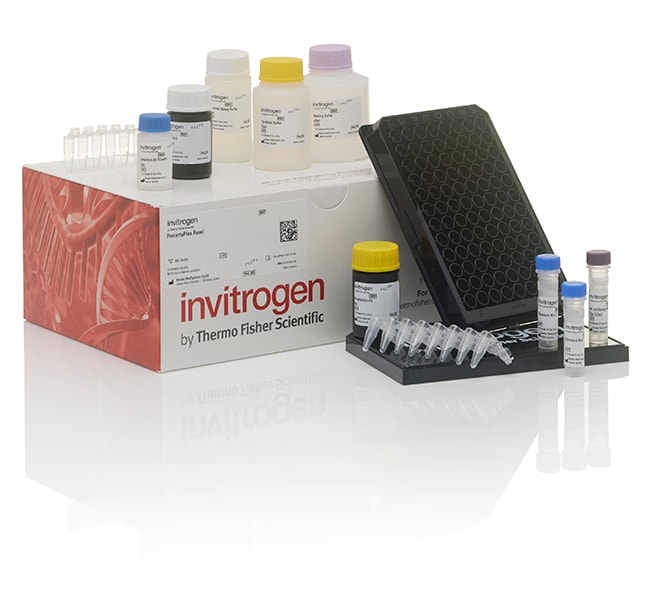
• 2 Fläschchen NHP-Standard-Mischung A (gefriergetrocknet)
• 1 Fläschchen Erfassungs-Bead-Mischung A (1x)
• 1 Fläschchen Erfassungs-Bead-Mischung B (1x)
• 1 Fläschchen Erfassungs-Bead-Mischung C (1x)
• 1 Fläschchen biotinylierte Detektionsantikörper-Mischung A (50x)
• 1 Fläschchen biotinylierte Detektionsantikörper-Mischung B (50x)
• 1 Fläschchen biotinylierte Detektionsantikörper-Mischung C (50x)
• 1 Flasche Lesepuffer (1x)
• 1 Flasche Waschpuffer (10x)
• 1 Flasche Streptavidin-PE (1x)
• 1 Flasche Universal-Assay-Puffer (1x)
• 1 Flasche Detektionsantikörper-Verdünnung (1x)
• Streifen mit 8 Röhrchen
• Klebefolie
• 96-Well-Mikrotiterplatte mit flachem Boden, schwarz
• 1 Fläschchen Erfassungs-Bead-Mischung A (1x)
• 1 Fläschchen Erfassungs-Bead-Mischung B (1x)
• 1 Fläschchen Erfassungs-Bead-Mischung C (1x)
• 1 Fläschchen biotinylierte Detektionsantikörper-Mischung A (50x)
• 1 Fläschchen biotinylierte Detektionsantikörper-Mischung B (50x)
• 1 Fläschchen biotinylierte Detektionsantikörper-Mischung C (50x)
• 1 Flasche Lesepuffer (1x)
• 1 Flasche Waschpuffer (10x)
• 1 Flasche Streptavidin-PE (1x)
• 1 Flasche Universal-Assay-Puffer (1x)
• 1 Flasche Detektionsantikörper-Verdünnung (1x)
• Streifen mit 8 Röhrchen
• Klebefolie
• 96-Well-Mikrotiterplatte mit flachem Boden, schwarz
Häufig gestellte Fragen (FAQ)
What is the size of the Luminex beads you currently use?
I am interested in performing Luminex assays using BioSource kits, and I have a Luminex xMAP system. Besides the kits and system, what other reagents and equipment will I need?
Do the Luminex beads require special care in handling?
Why would the Luminex acquisition software display "Sample Empty" messages during analysis?
What are the Luminex beads made of?
Zitierungen und Referenzen (2)
Zitierungen und Referenzen
Abstract
TLR-adjuvanted nanoparticle vaccines differentially influence the quality and longevity of responses to malaria antigen Pfs25.
Journal:JCI Insight
PubMed ID:29769448
Transmission-blocking vaccines (TBVs) are considered an integral element of malaria eradication efforts. Despite promising evaluations of Plasmodium falciparum Pfs25-based TBVs in mice, clinical trials have failed to induce robust and long-lived Ab titers, in part due to the poorly immunogenic nature of Pfs25. Using nonhuman primates, we demonstrate that multiple
SARS-CoV-2 infection of African green monkeys results in mild respiratory disease discernible by PET/CT imaging and shedding of infectious virus from both respiratory and gastrointestinal tracts.
Journal:PLoS Pathog
PubMed ID:32946524
Vaccines are urgently needed to combat the global coronavirus disease 2019 (COVID-19) pandemic, and testing of candidate vaccines in an appropriate non-human primate (NHP) model is a critical step in the process. Infection of African green monkeys (AGM) with a low passage human isolate of SARS-CoV-2 by aerosol or mucosal