Search


Zitierungen und Referenzen (22)
Invitrogen™
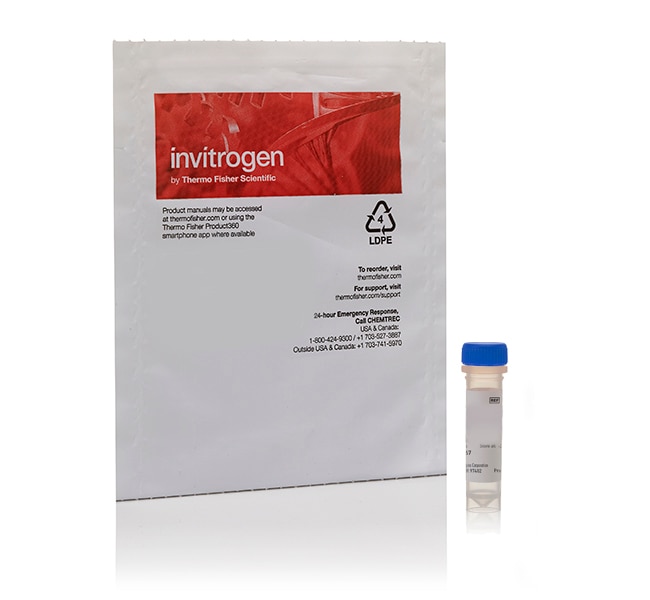
NeuroTrace™ 500/525 Green Fluorescent Nissl Stain - Solution in DMSO
Der grün fluoreszierende NeuroTrace Nissl Farbstoff, nur bei Molecular Probes erhältlich, bindet an die Nissl-Substanz, die ausschließlich in den SomataWeitere Informationen
| Katalognummer | Menge |
|---|---|
| N21480 | 1 ml |
Katalognummer N21480
Preis (EUR)
422,65
Online Exclusive
440,00Ersparnis 17,35 (4%)
Each
Menge:
1 ml
Preis (EUR)
422,65
Online Exclusive
440,00Ersparnis 17,35 (4%)
Each
Der grün fluoreszierende NeuroTrace Nissl Farbstoff, nur bei Molecular Probes erhältlich, bindet an die Nissl-Substanz, die ausschließlich in den Somata neuronaler Zellen vorhanden ist. Der grün fluoreszierende NeuroTrace Nissl Farbstoff zeigt eine helle, grüne Fluoreszenz, die durch für Fluorescein geeigneten Filtern sichtbar wird, und ist um ein Vielfaches empfindlicher als die Cresylviolett-Färbung. Der grün fluoreszierende NeuroTrace Nissl-Farbstoff ist eine Verbesserung gegenüber dem klassischen FluoroNissl Green Farbstoff.
Nur für Forschungszwecke. Nicht zur Verwendung bei diagnostischen Verfahren.
Specifications
FarbeGrün
NachweisverfahrenFluoreszenz
Zur Verwendung mit (Geräte)Fluoreszenzmikroskop
ProdukttypNissl-Färbung
Menge1 ml
VersandbedingungRaumtemperatur
Subzelluläre LokalisationNissl-Schollen
Excitation/Emission500/525 nm.
ProduktlinieNEUROTRACE
Unit SizeEach
Inhalt und Lagerung
Bei -5 bis -30 °C lagern und vor Licht schützen.
Häufig gestellte Fragen (FAQ)
I am labeling brain cryosections with a NeuroTrace Nissl Stain. Is this compatible with antibody labeling?
I can use the NeuroTrace Nissl stains for staining glia or other cell types. What can I do to improve the staining so that it is more selective for neurons?
Can the NeuroTrace Nissl stains be used on paraffin sections?
What are the NeuroTrace Nissl stains?
What products do you have for neuronal tracing?
Zitierungen und Referenzen (22)
Zitierungen und Referenzen
Abstract
Beyond the olfactory bulb: an odotopic map in the forebrain.
Journal:Proc Natl Acad Sci U S A
PubMed ID:16339016
'We report electrophysiological evidence that a simple odotopy, the spatial mapping of different odorants, is maintained above the level of the olfactory bulb (OB). Three classes of biologically relevant odorants for fish are processed in distinct regions of the forebrain (FB) in the channel catfish. Feeding cues, mainly amino acids
JNK-mediated induction of cyclooxygenase 2 is required for neurodegeneration in a mouse model of Parkinson's disease.
Journal:Proc Natl Acad Sci U S A
PubMed ID:14704277
'Parkinson''s disease (PD) is a neurodegenerative disorder characterized by loss of dopamine-containing neurons, but the molecular pathways underlying its pathogenesis remain uncertain. Here, we show that by eliminating c-Jun N-terminal kinases (JNKs) we can prevent neurodegeneration and improve motor function in an animal model of PD. First, we found that
Defects in pancreatic development and glucose metabolism in SMN-depleted mice independent of canonical spinal muscular atrophy neuromuscular pathology.
Journal:
PubMed ID:24497575
Spinal muscular atrophy (SMA) is characterized by motor neuron loss, caused by mutations or deletions in the ubiquitously expressed survival motor neuron 1 (SMN1) gene. We recently identified a novel role for Smn protein in glucose metabolism and pancreatic development in both an intermediate SMA mouse model (Smn(2B/-)) and type
Cortical control of adaptation and sensory relay mode in the thalamus.
Journal:
PubMed ID:24748112
A major synaptic input to the thalamus originates from neurons in cortical layer 6 (L6); however, the function of this cortico-thalamic pathway during sensory processing is not well understood. In the mouse whisker system, we found that optogenetic stimulation of L6 in vivo results in a mixture of hyperpolarization and
High-throughput morphometric analysis of individual neurons.
Journal:Cereb Cortex
PubMed ID:15054070
To facilitate high-throughput quantitative analysis of neuronal structure, this study optimized the diOlistic method of whole neuron labeling to examine multiple neurons in fixed brain, and optimized image acquisition parameters to preserve signal for subsequent photoconversion. Fluorescent dye-coated gold particles were successively delivered by helium-powered ejection to 250 microm thick