Search



Citations et références (43)
Gibco™
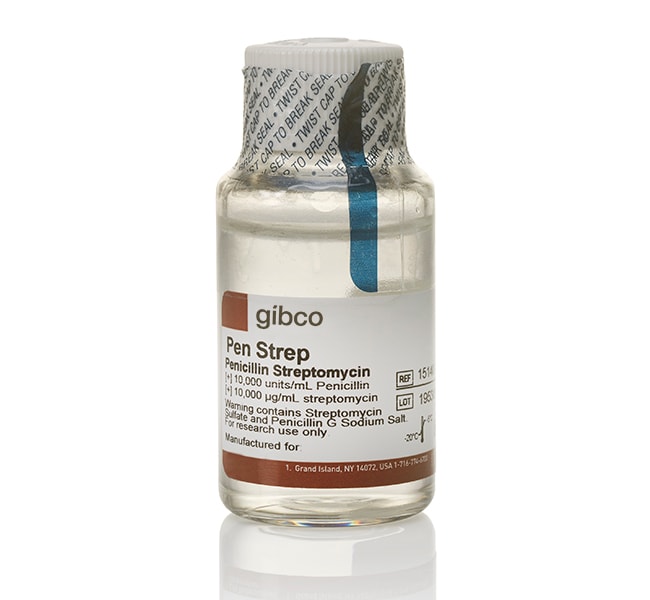
Pénicilline-streptomycine (10 000 U/ml)
Cette solution contient 10 000 unités/ml de pénicilline et 10 000 μg/mL de streptomycine. Les antibiotiques pénicilline et streptomycine sontAfficher plus
Have Questions?
Modifier l'affichage

| Référence | Quantité |
|---|---|
| 15140148 également connu sous le numéro 15140-148 | 20 mL |
| 15140122 également connu sous le numéro 15140-122 | 100 mL |
| 15140163 également connu sous le numéro 15140-163 | 20 x 100 mL |
Référence 15140148
également connu sous le numéro 15140-148
Prix (EUR)
16,65
Exklusiv online
20,24Économisez 3,59 (18%)
Each
Quantité:
20 mL
Prix (EUR)
16,65
Exklusiv online
20,24Économisez 3,59 (18%)
Each
Cette solution contient 10 000 unités/ml de pénicilline et 10 000 μg/mL de streptomycine. Les antibiotiques pénicilline et streptomycine sont utilisés pour éviter la contamination bactérienne des cultures cellulaires en raison de leur action combinée effective contre les bactéries à Gram positif et à Gram négatif. À l’origine, la pénicilline a été purifiée à partir de champignons Penicillium et agit en interférant directement avec l’activité des parois des cellules bactériennes et indirectement en déclenchant la libération d’enzymes qui continuent à modifier la paroi cellulaire. À l’origine, la streptomycine a été purifiée à partir de Streptomyces griseus. Elle agit en se liant à la sous-unité 30S du ribosome bactérien, ce qui conduit à l’inhibition de la synthèse protéique et à la mort des bactéries sensibles.
Nous proposons une large gamme d’antibiotiques et d’antimycosiques aussi bien sous forme liquide qu’en poudre. En savoir plus sur les types de produits suivants :
• Antibiotiques de culture cellulaire
• Sélection des antibiotiques (y compris les concentrations de travail recommandées)
En savoir plus sur l’utilisation des antibiotiques et des antimycosiques dans la culture cellulaire et revoir les recommandations relatives à la décontamination des cultures.
Nous proposons une large gamme d’antibiotiques et d’antimycosiques aussi bien sous forme liquide qu’en poudre. En savoir plus sur les types de produits suivants :
• Antibiotiques de culture cellulaire
• Sélection des antibiotiques (y compris les concentrations de travail recommandées)
En savoir plus sur l’utilisation des antibiotiques et des antimycosiques dans la culture cellulaire et revoir les recommandations relatives à la décontamination des cultures.
Usage exclusivement réservé à la recherche. Ne pas utiliser pour des procédures de diagnostic.
Spécifications
Concentration100 X
À utiliser avec (application)Prévention de la contamination par culture cellulaire
Quantité20 mL
Durée de conservation12 mois
Conditions d’expéditionGlace carbonique
FormeLiquide
Type de produitAntibiotique
StérilitéStérilisation par filtration
Sterilization MethodStérilisation par filtration
Unit SizeEach
Contenu et stockage
Conditions de stockage : -5 à -20°C
Conditions d’expédition : congelé
Durée de conservation : 12 mois à compter de la date de fabrication
Conditions d’expédition : congelé
Durée de conservation : 12 mois à compter de la date de fabrication
Foire aux questions (FAQ)
My Penicillin-Streptomycin solution is not colorless. Is this normal?
How can I decontaminate my cultures?
What antibiotics do you offer to help control or eliminate cell culture contamination?
Citations et références (43)
Citations et références
Abstract
Identification of a novel redox-sensitive gene, Id3, which mediates angiotensin II-induced cell growth.
Journal:Circulation
PubMed ID:12021231
BACKGROUND: Reactive oxygen species, such as superoxide (O(2)(-)), are involved in the abnormal growth of various cell types. Angiotensin II (Ang II) is one of the most potent inducers of oxidative stress in the vasculature. The molecular events involved in Ang II-induced proliferation of vascular smooth muscle cells (VSMCs) are
Functional interaction of caveolin-1 with Bruton's tyrosine kinase and Bmx.
Journal:J Biol Chem
PubMed ID:11751885
'Bruton''s tyrosine kinase (Btk), a member of the Tec family of protein-tyrosine kinases, has been shown to be crucial for B cell development, differentiation, and signaling. Mutations in the Btk gene lead to X-linked agammaglobulinemia in humans and X-linked immunodeficiency in mice. Using a co-transfection approach, we present evidence here
Repression of activator protein-1-mediated transcriptional activation by the Notch-1 intracellular domain.
Journal:J Biol Chem
PubMed ID:11739397
'Developmental decisions that control cell fate are commonly regulated by the Notch signaling pathway. Activation of transmembrane Notch receptors results in proteolytic liberation of the intracellular domain of Notch, which translocates into the nucleus, binds a repressor (C promoter binding factor 1/RBP-Jkappa, Su(H), and Lag-1 (CSL)), and induces target genes.
A differential role for the mitogen-activated protein kinases in lipopolysaccharide signaling: the MEK/ERK pathway is not essential for nitric oxide and interleukin 1beta production.
Journal:J Biol Chem
PubMed ID:11786532
'Endotoxin (lipopolysaccharide, LPS) is a component of the outer membrane of Gram-negative bacteria and promotes the activation of macrophages and microglia. Although these cells are highly LPS-responsive, they serve unique tissue-specific functions and exhibit different LPS sensitivities. Accordingly, it was of interest to evaluate whether these biological differences reside in
Cholesteryl ester is transported from caveolae to internal membranes as part of a caveolin-annexin II lipid-protein complex.
Journal:J Biol Chem
PubMed ID:11733519
'We previously demonstrated that in Chinese hamster ovary cells scavenger receptor, class B, type I-dependent selective cholesteryl ester uptake occurs in caveolae. In the present study we hypothesized that cholesteryl ester is transported from caveolae through the cytosol to an internal membrane by a caveolin chaperone complex similar to the