Search


Citations et références (16)
Gibco™
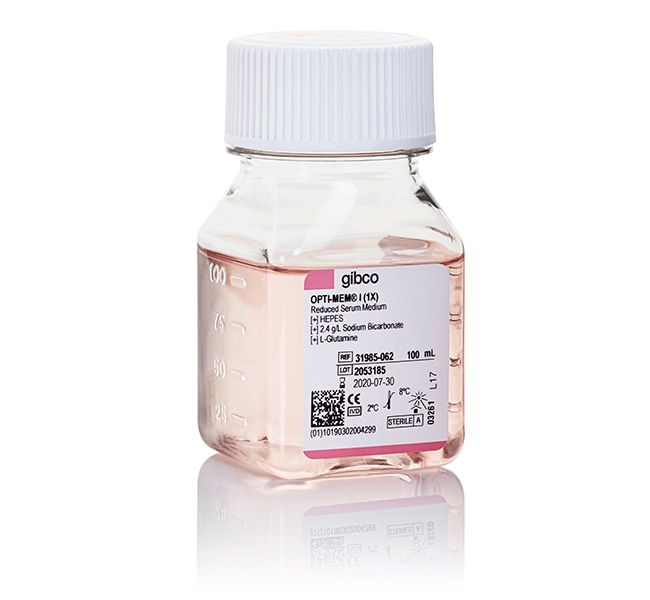
Milieu de culture à réduction de sérum Opti-MEM™ I
Le milieu à sérum réduit Opti-MEM™ I est un milieu essentiel minimal (MEM) amélioré qui permet une réduction de laAfficher plus
Have Questions?
Modifier l'affichage

| Référence | Quantité |
|---|---|
| 31985062 | 100 mL |
| 31985070 | 500 mL |
Référence 31985062
Prix (EUR)
15,85
Each
Quantité:
100 mL
Prix (EUR)
15,85
Each
Le milieu à sérum réduit Opti-MEM™ I est un milieu essentiel minimal (MEM) amélioré qui permet une réduction de la supplémentation en sérum de veau fœtal d’au moins 50 % sans modification du taux de croissance ni de la morphologie. Le milieu de culture Opti-MEM™ I est également recommandé avec l’utilisation des réactifs de transfection des lipides cationiques, tels que le réactif Lipofectamine™. Le milieu Opti-MEM™ I peut être utilisé avec une variété de cellules de mammifère en suspension et adhérentes, notamment les cellules Sp2, AE-1, CHO, BHK-21, HEK, et les fibroblastes primaires. Nous proposons une variété de modifications du milieu Opti-MEM™ I pour une gamme d’applications de culture cellulaire.
Ce milieu Opti-MEM™ I est modifié comme suit :
La formulation complète est confidentielle. Pour plus d’informations, veuillez contacter les services techniques.
Utilisation du milieu Opti-MEM™ I
Le milieu à sérum réduit Opti-MEM™ I est un milieu unique qui contient de l’insuline, de la transferrine, de l’hypoxanthine, de la thymidine et des éléments à l’état de traces. Ces composants complémentaires permettent une réduction de la supplémentation en sérum d’au moins 50 %. Le milieu Opti-MEM™ I utilise un système de tampon au bicarbonate de sodium (2,4 g / l) et, par conséquent, nécessite un environnement contenant 5 à 10 % de CO2 pour préserver le pH physiologique.
Système de qualité et fabrication conforme aux BPFa
Le milieu Opti-MEM™ I est fabriqué sur un site conforme aux BPFa situé à Grand Island, dans l’État de New York. Ce site est homologué par la FDA comme fabricant de dispositifs médicaux et il est certifié ISO 13485. Pour la continuité de la chaîne d’approvisionnement, nous proposons un produit identique au milieu Opti-MEM™ I fabriqué dans notre installation située en Écosse (31985-047). Cette installation est également homologuée par la FDA comme fabricant de dispositifs médicaux et elle est certifiée ISO 13485.
Ce milieu Opti-MEM™ I est modifié comme suit :
| Avec |
| • L-glutamine |
| • Rouge de phénol |
La formulation complète est confidentielle. Pour plus d’informations, veuillez contacter les services techniques.
Utilisation du milieu Opti-MEM™ I
Le milieu à sérum réduit Opti-MEM™ I est un milieu unique qui contient de l’insuline, de la transferrine, de l’hypoxanthine, de la thymidine et des éléments à l’état de traces. Ces composants complémentaires permettent une réduction de la supplémentation en sérum d’au moins 50 %. Le milieu Opti-MEM™ I utilise un système de tampon au bicarbonate de sodium (2,4 g / l) et, par conséquent, nécessite un environnement contenant 5 à 10 % de CO2 pour préserver le pH physiologique.
Système de qualité et fabrication conforme aux BPFa
Le milieu Opti-MEM™ I est fabriqué sur un site conforme aux BPFa situé à Grand Island, dans l’État de New York. Ce site est homologué par la FDA comme fabricant de dispositifs médicaux et il est certifié ISO 13485. Pour la continuité de la chaîne d’approvisionnement, nous proposons un produit identique au milieu Opti-MEM™ I fabriqué dans notre installation située en Écosse (31985-047). Cette installation est également homologuée par la FDA comme fabricant de dispositifs médicaux et elle est certifiée ISO 13485.
À des fins de recherche ou de commercialisation avancée Non destiné aux diagnostics ou à l’administration directe à des humains ou des animaux.
Spécifications
Lignée cellulaireSp2, AE-1, CHO, BHK-21 et HEK
Type de celluleFibroblastes primaires
Concentration1 X
Environnement culturelCO2
À utiliser avec (application)Mammalian Cell Culture, Lipid-Based Transfection
FormatBottle
Qualité de fabricationConforme aux BPFa en vertu de la norme ISO 13485
Gamme de produitsGibco, Opti-MEM
Type de produitOpti-MEM I
Quantité100 mL
Durée de conservation18 mois à compter de la date de fabrication
Conditions d’expéditionTempérature ambiante
ClassificationOrigine humaine
Culture TypeMammalian Cell Culture
FormeLiquide
Serum LevelReduced Serum
StérilitéStérilisation par filtration
Sterilization MethodSterile-filtered
Avec additifsGlutamine, Rouge de phénol
Sans additifNo FBS
Unit SizeEach
Contenu et stockage
Conditions de stockage : 2 à 8°C À l’abri de la lumière
Conditions d’expédition : température ambiante
Durée de conservation : 18 mois à compter de la date de fabrication
Conditions d’expédition : température ambiante
Durée de conservation : 18 mois à compter de la date de fabrication
Foire aux questions (FAQ)
What should I use to dilute my RNAi duplexes and Lipofectamine RNAiMAX before complexing?
Do you offer an alternative for Opti-MEM I Reduced Serum Medium (Cat. No. 31985070)?
My OpitMEM Reduced Serum Medium (Cat. No. 31985070) was accidentally frozen. Can I still use it?
Is there any other difference between Opti-MEM I Reduced Serum Medium and Opti-MEM I Reduced Serum Medium, no phenol red besides the presence/absence of phenol red?
Where can I find the osmolality for my lot of Opti-MEM I Reduced Serum Medium?
Citations et références (16)
Citations et références
Abstract
Regulation of cortical dendrite development by Slit-Robo interactions.
Journal:Neuron
PubMed ID:11779471
Slit proteins have previously been shown to regulate axon guidance, branching, and neural migration. Here we report that, in addition to acting as a chemorepellant for cortical axons, Slit1 regulates dendritic development. Slit1 is expressed in the developing cortex, and exposure to Slit1 leads to increased dendritic growth and branching.
Identification of a novel redox-sensitive gene, Id3, which mediates angiotensin II-induced cell growth.
Journal:Circulation
PubMed ID:12021231
BACKGROUND: Reactive oxygen species, such as superoxide (O(2)(-)), are involved in the abnormal growth of various cell types. Angiotensin II (Ang II) is one of the most potent inducers of oxidative stress in the vasculature. The molecular events involved in Ang II-induced proliferation of vascular smooth muscle cells (VSMCs) are
Vinexin beta Regulates the Anchorage Dependence of ERK2 Activation Stimulated by Epidermal Growth Factor.
Journal:J Biol Chem
PubMed ID:11825889
'ERK is activated by soluble growth factors in adherent cells. However, activation of ERK is barely detectable and not sufficient for cell proliferation in non-adherent cells. Here, we show that exogenous expression of vinexin beta, a novel focal adhesion protein, allows anchorage-independent ERK2 activation stimulated by epidermal growth factor. In
Hypoxia induces cyclooxygenase-2 via the NF-kappaB p65 transcription factor in human vascular endothelial cells.
Journal:J Biol Chem
PubMed ID:8995303
'The inducible cyclooxygenase, COX-2, has been associated with vascular inflammation and cellular proliferation. We have discovered that hypoxia increases expression of the COX-2 gene in human vascular endothelial cells in culture independent of other stimuli. Western analysis of human umbilical vein endothelial cells (HUVEC) revealed a greater than 4-fold induction
The proximal promoter of the human transglutaminase 3 gene. Stratified squamous epithelial-specific expression in cultured cells is mediated by binding of Sp1 and ets transcription factors to a proximal promoter element.
Journal:J Biol Chem
PubMed ID:8626812
'The transglutaminase 3 enzyme is expressed during the late stages of the terminal differentiation of the epidermis and in certain cell types of the hair follicle. The enzyme is thought to be critically involved in the cross-linking of structural proteins and in the formation of the cornified cell envelope, thereby