Search

Invitrogen™
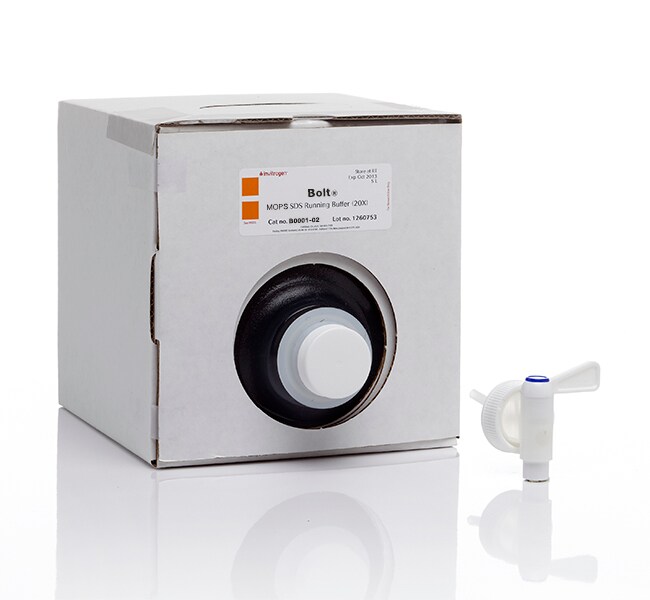
Tampon de migration MOPS SDS 20X Bolt™
Le tampon de migration Bolt MOPS SDS (20X) est formulé pour la migration de protéines sur des gels Bolt Bis-TrisAfficher plus
Have Questions?
Modifier l'affichage

| Référence | Quantité |
|---|---|
| B000102 | 5 l |
| B0001 | 500 ml |
Référence B000102
Prix (EUR)
406,00
Each
Quantité:
5 l
Prix (EUR)
406,00
Each
Le tampon de migration Bolt MOPS SDS (20X) est formulé pour la migration de protéines sur des gels Bolt Bis-Tris Plus. Il est recommandé de séparer les protéines moyennes à grandes.
Utilisez le bon tampon pour optimiser la séparation des protéines
Le tampon de migration Bolt MES SDS et le tampon de migration Bolt MOPS SDS peuvent tous les deux être utilisés avec les gels Bolt Bis-Tris Plus. Le MES possède un pKa inférieur à celui du MOPS, ce qui rend le tampon de migration MES SDS plus rapide que les tampons de migration MOPS SDS. La différence de migration ionique affecte l’empilage et entraîne une différence dans la plage de séparation des protéines entre ces tampons. L’utilisation du tampon MOPS permet aux protéines de fonctionner plus lentement qu’avec l’utilisation du tampon MES.
Comparer les profils de migration des protéines à l’aide de MES et de MOPs sur les gels Bolt Bis-Tris Plus
Voir tous les tampons et réactifs disponibles pour SDS-PAGE
Utilisez le bon tampon pour optimiser la séparation des protéines
Le tampon de migration Bolt MES SDS et le tampon de migration Bolt MOPS SDS peuvent tous les deux être utilisés avec les gels Bolt Bis-Tris Plus. Le MES possède un pKa inférieur à celui du MOPS, ce qui rend le tampon de migration MES SDS plus rapide que les tampons de migration MOPS SDS. La différence de migration ionique affecte l’empilage et entraîne une différence dans la plage de séparation des protéines entre ces tampons. L’utilisation du tampon MOPS permet aux protéines de fonctionner plus lentement qu’avec l’utilisation du tampon MES.
Comparer les profils de migration des protéines à l’aide de MES et de MOPs sur les gels Bolt Bis-Tris Plus
Voir tous les tampons et réactifs disponibles pour SDS-PAGE
Usage exclusivement réservé à la recherche. Ne pas utiliser pour des procédures de diagnostic.
Spécifications
Nom chimique ou matériauBis-Tris Plus
Température de stockageTampon de migration MOPS SDS (20X).
Conserver entre 4°C et 25°C.
La durée de conservation est de 6 mois sous réserve d’un stockage correct.
Conserver entre 4°C et 25°C.
La durée de conservation est de 6 mois sous réserve d’un stockage correct.
Concentration20X
À utiliser avec (équipement)Boulon
Forme physiqueLiquid
Gamme de produitsBolt
Quantité5 l
Unit SizeEach