Search


Citations et références (19)
Invitrogen™
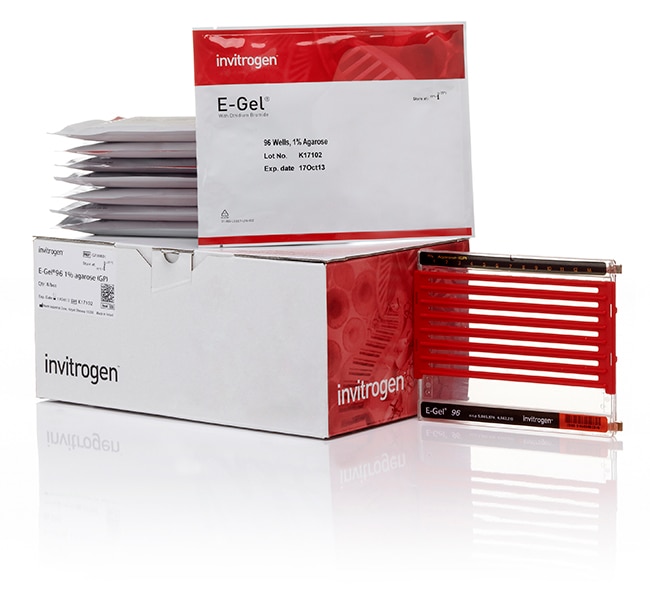
E-Gel™ 96 Agarose Gels
Les gels d’agarose prémoulés à débit élevé Invitrogen E-Gel 96 avec colorant de gel d’ADN SYBR Safe sont conçus pourAfficher plus
Have Questions?
Modifier l'affichage

| Référence | Quantité | Plage de séparation | dimStainType | Pourcentage de gel |
|---|---|---|---|---|
| G700801 | 8 gels | 400 à 10 000 bp | 1 % | |
| G720801 | 8 gels | 400 bp jusqu’à 10 kb | 1% | |
| G720841 | 4 x 8 gels | 400 bp jusqu’à 10 kb | 1% | |
| G700802 | 8 gels | 100 à 2 000 bp | 2% | |
| G720802 | 8 gels | 100 bp jusqu’à 2 kb | 2% | |
| G720842 | 4 x 8 gels | 100 bp jusqu’à 2 kb | 2% |
Référence G700801
Prix (EUR)
381,00
Each
Quantité:
8 gels
Plage de séparation:
400 à 10 000 bp
Pourcentage de gel:
1 %
Prix (EUR)
381,00
Each
Les gels d’agarose prémoulés à débit élevé Invitrogen E-Gel 96 avec colorant de gel d’ADN SYBR Safe sont conçus pour une électrophorèse rapide, pratique et sans danger des échantillons d’ADN. Chaque cassette de gel d’agarose E-Gel contient tous les composants et la coloration nécessaires à une séparation efficace du gel et à l’analyse — il suffit de charger vos échantillons et de lancer le cycle.
Chaque gel contient 96 voies d’échantillonnage et 8 voies de marquage, idéales pour la sélection de multiples produits PCR, préparations de plasmides et digestion par restriction. Le format de chargement E-Gel 96 est compatible avec les pipettes multicanaux et les robots de manipulation de liquides à 8, 12 et 96 embouts les plus couramment utilisés. Avec une durée d’exécution de 12 minutes, jusqu’à 20 000 échantillons peuvent être résolus en une seule journée.
Le format unique à 96 puits échelonné offre une longueur de cycle de 1,6 cm avec les plages de séparation suivantes pour les fragments d’ADN :
• Gels d’agarose à 1 % : Fragments d’ADN entre 400 bp et 10 kb
• Gels d’agarose à 2 % : Fragments d’ADN entre 100 bp et 2 kb
Chaque cassette est étiquetée individuellement avec un code-barres EAN39 unique par la plupart des lecteurs de codes-barres robotisés disponibles dans le commerce.
Caractéristiques des gels E-Gel 96 :
• Analyse à débit élevé—contient 96 voies d’échantillonnage et 8 voies de marquage
• Automatisation compatible—convient à une utilisation avec les pipettes multicanaux et les robots de manipulation de liquides couramment utilisés à 8, 12 et 96 embouts
• Évolution—résolution jusqu’à 384 échantillons en un seul cycle en combinant jusqu’à quatre unités E-Base mère et fille
• Choix plus sûr : contient un colorant d’ADN SYBR Safe, une alternative plus sûre au bromure d’éthidium
• Hautes performances—détecte 3 ng d’ADN d’échantillon avec un temps de séparation d’environ 12 à 17 minutes seulement
Option plus sûre
Choisissez les gels colorés d’ADN SYBR Safe pour minimiser l’exposition à des facteurs dangereux et mutagènes tels que le bromure d’éthidium ou les UV. Les gels d’agarose E-Gel prémoulés avec SYBR Safe, en combinaison avec une transilllumination à lumière bleue, offrent une meilleure intégrité de l’échantillon et un environnement de travail plus sûr.
Contrairement au bromure d’éthidium, la coloration d’ADN la plus couramment incorporée dans les gels d’agarose, la coloration de gel d’ADN SYBR Safe est une coloration d’ADN non toxique et non mutagène qui est plus sûre pour l’utilisateur et l’environnement et qui peut réduire les frais généraux institutionnels liés à l’élimination.
Analyse rapide et pratique
Les gels d’agarose E-Gel permettent une analyse rapide et de hautes performances avec une sensibilité de détection de 3 ng d’ADN d’échantillon par bande et une durée de séparation 2–3 fois plus rapide que celle des gels classiques que vous versez vous-mêmes. Chaque gel d’agarose E-Gel contient de l’agarose, des électrodes, un colorant d’ADN SYBR Safe et un système d’échange d’ions sans tampon conditionné dans une cassette sèche jetable. La technologie E-Gel n’exige aucune préparation de gel ou de tampon ni aucune étape de coloration de gel. Chargez simplement vos échantillons et lancez le cycle.
Marqueurs d’acides nucléiques
En savoir plus sur nos échelles d’ADN E-Gel ›
Dispositifs de fonctionnement et d’imagerie
Les gels d’agarose E-Gel à haut débit nécessitent le dispositif d’électrophorèse E-Base pour le fonctionnement sur gel.
En savoir plus sur l’appareil E-Base ›
Disponible dans une variété de formats de gel
Les gels d’agarose E-Gel sont disponibles dans divers formats de gel, de coloration et de puits. Les gels d’agarose E-Gel 96 et 48 à débit élevé avec SYBR Safe sont disponibles en pourcentage de gel de 1 % et 2 %. Guide de sélection des gels d’agarose E-Gel
Chaque gel contient 96 voies d’échantillonnage et 8 voies de marquage, idéales pour la sélection de multiples produits PCR, préparations de plasmides et digestion par restriction. Le format de chargement E-Gel 96 est compatible avec les pipettes multicanaux et les robots de manipulation de liquides à 8, 12 et 96 embouts les plus couramment utilisés. Avec une durée d’exécution de 12 minutes, jusqu’à 20 000 échantillons peuvent être résolus en une seule journée.
Le format unique à 96 puits échelonné offre une longueur de cycle de 1,6 cm avec les plages de séparation suivantes pour les fragments d’ADN :
• Gels d’agarose à 1 % : Fragments d’ADN entre 400 bp et 10 kb
• Gels d’agarose à 2 % : Fragments d’ADN entre 100 bp et 2 kb
Chaque cassette est étiquetée individuellement avec un code-barres EAN39 unique par la plupart des lecteurs de codes-barres robotisés disponibles dans le commerce.
Caractéristiques des gels E-Gel 96 :
• Analyse à débit élevé—contient 96 voies d’échantillonnage et 8 voies de marquage
• Automatisation compatible—convient à une utilisation avec les pipettes multicanaux et les robots de manipulation de liquides couramment utilisés à 8, 12 et 96 embouts
• Évolution—résolution jusqu’à 384 échantillons en un seul cycle en combinant jusqu’à quatre unités E-Base mère et fille
• Choix plus sûr : contient un colorant d’ADN SYBR Safe, une alternative plus sûre au bromure d’éthidium
• Hautes performances—détecte 3 ng d’ADN d’échantillon avec un temps de séparation d’environ 12 à 17 minutes seulement
Option plus sûre
Choisissez les gels colorés d’ADN SYBR Safe pour minimiser l’exposition à des facteurs dangereux et mutagènes tels que le bromure d’éthidium ou les UV. Les gels d’agarose E-Gel prémoulés avec SYBR Safe, en combinaison avec une transilllumination à lumière bleue, offrent une meilleure intégrité de l’échantillon et un environnement de travail plus sûr.
Contrairement au bromure d’éthidium, la coloration d’ADN la plus couramment incorporée dans les gels d’agarose, la coloration de gel d’ADN SYBR Safe est une coloration d’ADN non toxique et non mutagène qui est plus sûre pour l’utilisateur et l’environnement et qui peut réduire les frais généraux institutionnels liés à l’élimination.
Analyse rapide et pratique
Les gels d’agarose E-Gel permettent une analyse rapide et de hautes performances avec une sensibilité de détection de 3 ng d’ADN d’échantillon par bande et une durée de séparation 2–3 fois plus rapide que celle des gels classiques que vous versez vous-mêmes. Chaque gel d’agarose E-Gel contient de l’agarose, des électrodes, un colorant d’ADN SYBR Safe et un système d’échange d’ions sans tampon conditionné dans une cassette sèche jetable. La technologie E-Gel n’exige aucune préparation de gel ou de tampon ni aucune étape de coloration de gel. Chargez simplement vos échantillons et lancez le cycle.
Marqueurs d’acides nucléiques
En savoir plus sur nos échelles d’ADN E-Gel ›
Dispositifs de fonctionnement et d’imagerie
Les gels d’agarose E-Gel à haut débit nécessitent le dispositif d’électrophorèse E-Base pour le fonctionnement sur gel.
En savoir plus sur l’appareil E-Base ›
Disponible dans une variété de formats de gel
Les gels d’agarose E-Gel sont disponibles dans divers formats de gel, de coloration et de puits. Les gels d’agarose E-Gel 96 et 48 à débit élevé avec SYBR Safe sont disponibles en pourcentage de gel de 1 % et 2 %. Guide de sélection des gels d’agarose E-Gel
Usage exclusivement réservé à la recherche. Ne pas utiliser pour des procédures de diagnostic.
Spécifications
Quantité8 gels
Conditions d’expéditionTempérature ambiante
Pourcentage de gel1 %
Type de gelE-Gel
Marqueur ou colorantEthidium Bromide
Type de produitGel d’agarose
Plage de séparation400 à 10 000 bp
Puits96 puits
Unit SizeEach
Contenu et stockage
• Chaque boîte de gels E-Gel™ 96 contient 8 gels et un manuel
Conserver à température ambiante.
Conserver à température ambiante.
Foire aux questions (FAQ)
My E-Gel agarose gel has speckles when viewed in the imager. What should I do?
My sample is leaking from the wells when running my E-Gel agarose gels. What happened?
I accidentally stored my E-Gel agarose gels at 4 degrees C instead of room temperature. Can I still use them?
Are there robotic scripts for running E-Gel 48/96 or E-PAGE 48/96 gels?
What loading buffer should I use for my E-Gel agarose gels?
Citations et références (19)
Citations et références
Abstract
Excess variants in AFF2 detected by massively parallel sequencing of males with autism spectrum disorder.
Journal:Hum Mol Genet
PubMed ID:22773736
'Autism spectrum disorder (ASD) is a heterogeneous disorder with substantial heritability, most of which is unexplained. ASD has a population prevalence of one percent and affects four times as many males as females. Patients with fragile X E (FRAXE) intellectual disability, which is caused by a silencing of the X-linked
Identifying the last supper: utility of the DNA barcode library for bloodmeal identification in ticks.
Journal:Mol Ecol Resour
PubMed ID:22471892
'Ticks are among the most important vectors of disease in the Northern Hemisphere, and a better understanding of their feeding behaviour and life cycle is critical to the management and control of tick-borne zoonoses. DNA-based tools for the identification of residual bloodmeals in hematophagous arthropods have proven useful in the
Development and testing of a high-density cDNA microarray resource for cattle.
Journal:Physiol Genomics
PubMed ID:13130080
'A cDNA microarray resource has been developed with the goal of providing integrated functional genomics resources for cattle. The National Bovine Functional Genomics Consortium''s (NBFGC) expressed sequence tag (EST) collection was established in 2001 to develop resources for functional genomics research. The NBFGC EST collection and microarray contains 18,263 unique
Bovine mammary gene expression profiling using a cDNA microarray enhanced for mammary-specific transcripts.
Journal:Physiol Genomics
PubMed ID:14559974
'A cDNA microarray resource enhanced for transcripts specific to the bovine mammary gland (BMAM) has been developed and used in pilot studies to examine gene expression profiles in the mammary gland. One goal driving development of this resource was to shed some light on the pathways and mechanisms specifically related
Protocols for dry DNA storage and shipment at room temperature.
Journal:
PubMed ID:23789643
'The globalization of DNA barcoding will require core analytical facilities to develop cost-effective, efficient protocols for the shipment and archival storage of DNA extracts and PCR products. We evaluated three dry-state DNA stabilization systems: commercial Biomatrica(®) DNAstable(®) plates, home-made trehalose and polyvinyl alcohol (PVA) plates on 96-well panels of insect