Search


引用資料與參考文獻 (3)
Thermo Scientific™
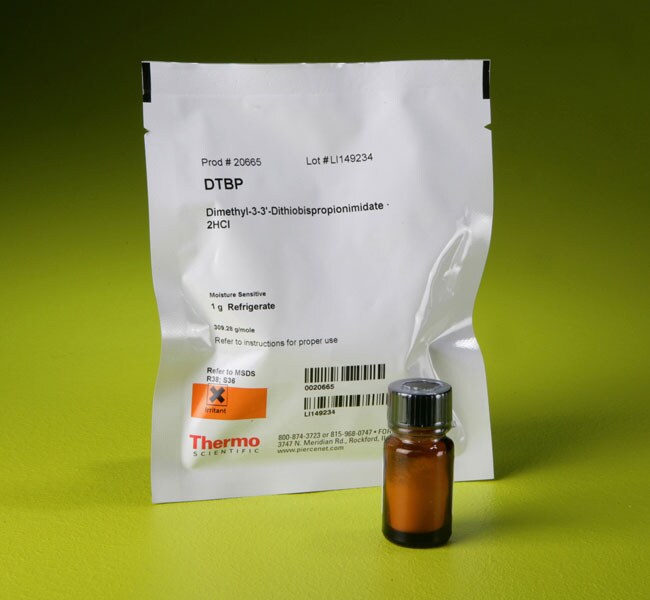
DTBP (Wang and Richard's Reagent)
Thermo Scientific Pierce DTBP is dimethyl 3,3'-dithiobispropionimidate, a crosslinker that contains amine-reactive imidoester groups around an 8-atom spacer arm, whose深入閱讀
| 產品號碼 | Quantity |
|---|---|
| 20665 | 1 g |
產品號碼 20665
價格 (HKD)
2,507.00
Each
Quantity:
1 g
價格 (HKD)
2,507.00
Each
Thermo Scientific Pierce DTBP is dimethyl 3,3'-dithiobispropionimidate, a crosslinker that contains amine-reactive imidoester groups around an 8-atom spacer arm, whose central disulfide bond can be cleaved with reducing agents.
Dimethyl dithiobispropionimidate (DTBP) is a homobifunctional, cleavable and membrane permeable crosslinker. It contains an amine-reactive imidoester at each end of an 8-atom spacer arm. Imidoesters react with primary amines at pH 8-10 to form stable amidine bonds. The amidine is protonated and therefore, like the lysine it modified, has a positive charge at physiological pH. Proteins, including antibodies, generally have several primary amines in the side chain of lysine (K) residues and the N-terminus of each polypeptide that are available as targets for imidoester crosslinking reagents.
Features of dimethyl 3,3'-dithiobispropionimidate:
• Reactive groups: imidoester (both ends)
• Reactive towards: amino groups (primary amines)
• Imidoester reacts rapidly with any primary amine-containing molecule to form amidine bonds
• Cleavable by reduction of spacer arm disulfide bond with DTT, TCEP or other reducing agents
• Compare to DMS (non-cleavable)
• Water-soluble
Applications:
• Reversibly crosslink and stabilize protein-protein interactions
• Stabilize protein interactions prior to ChIP assays to capture indirect protein interactions
DTBP crosslinks can be easily reversed by the addition of 100-150 mM DTT at 37°C for 30 minutes. DMS, the non-cleavable analog of DTBP is available for applications that require a stable, non-cleavable bond. DTSSP, the NHS-ester analog of DTBP is also available for applications that require crosslinking at physiologic pH or greater stability of the crosslinked product at elevated pH. DTBP and DMS have essentially identical crosslinking activity toward primary amines.
Properties of DTBP
• Alternate names: Cleavable DMS
• Molecular weight: 309.28
• Spacer arm length: 11.9 Å (8 atoms)
• CAS number: 38285-78-8
• Reactive groups: Imidoesters, react with primary amines at pH 8–10
DTBP Specifications
We manufacture DTBP to the highest specifications to produce the most specific bioconjugates, ensure the integrity of your data and to provide you with the highest degree of consistency. Each lot of DTBP cross-linker is tested to meet the following minimum specifications:
• Identity: IR scan shows only peaks characteristic of the structure and functional groups of DTBP
• Melting point: begins melting between 170-178°C, melts within a 2°C range
Product References:
Crosslinker Application Guide -- search for recent literature references for this product
Related Products
DMA (dimethyl adipimidate)
DMP (dimethyl pimelimidate)
DMS (dimethyl suberimidate)
Dimethyl dithiobispropionimidate (DTBP) is a homobifunctional, cleavable and membrane permeable crosslinker. It contains an amine-reactive imidoester at each end of an 8-atom spacer arm. Imidoesters react with primary amines at pH 8-10 to form stable amidine bonds. The amidine is protonated and therefore, like the lysine it modified, has a positive charge at physiological pH. Proteins, including antibodies, generally have several primary amines in the side chain of lysine (K) residues and the N-terminus of each polypeptide that are available as targets for imidoester crosslinking reagents.
Features of dimethyl 3,3'-dithiobispropionimidate:
• Reactive groups: imidoester (both ends)
• Reactive towards: amino groups (primary amines)
• Imidoester reacts rapidly with any primary amine-containing molecule to form amidine bonds
• Cleavable by reduction of spacer arm disulfide bond with DTT, TCEP or other reducing agents
• Compare to DMS (non-cleavable)
• Water-soluble
Applications:
• Reversibly crosslink and stabilize protein-protein interactions
• Stabilize protein interactions prior to ChIP assays to capture indirect protein interactions
DTBP crosslinks can be easily reversed by the addition of 100-150 mM DTT at 37°C for 30 minutes. DMS, the non-cleavable analog of DTBP is available for applications that require a stable, non-cleavable bond. DTSSP, the NHS-ester analog of DTBP is also available for applications that require crosslinking at physiologic pH or greater stability of the crosslinked product at elevated pH. DTBP and DMS have essentially identical crosslinking activity toward primary amines.
Properties of DTBP
• Alternate names: Cleavable DMS
• Molecular weight: 309.28
• Spacer arm length: 11.9 Å (8 atoms)
• CAS number: 38285-78-8
• Reactive groups: Imidoesters, react with primary amines at pH 8–10
DTBP Specifications
We manufacture DTBP to the highest specifications to produce the most specific bioconjugates, ensure the integrity of your data and to provide you with the highest degree of consistency. Each lot of DTBP cross-linker is tested to meet the following minimum specifications:
• Identity: IR scan shows only peaks characteristic of the structure and functional groups of DTBP
• Melting point: begins melting between 170-178°C, melts within a 2°C range
Product References:
Crosslinker Application Guide -- search for recent literature references for this product
Related Products
DMA (dimethyl adipimidate)
DMP (dimethyl pimelimidate)
DMS (dimethyl suberimidate)
For Research Use Only. Not for use in diagnostic procedures.
規格
Cell PermeabilityYes
DescriptionDTBP
FormPowder
Labeling MethodChemical Labeling
Molecular Weight (g/mol)309.28
PEGylatedNo
Product LinePierce
Quantity1 g
Reactive MoietyImidoester
Shipping ConditionAmbient
SolubilityWater
Spacer Arm Length11.9 Å
Water SolubleYes
Chemical ReactivityAmine-Amine
CleavableBy Thiols
Crosslinker TypeHomobifunctional
FormatStandard
Product TypeCrosslinker
SpacerMedium (10 to 30 Å)
Unit SizeEach
內容物與存放
Upon receipt store desiccated at 4°C.
常見問答集 (常見問題)
Can you provide the shelf-life for DTBP (Wang and Richard's Reagent)?
引用資料與參考文獻 (3)
引用資料與參考文獻
Abstract
Peroxisome proliferator-activated receptor ß/d cross talks with E2F and attenuates mitosis in HRAS-expressing cells.
Journal:Mol Cell Biol
PubMed ID:22473992
'The role of peroxisome proliferator-activated receptor ß/d (PPARß/d) in Harvey sarcoma ras (Hras)-expressing cells was examined. Ligand activation of PPARß/d caused a negative selection with respect to cells expressing higher levels of the Hras oncogene by inducing a mitotic block. Mitosis-related genes that are predominantly regulated by E2F were induced
Two novel WD40 domain-containing proteins, Ere1 and Ere2, function in the retromer-mediated endosomal recycling pathway.
Journal:Mol Biol Cell
PubMed ID:21880895
'Regulated secretion, nutrient uptake, and responses to extracellular signals depend on cell-surface proteins that are internalized and recycled back to the plasma membrane. However, the underlying mechanisms that govern membrane protein recycling to the cell surface are not fully known. Using a chemical-genetic screen in yeast, we show that the
IQGAP1 is necessary for pulmonary vascular barrier protection in murine acute lung injury and pneumonia.
Journal:Am J Physiol Lung Cell Mol Physiol
PubMed ID:22561460
We recently reported that integrin a(v)ß(3) is necessary for vascular barrier protection in mouse models of acute lung injury and peritonitis. Here, we used mass spectrometric sequencing of integrin complexes to isolate the novel ß(3)-integrin binding partner IQGAP1. Like integrin ß(3), IQGAP1 localized to the endothelial cell-cell junction after sphingosine-1-phosphate