Search
 Element Search
 Structure Search

Thermo Scientific Chemicals
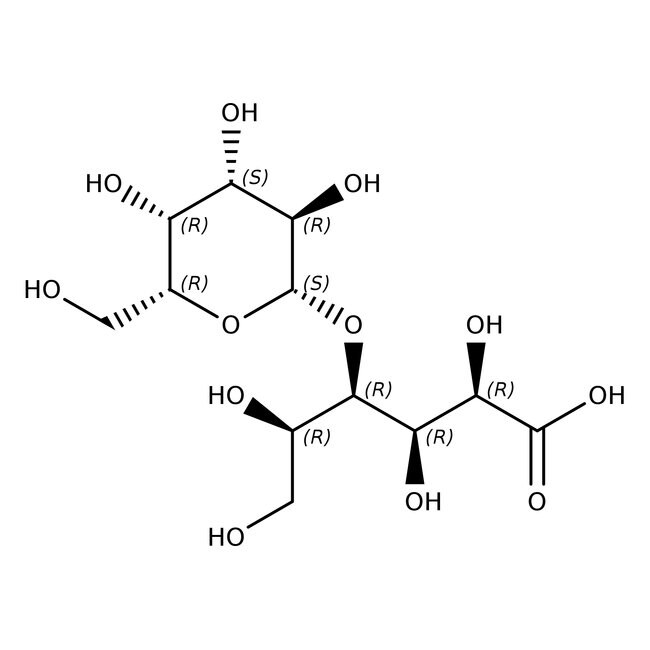
Lactobionic acid, 97%
Lactobionic acid, CAS # 96-82-2, is a product of lactose oxidation that can act as an antioxidant or drug delivery carrier. | CAS: 96-82-2 | C12H22O12 | 358.296 g/mol
Change view


Catalog number 167110250
Price (JPY)
-
Quantity:
25 g
Packaging:
Plastic bottle
Chemical Identifiers
CAS96-82-2
IUPAC Name(2R,3R,4R,5R)-2,3,5,6-tetrahydroxy-4-{[(2S,3R,4S,5R,6R)-3,4,5-trihydroxy-6-(hydroxymethyl)oxan-2-yl]oxy}hexanoic acid
Molecular FormulaC12H22O12
InChI KeyJYTUSYBCFIZPBE-AMTLMPIISA-N
SMILESOC[C@@H](O)[C@@H](O[C@@H]1O[C@H](CO)[C@H](O)[C@H](O)[C@H]1O)[C@H](O)[C@@H](O)C(O)=O
View more
Specifications Specification Sheet
Specification SheetAppearance (Color)White to off-white
Titration with NaOH>=96.0 %
Calcium (Ca)=<500 ppm
Iron (Fe)=<80 ppm
Chloride (Cl)=<400 ppm
View more
This Thermo Scientific Chemicals brand product was originally part of the Acros Organics product portfolio. Some documentation and label information may refer to the legacy brand. The original Acros Organics product / item code or SKU reference has not changed as a part of the brand transition to Thermo Scientific Chemicals.
General Description
- Lactobionic acid is an aldonic acid generated from lactose oxidation that has antioxidant, chelating, and moisture-retaining properties
- Lactobionic acid can chelate metal ions and reduce oxidative damage
- Can be used in the synthesis of nanomaterials and drug-delivery nanoparticles
- Has been shown to enhance solubility of macrolide antibiotics
Applications
- Laboratory studies have show that lactobionic acid application reduced atopic dermatitis in a mouse model of skin disease
- Lactobionic acid has been found to inhibit galectin-1 in rats
- Has been used in nanotechnology to improve the solubility of chitosan hydrogels or as a nanoparticle conjugate to promote targeting of anti-cancer therapies to tumors
RUO – Research Use Only
General References:
- Mukherjee, R.; Yun, J.W. Lactobionic acid reduces body weight gain in diet-induced obese rats by targeted inhibition of galectin-1. Biochem Biophys Res Commun. 2015, 463(4), 1311-6.
- Wang, J.; Zhang, Z.; Ai, Y.; Liu, F.; Chen, M.M.; Liu, D. Lactobionic acid-modified thymine-chitosan nanoparticles as potential carriers for methotrexate delivery. Carbohydr Res. 2021, 501, 108275.
- Hatano, Y.; Man, M.Q.; Uchida, Y.; Crumrine, D.; Scharschmidt, T.C.; Kim, E.G.; Mauro, T.M.; Feingold, K.R.; Elias, P.M.; Holleran, W.M. Maintenance of an acidic stratum corneum prevents emergence of murine atopic dermatitis. J Invest Dermatol. 2009, 129(7), 1824-35.
- Gutiérrez, L.F., Hamoudi, S.; Belkacemi, K. Lactobionic acid: A high value-added lactose derivative for food and pharmaceutical applications. International Dairy Journal. Volume 26, Issue 2. 2012. pp 103-111.