Search
 Element Search
 Structure Search


Thermo Scientific Chemicals
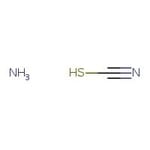
Ammonium thiocyanate, 98+%
CAS: 1762-95-4 | CH4N2S | 76.117 g/mol
Change view


Catalog number A10632.30
also known as A10632-30
Price (JPY)
-
Quantity:
250 g
Chemical Identifiers
CAS1762-95-4
IUPAC Nameammonium cyanosulfanide
Molecular FormulaCH4N2S
InChI KeySOIFLUNRINLCBN-UHFFFAOYSA-N
SMILES[NH4+].[S-]C#N
View more
Specifications Specification Sheet
Specification SheetAssay (Argentometric Titration)≥98.0 to ≤102.0%
Identification (FTIR)Conforms
Water Content (Karl Fischer Titration)≤1.25%
Melting Point (clear melt)144-152?C
Appearance (Color)White to pale cream
View more
Ammonium thiocyanate has many uses in manufacturing chemicals such as metal thiocyanates [CuSCN, Ca(SCN)2, NaSCN, KSCN] and in a number of pharmaceuticals. It is used in freezing solutions, pickling, printing, and as a corrosion inhibitor against acid gases. It is used in the photography industry as a stabilizer or an accelerator. It is also used in fertilizers, fabric dyeing, zinc coating, electroplating and as a separator of zirconium and hafnium as well as gold and iron. It is also used in analytical chemistry for titrimetric analysis and to determine the iron content by colorimetry in soft drinks.
This Thermo Scientific Chemicals brand product was originally part of the Alfa Aesar product portfolio. Some documentation and label information may refer to the legacy brand. The original Alfa Aesar product / item code or SKU reference has not changed as a part of the brand transition to Thermo Scientific Chemicals.
Applications
Ammonium thiocyanate has many uses in manufacturing chemicals such as metal thiocyanates [CuSCN, Ca(SCN)2, NaSCN, KSCN] and in a number of pharmaceuticals. It is used in freezing solutions, pickling, printing, and as a corrosion inhibitor against acid gases. It is used in the photography industry as a stabilizer or an accelerator. It is also used in fertilizers, fabric dyeing, zinc coating, electroplating and as a separator of zirconium and hafnium as well as gold and iron. It is also used in analytical chemistry for titrimetric analysis and to determine the iron content by colorimetry in soft drinks.
Solubility
Soluble in water, ethanol, methanol, ammonia and acetone. Insoluble in chloroform and ethyl acetate.
Notes
Light sensitive and hygroscopic. Incompatible with strong oxidizing agents, strong acids and lead nitrate.
Ammonium thiocyanate has many uses in manufacturing chemicals such as metal thiocyanates [CuSCN, Ca(SCN)2, NaSCN, KSCN] and in a number of pharmaceuticals. It is used in freezing solutions, pickling, printing, and as a corrosion inhibitor against acid gases. It is used in the photography industry as a stabilizer or an accelerator. It is also used in fertilizers, fabric dyeing, zinc coating, electroplating and as a separator of zirconium and hafnium as well as gold and iron. It is also used in analytical chemistry for titrimetric analysis and to determine the iron content by colorimetry in soft drinks.
Solubility
Soluble in water, ethanol, methanol, ammonia and acetone. Insoluble in chloroform and ethyl acetate.
Notes
Light sensitive and hygroscopic. Incompatible with strong oxidizing agents, strong acids and lead nitrate.
RUO – Research Use Only
General References:
- Thiocyanogen bromide can be generated in situ by reaction with bromine in acetic acid, e.g. in the thiocyanation of N,N-dimethylaniline to 4-N,N-dimethylaminophenylisothiocyanate: Org. Synth. Coll., 2, 574 (1943).
- Also useful for the conversion of arylamines to thioureas either indirectly via benzoyl isothiocyanate: Org. Synth. Coll., 3, 735 (1955), or directly, but in lower yield, by reaction of ammonium thiocyanate with the amine in the presence of HCl: Org. Synth. Coll., 4, 180 (1963).
- In combination with CAN in t-butanol, epoxides are converted to thiiranes in high yield: Synthesis, 821 (1996). The same conversion can also be effected in the presence of SbCl3 in acetonitrile: Indian J. Chem., 38B, 605 (1999). CAN also promotes the direct conversion of activated aryl systems, e.g. indoles, pyrroles and N,N-dialkylanilines to aryl thiocyanates: Tetrahedron Lett., 40, 1195 (1999).
- Yang, X.; Fu, Y.; Zhang, X.; Dong, H.; Wang, Y.; Yue, G.; Liu, J. Chiral supramolecular nanoparticles: Liquid-Liquid Equilibria of Benzene + Cyclohexane + N,N-Dimethyl Acetamide + Ammonium Thiocyanate at 298.15 K and Atmospheric Pressure. J. Chem. Eng. Data 2015, 60 (4), 971-975.
- Ichiba, M.; Sakai, J.; Doshida, T.; Takai, K. Corrosion reaction and hydrogen absorption of steel for prestressed concrete in a 20 mass% ammonium thiocyanate solution. Scripta Materialia 2015, 102, 59-62.