Search
 Element Search
 Structure Search

Thermo Scientific Chemicals
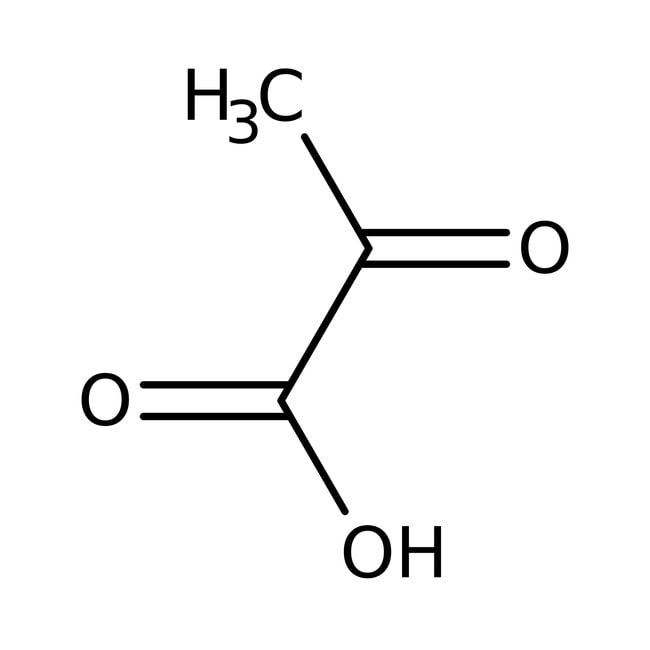
Pyruvic acid, 98%
CAS: 127-17-3 | C3H4O3 | 88.06 g/mol
Change view


Catalog number A13875.0E
also known as A13875-0E
Price (JPY)
-
Quantity:
2500 g
Chemical Identifiers
CAS127-17-3
IUPAC Name2-oxopropanoic acid
Molecular FormulaC3H4O3
InChI KeyLCTONWCANYUPML-UHFFFAOYSA-N
SMILESCC(=O)C(O)=O
View more
Specifications Specification Sheet
Specification SheetAppearance (Color)Clear colorless to yellow to orange
FormLiquid
Assay (Aqueous acid-base Titration)≥97.5 to ≤102.5% (non-U.S. specification)
Assay≥97.5% (U.S. specification)
CommentSpecification differs for U.S. and non-U.S. material where indicated
View more
Pyruvic acid is used as a component in culture broths and media as commercial red seaweed polysaccharide. It is involved in the construction of amino acid alanine as well as supplies energy to living cells via citric acid cycle (Krebs cycle). It reacts with N-acetyl mannosamine by an aldol-type condensation to prepare sialic acid. It is employed to study the cultivation of soil bacteria as micro colonies using soil substrate membrane system. It finds application in liquid chromatography and in the determination of organic acids in red wine.
This Thermo Scientific Chemicals brand product was originally part of the Alfa Aesar product portfolio. Some documentation and label information may refer to the legacy brand. The original Alfa Aesar product / item code or SKU reference has not changed as a part of the brand transition to Thermo Scientific Chemicals.
Applications
Pyruvic acid is used as a component in culture broths and media as commercial red seaweed polysaccharide. It is involved in the construction of amino acid alanine as well as supplies energy to living cells via citric acid cycle (Krebs cycle). It reacts with N-acetyl mannosamine by an aldol-type condensation to prepare sialic acid. It is employed to study the cultivation of soil bacteria as micro colonies using soil substrate membrane system. It finds application in liquid chromatography and in the determination of organic acids in red wine.
Solubility
Miscible with chloroform and methanol.
Notes
Store in cool place. Incompatible with strong oxidizing agents, strong bases and reducing agents.
Pyruvic acid is used as a component in culture broths and media as commercial red seaweed polysaccharide. It is involved in the construction of amino acid alanine as well as supplies energy to living cells via citric acid cycle (Krebs cycle). It reacts with N-acetyl mannosamine by an aldol-type condensation to prepare sialic acid. It is employed to study the cultivation of soil bacteria as micro colonies using soil substrate membrane system. It finds application in liquid chromatography and in the determination of organic acids in red wine.
Solubility
Miscible with chloroform and methanol.
Notes
Store in cool place. Incompatible with strong oxidizing agents, strong bases and reducing agents.
RUO – Research Use Only
General References:
- Canbay, E.; Habip, A.; Kara, G.; Eren, Z.; Akyilmaz, E. A microbial biosensor based on Lactobacillus delbruecki sp. bacterial cells for simultaneous determination of lactic and pyruvic acid. Food Chem. 2015, 169, 197-202.
- Barone, V.; Biczysko, M.; Bloino, J.; Cimino, P.; Penocchio, E.; Puzzarini, C. CC/DFT Route toward Accurate Structures and Spectroscopic Features for Observed and Elusive Conformers of Flexible Molecules: Pyruvic Acid as a Case Study. J. Chem. Theory Comput. 2015, 11 (9), 4342-4363.