Search
 Element Search
 Structure Search


Thermo Scientific Chemicals
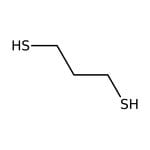
1,3-Propanedithiol, 97%
CAS: 109-80-8 | C3H8S2 | 108.217 g/mol
Change view

Catalog number A15261.06
also known as A15261-06
Price (JPY)Request A Quote
-
Quantity:
5 g
Chemical Identifiers
CAS109-80-8
IUPAC Namepropane-1,3-dithiol
Molecular FormulaC3H8S2
InChI KeyZJLMKPKYJBQJNH-UHFFFAOYSA-N
SMILESSCCCS
View more
Specifications Specification Sheet
Specification SheetFormLiquid
Appearance (Color)Clear, colorless to pale yellow
Assay (GC)>96.0%
Refractive Index1.5375-1.5425 @ 20?C
1,3-Propanedithiol is used as a reagent in the preparation of thioketals and thioacetals. It acts as a flavoring agent. It is used as a precursor in the synthesis of cyclic dithioacetal (1,3-dithiane) derivatives of carbonyl compounds. It is involved in the preparation of diiron propanedithiolate hexacarbonyl by reacting reaction with triiron dodecacarbonyl. Further, it is used for the protection of aldehydes and ketones through their reversible formation of dithianes. In addition to this, it reacts with metal ions to form chelate rings.
This Thermo Scientific Chemicals brand product was originally part of the Alfa Aesar product portfolio. Some documentation and label information may refer to the legacy brand. The original Alfa Aesar product / item code or SKU reference has not changed as a part of the brand transition to Thermo Scientific Chemicals.
Applications
1,3-Propanedithiol is used as a reagent in the preparation of thioketals and thioacetals. It acts as a flavoring agent. It is used as a precursor in the synthesis of cyclic dithioacetal (1,3-dithiane) derivatives of carbonyl compounds. It is involved in the preparation of diiron propanedithiolate hexacarbonyl by reacting reaction with triiron dodecacarbonyl. Further, it is used for the protection of aldehydes and ketones through their reversible formation of dithianes. In addition to this, it reacts with metal ions to form chelate rings.
Solubility
Slightly soluble in water. Miscible with alcohol, ether, chloroform, etherMiscible with alcohol, ether, chloroform and ether. Slightly miscible with water.
Notes
Store in a cool place. Incompatible with bases, oxidizing agents, reducing agents and alkali metals.
1,3-Propanedithiol is used as a reagent in the preparation of thioketals and thioacetals. It acts as a flavoring agent. It is used as a precursor in the synthesis of cyclic dithioacetal (1,3-dithiane) derivatives of carbonyl compounds. It is involved in the preparation of diiron propanedithiolate hexacarbonyl by reacting reaction with triiron dodecacarbonyl. Further, it is used for the protection of aldehydes and ketones through their reversible formation of dithianes. In addition to this, it reacts with metal ions to form chelate rings.
Solubility
Slightly soluble in water. Miscible with alcohol, ether, chloroform, etherMiscible with alcohol, ether, chloroform and ether. Slightly miscible with water.
Notes
Store in a cool place. Incompatible with bases, oxidizing agents, reducing agents and alkali metals.
RUO – Research Use Only
General References:
- Precursor of cyclic dithioacetal (1,3-dithiane) derivatives of carbonyl compounds. The protection step is catalyzed by Lewis acids, e.g. BF3 etherate: Tetrahedron Lett., 871 (1971), TiCl4: Tetrahedron Lett., 24, 1289 (1983), Aluminum trifluoromethanesulfonate, B20785, or Indium(III) trifluoromethanesulfonate, 40131. Diothioacetalization can be accomplished under neutral, solvent-free conditions using Lithium trifluoromethanesulfonate, 39322, as catalyst: Tetrahedron Lett., 40, 4055 (1999). For the preparation of monocyclic dithioacetals of ß-diketones at low temperature in the presence of BF3 etherate, see: Tetrahedron, 44, 2283 (1988).
- Alternatively, 1,3-dithianes can be prepared by alkylation with reactive gem-dihalides under phase-transfer conditions: Liebigs Ann. Chem., 1589 (1982).
- For deprotection methods and uses of 1,3-dithianes as acyl anion equivalents, see: 1,3-Dithiane, A10505.
- Wang, L.; Li, R.; Feng, L.; Liu, J.; Gao, X.; Wang, W. Study on the interface electronic states of chemically modified ZnO nanowires. RSC Adv. 2015, 5 (119), 98130-98135.
- Kuciński, K.; Pawluć, P.; Marciniec, B.; Hreczycho, G. Highly Selective Hydrothiolation of Unsaturated Organosilicon Compounds Catalyzed by Scandium(III) Triflate. Chem. Eur. J. 2015, 21 (13), 4940-4943.