Search
 Element Search
 Structure Search


Thermo Scientific Chemicals
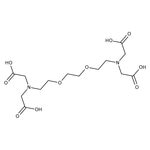
Ethylene glycol-O,O'-bis(2-aminoethyl)-N,N,N',N'-tetraacetic acid, 97%
CAS: 67-42-5 | C14H24N2O10 | 380.35 g/mol
Change view


Catalog number A16086.09
also known as A16086-09
Price (JPY)
-
Quantity:
10 g
Specifications
Beilstein1717370
CAS67-42-5
ChEBICHEBI:30740
Chemical Name or MaterialEthylene glycol-O,O'-bis(2-aminoethyl)-N,N,N',N'-tetraacetic acid
EINECS Number200-651-2
View more
Ethylene glycol-O,O'-bis(2-aminoethyl)-N,N,N',N'-tetraacetic acid is a chelating agent used for making complexes, especially for calcium ions, which help to determine calcium in the presence of magnesium. It can be used experimentally for treating animals possessing cerium poisoning. It is useful in the separation of thorium from monazite. It also acts as a buffer and is used in protein purification.
This Thermo Scientific Chemicals brand product was originally part of the Alfa Aesar product portfolio. Some documentation and label information may refer to the legacy brand. The original Alfa Aesar product / item code or SKU reference has not changed as a part of the brand transition to Thermo Scientific Chemicals.
Applications
Ethylene glycol-O,O′-bis(2-aminoethyl)-N,N,N′,N′-tetraacetic acid is a chelating agent used for making complexes, especially for calcium ions, which help to determine calcium in the presence of magnesium. It can be used experimentally for treating animals possessing cerium poisoning. It is useful in the separation of thorium from monazite. It also acts as a buffer and is used in protein purification.
Solubility
Soluble in 0.1M sodium hydroxide solution. Slightly soluble in water.
Notes
Incompatible with strong oxidizing agents, alkali, alkali earth metal and many reactive organic and inorganic chemicals.
Ethylene glycol-O,O′-bis(2-aminoethyl)-N,N,N′,N′-tetraacetic acid is a chelating agent used for making complexes, especially for calcium ions, which help to determine calcium in the presence of magnesium. It can be used experimentally for treating animals possessing cerium poisoning. It is useful in the separation of thorium from monazite. It also acts as a buffer and is used in protein purification.
Solubility
Soluble in 0.1M sodium hydroxide solution. Slightly soluble in water.
Notes
Incompatible with strong oxidizing agents, alkali, alkali earth metal and many reactive organic and inorganic chemicals.
RUO – Research Use Only
General References:
- Reagent for complexometry.
- Zhang, J.; Pan, X.; Li, N., Li, X.; Wang, Y.; Liu, X.; Yu, Z. Grape seed extract attenuates arsenic‑induced nephrotoxicity in rats. Exp Ther Med 2014, 7 (1), 260-266.
- Nishida, S.; Satoh, H. Role of gap junction involved with endothelium-derived hyperpolarizing factor for the quercetin-induced vasodilatation in rat mesenteric artery. Life Sci. 2013, 92 (13), 752-756.