Search
 Element Search
 Structure Search
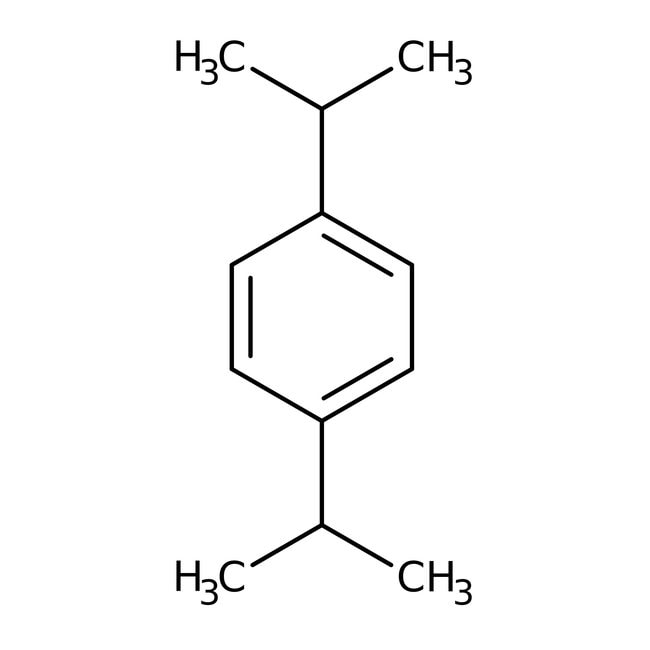

Thermo Scientific Chemicals
1,4-Diisopropylbenzene, 98%
CAS: 100-18-5 | C12H18 | 162.28 g/mol
Change view


Catalog number B22871.22
also known as B22871-22
Price (JPY)Request A Quote
-
Quantity:
100 g
Chemical Identifiers
CAS100-18-5
IUPAC Name1,4-bis(propan-2-yl)benzene
Molecular FormulaC12H18
InChI KeySPPWGCYEYAMHDT-UHFFFAOYSA-N
SMILESCC(C)C1=CC=C(C=C1)C(C)C
View more
Specifications Specification Sheet
Specification SheetAssay (GC)≥98.5%
Appearance (Color)Clear colorless
Refractive Index1.4875-1.4920 @ 20?C
FormLiquid
1,4-Diisopropylbenzene is used as an intermediate for the synthesis of stabilizers, polymers, synthetic lubricants and hydroperoxides. It is also used in the trivalent actinide-lanthanide separation by phosphorus reagent extraction from aqueous komplexes (TALSPEAK) process for separating trivalent lanthanides from trivalent actinide cations. It finds application in nuclear fuel reprocessing.
This Thermo Scientific Chemicals brand product was originally part of the Alfa Aesar product portfolio. Some documentation and label information may refer to the legacy brand. The original Alfa Aesar product / item code or SKU reference has not changed as a part of the brand transition to Thermo Scientific Chemicals.
Applications
1,4-Diisopropylbenzene is used as an intermediate for the synthesis of stabilizers, polymers, synthetic lubricants and hydroperoxides. It is also used in the trivalent actinide-lanthanide separation by phosphorus reagent extraction from aqueous komplexes (TALSPEAK) process for separating trivalent lanthanides from trivalent actinide cations. It finds application in nuclear fuel reprocessing.
Solubility
Soluble in alcohol, ether, acetone and benzene. Insoluble in water.
Notes
Incompatible with oxidizing agents and strong oxidizing agents.
1,4-Diisopropylbenzene is used as an intermediate for the synthesis of stabilizers, polymers, synthetic lubricants and hydroperoxides. It is also used in the trivalent actinide-lanthanide separation by phosphorus reagent extraction from aqueous komplexes (TALSPEAK) process for separating trivalent lanthanides from trivalent actinide cations. It finds application in nuclear fuel reprocessing.
Solubility
Soluble in alcohol, ether, acetone and benzene. Insoluble in water.
Notes
Incompatible with oxidizing agents and strong oxidizing agents.
RUO – Research Use Only
General References:
- Yi, J.; Kruk, M. Pluronic-P123-Templated Synthesis of Silica with CubicIa3d Structure in the Presence of Micelle Swelling Agent. Langmuir 2015, 31 (27), 7623-7632.
- Venkatesh, P. T.; Vidhya, B.; Vishnubharath, A.; Tejaashwine, M.; Eganathan, P.; Saranya, J.; Sujanapal, P. Essential Oil Composition of Leaves and Stem Bark of Cullenia exarillata Robyns (Bombacaceae). J. Essent. Oil Bear. Pl. 2015, 18 (1), 199-207.