Search
 Element Search
 Structure Search


Thermo Scientific Chemicals
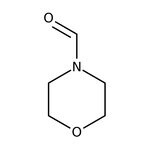
4-Formylmorpholine, 99%
CAS: 4394-85-8 | C5H9NO2 | 115.132 g/mol
Change view


Catalog number B23315.0E
also known as B23315-0E
Price (JPY)
-
Quantity:
2500 g
Chemical Identifiers
CAS4394-85-8
IUPAC Namemorpholine-4-carbaldehyde
Molecular FormulaC5H9NO2
InChI KeyLCEDQNDDFOCWGG-UHFFFAOYSA-N
SMILESO=CN1CCOCC1
View more
Specifications Specification Sheet
Specification SheetAppearance (Color)Clear colorless
Refractive Index1.4850-1.4880 @ 20?C
FormLiquid
Identification (FTIR)Conforms
Assay (GC)≥98.5%
4-Formylmorpholine is widely used as a solvent and extracting agent for aromatics. It is used as a scrubbing agent for acidic gases. It is employed in the preparation of adenine hydrochloride labeled with 14C, 4-(trifluoromethyl)morpholine, 3-alkyl-2-chloro-5,6-dihydrobenzaldehyde and terphenyl dialdehyde. It plays an important role in the desulfurization of natural gas, synthetic gas, flue gas and gasoline.
This Thermo Scientific Chemicals brand product was originally part of the Alfa Aesar product portfolio. Some documentation and label information may refer to the legacy brand. The original Alfa Aesar product / item code or SKU reference has not changed as a part of the brand transition to Thermo Scientific Chemicals.
Applications
4-Formylmorpholine is widely used as a solvent and extracting agent for aromatics. It is used as a scrubbing agent for acidic gases. It is employed in the preparation of adenine hydrochloride labeled with 14C, 4-(trifluoromethyl)morpholine, 3-alkyl-2-chloro-5,6-dihydrobenzaldehyde and terphenyl dialdehyde. It plays an important role in the desulfurization of natural gas, synthetic gas, flue gas and gasoline.
Solubility
Miscible with water.
Notes
Store in a cool place. Keep the container tightly closed in a dry and well-ventilated place. Incompatible with strong oxidizing agents.
4-Formylmorpholine is widely used as a solvent and extracting agent for aromatics. It is used as a scrubbing agent for acidic gases. It is employed in the preparation of adenine hydrochloride labeled with 14C, 4-(trifluoromethyl)morpholine, 3-alkyl-2-chloro-5,6-dihydrobenzaldehyde and terphenyl dialdehyde. It plays an important role in the desulfurization of natural gas, synthetic gas, flue gas and gasoline.
Solubility
Miscible with water.
Notes
Store in a cool place. Keep the container tightly closed in a dry and well-ventilated place. Incompatible with strong oxidizing agents.
RUO – Research Use Only
General References:
- Li, D.; Wang, M.; Liu, J.; Zhao, Q.; Wang, L. Cu(II)-catalyzed decarboxylative acylation of acyl C-H of formamides with α-oxocarboxylic acids leading to α-ketoamides. Chem. Commun. 2013, 49 (35), 3640-3642.
- Mundhwa, M.; Elmahmudi, S.; Maham, Y.; Henni, A. Molar Heat Capacity of Aqueous Sulfolane, 4-Formylmorpholine, 1-Methyl-2-pyrrolidinone, and Triethylene Glycol Dimethyl Ether Solutions from (303.15 to 353.15) K. J. Chem. Eng. Data 2009, 54 (10), 2895-2901.