Search
 Element Search
 Structure Search


Thermo Scientific Chemicals
Dichloroisocyanuric acid sodium salt, 97% (dry wt.)
CAS: 2893-78-9 | C3HCl2N3NaO3 | 220.949 g/mol
Change view


Catalog number B23504.22
also known as B23504-22
Price (JPY)Request A Quote
-
Quantity:
100 g
Chemical Identifiers
CAS2893-78-9
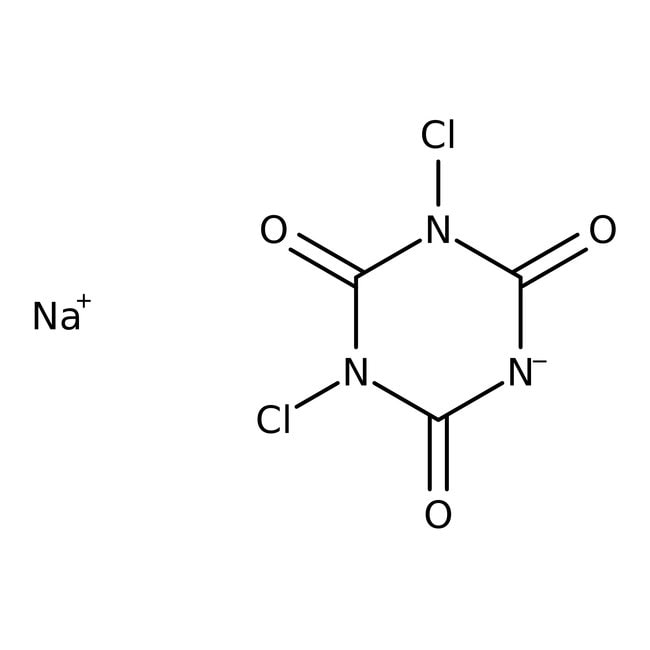
IUPAC Namesodium 3,5-dichloro-2,4,6-trioxo-1,3,5-triazinan-1-ide
Molecular FormulaC3Cl2N3NaO3
InChI KeyMSFGZHUJTJBYFA-UHFFFAOYSA-M
SMILES[Na+].ClN1C(=O)[N-]C(=O)N(Cl)C1=O
View more
Specifications Specification Sheet
Specification SheetAssay (Non-aqueous acid-base Titration)≥96.0 to ≤104.0% (on dried substance)
Appearance (Color)White
FormGranules or granular powder or crystals
Identification (FTIR)Conforms
Loss on Drying≤5.0%
This Thermo Scientific Chemicals brand product was originally part of the Alfa Aesar product portfolio. Some documentation and label information may refer to the legacy brand. The original Alfa Aesar product / item code or SKU reference has not changed as a part of the brand transition to Thermo Scientific Chemicals.
Suitable for battery materials development.
Applications
Sodium dichloroisocyanurate can be used as a reagent for N-monochlorination and dehydrochlorination of amino esters, synthesis of antimicrobial polyurethane additives to control biofilm. It is used as a emergency disinfectant in drinking water, widely used cleansing agent. It is also a reagent for chlorination to detect ammonium via formation of colored zebra-bands in a detecting tube.
Solubility
Soluble in water.
Notes
Store in a cool, dry conditions, in well sealed conditions. Store away from oxidizing agents.
Sodium dichloroisocyanurate can be used as a reagent for N-monochlorination and dehydrochlorination of amino esters, synthesis of antimicrobial polyurethane additives to control biofilm. It is used as a emergency disinfectant in drinking water, widely used cleansing agent. It is also a reagent for chlorination to detect ammonium via formation of colored zebra-bands in a detecting tube.
Solubility
Soluble in water.
Notes
Store in a cool, dry conditions, in well sealed conditions. Store away from oxidizing agents.
RUO – Research Use Only
General References:
- Tatsuaki Hori; Keizou Niki; Yoshiaki Kiso; Tatsuo Oguchi; Yuki Kamimoto; Toshiro Yamada; Masahiro Nagai; Tatsuaki Hori; Keizou Niki; Yoshiaki Kiso; Tatsuo Oguchi; Yuki Kamimoto; Toshiro Yamada; Masahiro Nagai. Ammonium detection by formation of colored zebra-bands in a detecting tube. Talanta. 2010, 81, (4-5), 1467-1471.
- S Devin McLennan; Lauren A Peterson; Joan B Rose. Comparison of point-of-use technologies for emergency disinfection of sewage-contaminated drinking water. Applied and Environmental Microbiology. 2009, 75 (22), 7283-7286.
- Reagent for N-chlorination of primary and secondary amines, particularly useful for chlorination of hindered amines: Synth. Commun., 18, 2135 (1988).