Search
 Element Search
 Structure Search
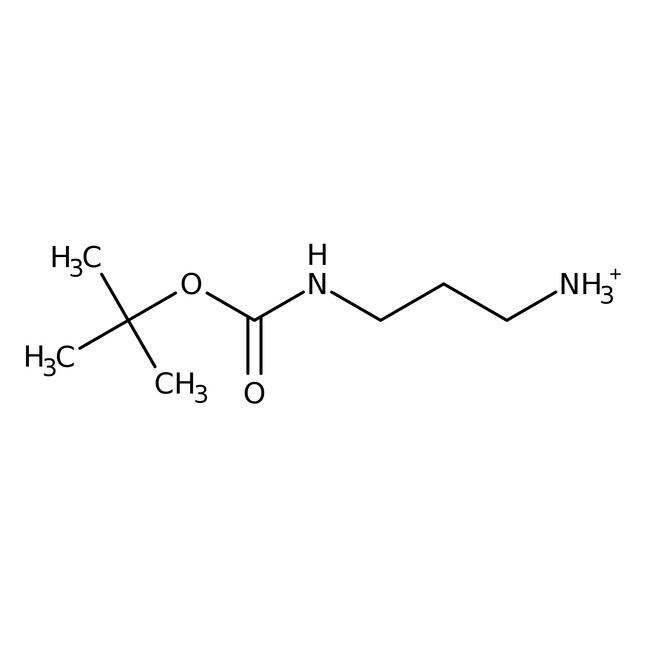

Thermo Scientific Chemicals
N-Boc-1,3-diaminopropane, 95%
CAS: 75178-96-0 | C8H19N2O2 | 175.25 g/mol
Change view


Chemical Identifiers
CAS75178-96-0
IUPAC Nametert-butyl N-(3-azaniumylpropyl)carbamate
Molecular FormulaC8H19N2O2
InChI KeyPOHWAQLZBIMPRN-UHFFFAOYSA-O
SMILESCC(C)(C)OC(=O)NCCC[NH3+]
View more
Specifications Specification Sheet
Specification SheetAssay (GC)94.0% min
N-Boc-1,3-diaminopropane is used in the preparation of spermidine analogues as well as in the preparation of pharmacologically active compounds. It is also used in suzuki reaction. Further, it is used in the preparation of [3-(3-cyano-propylamino)-propyl]-carbamic acid tert-butyl ester.
This Thermo Scientific Chemicals brand product was originally part of the Alfa Aesar product portfolio. Some documentation and label information may refer to the legacy brand. The original Alfa Aesar product / item code or SKU reference has not changed as a part of the brand transition to Thermo Scientific Chemicals.
Applications
N-Boc-1,3-diaminopropane is used in the preparation of spermidine analogues as well as in the preparation of pharmacologically active compounds. It is also used in suzuki reaction. Further, it is used in the preparation of [3-(3-cyano-propylamino)-propyl]-carbamic acid tert-butyl ester.
Solubility
Miscible with methanol.
Notes
Hygroscopic. Air sensitive. Incompatible with oxidizing agents and acids.
N-Boc-1,3-diaminopropane is used in the preparation of spermidine analogues as well as in the preparation of pharmacologically active compounds. It is also used in suzuki reaction. Further, it is used in the preparation of [3-(3-cyano-propylamino)-propyl]-carbamic acid tert-butyl ester.
Solubility
Miscible with methanol.
Notes
Hygroscopic. Air sensitive. Incompatible with oxidizing agents and acids.
RUO – Research Use Only
General References:
- Huang, M. L.; Shin, S. B. Y.; Benson, M. A.; Torres, V. J.; Kirshenbaum, K. A comparison of linear and cyclic peptoid oligomers as potent antimicrobial agents. ChemMedChem 2012, 7 (1), 114-122.
- Funk, A. R.; Goldberg, E.; Chang, E. L.; Trammell, S. A.; Knight, D. A. Attaching high charge density metal ions to surfaces and biomolecules. Reaction chemistry of hypodentate cobalt diamine complexes. Dalton Trans. 2013, 42 (44), 15617-15624.