Search
 Element Search
 Structure Search


Thermo Scientific Chemicals
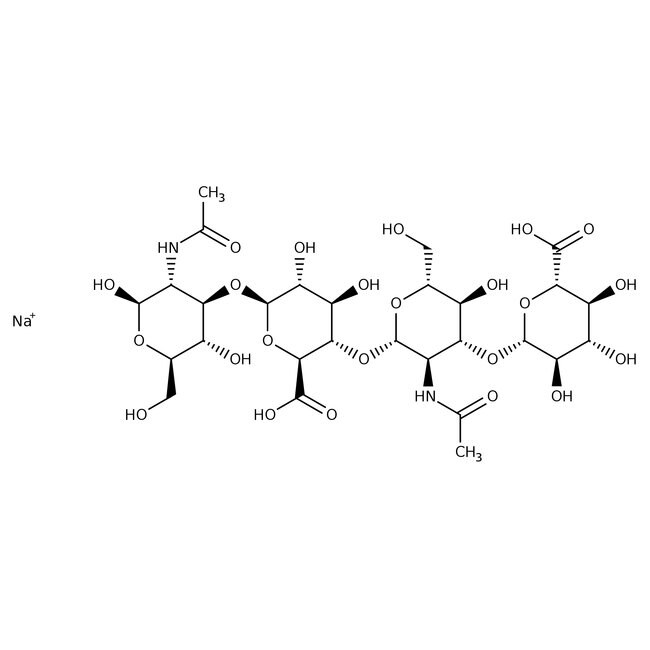
Hyaluronic acid, bovine vitreous humor
Hyaluronic acid from bovine vitreous humor, CAS # 9004-61-9, is a naturally derived glycosaminoglycan that shows an angiogenic activity that promotes wound healing processes. | CAS: 9004-61-9 | C28H44N2O23 | 776.651 g/mol
Change view


Catalog number J60566.MA
also known as J60566-MA
Price (JPY)
-
Quantity:
10 mg
Specifications
CAS9004-61-9
Chemical Name or MaterialHyaluronic acid
ColorWhite
EINECS Number232-678-0
IUPAC Name(2S,4S,5R,6S)-6-[(2S,3R,5S,6R)-3-acetamido-2-[(3S,4R,5R,6R)-6-[(3R,4R,5S,6R)-3-acetamido-2,5-dihydroxy-6-(hydroxymethyl)oxan-4-yl]oxy-2-carboxy-4,5-dihydroxyoxan-3-yl]oxy-5-hydroxy-6-(hydroxymethyl)oxan-4-yl]oxy-3,4,5-trihydroxyoxane-2-carboxylic acid
View more
Hyaluronic acid is a naturally derived, non - immunogenic, non - adhesive glycosaminoglycan that plays a prominent role in various wound - healing processes, as it as it is naturally angiogenic when degraded to small fragments. Hyaluronic acid promotes early inflammation which is critical for initiating wound healing, but then moderates later stages of the process, allowing matrix stabilization and reduction of long term inflammation.
This Thermo Scientific Chemicals brand product was originally part of the Alfa Aesar product portfolio. Some documentation and label information may refer to the legacy brand. The original Alfa Aesar product / item code or SKU reference has not changed as a part of the brand transition to Thermo Scientific Chemicals.
General Description
- Hyaluronic acid, derived from bovine vitreous humor, is a naturally derived, non-immunogenic, non-adhesive glycosaminoglycan that shows an angiogenic activity promoting wound-healing processes when degraded to small fragments
Application
- It is considered a mucopolysaccharide composed of repeating dimeric units of glucuronic acid and N-acetyl glucosamine, which forms the core of complex proteoglycan aggregates found in the extracellular matrix
- It has been used to study the activation of the MAPK/ERK pathway following infection of macrophages with Leishmania amazonensis
RUO – Research Use Only
General References:
- Yuushi Okumura. Serase-1B, a new splice variant of polyserase-1/TMPRSS9, activates urokinase-type plasminogen activator and the proteolytic activation is negatively regulated by glycosaminoglycans. Biochemical Journal. 2006, 400, (4), 551-555.