Search
 Element Search
 Structure Search


Thermo Scientific Chemicals
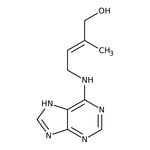
trans-Zeatin, 97%
Plant growth hormone that stimulates cell division | CAS: 1637-39-4 | C10H13N5O | 219.248 g/mol
Change view

Catalog number J61972.MD
also known as J61972-MD
Price (JPY)
-
Quantity:
250 mg
Chemical Identifiers
CAS1637-39-4
IUPAC Name(2E)-2-methyl-4-[(7H-purin-6-yl)amino]but-2-en-1-ol
Molecular FormulaC10H13N5O
InChI KeyUZKQTCBAMSWPJD-FARCUNLSSA-N
SMILESCC(CO)=C/CNC1=C2NC=NC2=NC=N1
View more
Specifications Specification Sheet
Specification SheetAppearance (Color)White to off-white
Assay from Suppliers CofA≥96.0%
Melting Point206-214°C
FormPowder or crystals or crystalline powder
trans-Zeatin regulates cell division, development, and nutrient processing. It acts as a high-affinity ligand for a number of receptors, including arabidopsis histidine kinases (AHKs), specifically AHK3, which is important in mediating plant development.
This Thermo Scientific Chemicals brand product was originally part of the Alfa Aesar product portfolio. Some documentation and label information may refer to the legacy brand. The original Alfa Aesar product / item code or SKU reference has not changed as a part of the brand transition to Thermo Scientific Chemicals.
Applications
trans-Zeatin regulates cell division, development, and nutrient processing. It acts as a high-affinity ligand for a number of receptors, including arabidopsis histidine kinases (AHKs), specifically AHK3, which is important in mediating plant development.
Solubility
Soluble in DMSO and DMF
Notes
Store at -20°C. Incompatible with heat and oxidizing agents.
trans-Zeatin regulates cell division, development, and nutrient processing. It acts as a high-affinity ligand for a number of receptors, including arabidopsis histidine kinases (AHKs), specifically AHK3, which is important in mediating plant development.
Solubility
Soluble in DMSO and DMF
Notes
Store at -20°C. Incompatible with heat and oxidizing agents.
RUO – Research Use Only
General References:
- Iwona Żur; Ewa Dubas; Monika Krzewska; Piotr Waligórski; Michał Dziurka; Franciszek Janowiak. Hormonal requirements for effective induction of microspore embryogenesis in triticale (x Triticosecale Wittm.) anther cultures. Plant Cell Reports. 2015, 34, (1), 47-62.
- Robbin L Koenig; Roy O Morris; Joe C Polacco. tRNA is the source of low-level trans-zeatin production in Methylobacterium spp. Journal of Bacteriology. 2002, 184, (7), 1832-1842.