Search


Citations & References (4)
Invitrogen™
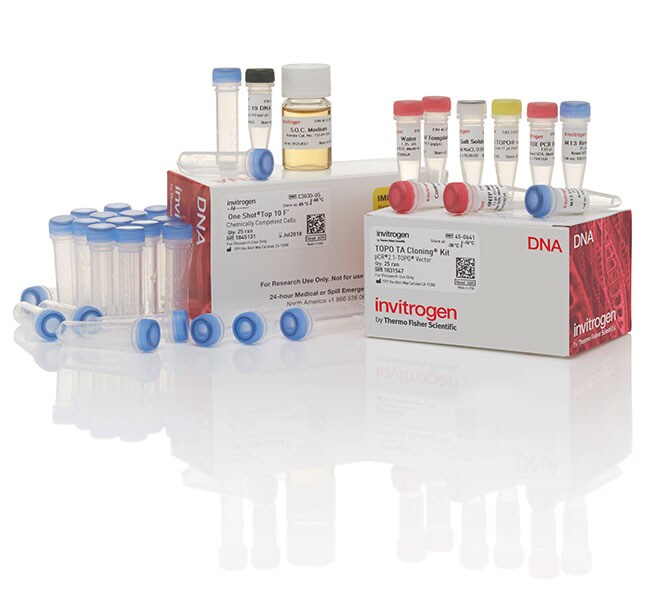
TOPO™ TA Cloning™ Kit for Subcloning, with TOP10F' E. coli
TOPO™ TA Cloning™ Kits for Subcloning provide a highly efficient, 5-minute, one-step cloning strategy ('TOPO™ cloning') for the direct insertionRead more
Change view

| Catalog Number | Quantity |
|---|---|
| K455001 | 25 Reactions |
| K455040 | 50 Reactions |
Catalog number K455001
Price (JPY)
119,800
Each
Quantity:
25 Reactions
TOPO™ TA Cloning™ Kits for Subcloning provide a highly efficient, 5-minute, one-step cloning strategy ('TOPO™ cloning') for the direct insertion of Taq polymerase-amplified PCR products into a plasmid vector for subcloning. Each kit uses the pCR™ 2.1-TOPO™ TA vector with convenient restriction sites for subcloning. The cloning kits are available with a variety of competent cells, or without competent cells, depending upon your needs and budget. Features of the TOPO™ TA Cloning™ Kits for Subcloning:
• Fast and easy—go from PCR to clones in just 3 steps and in as little as 5 minutes hands-on time
• Efficient—obtain up to 95% clones with correct insert
• Proven—reliable performance for over a decade with over 4,000 citations
• Simple—no ligase, post-PCR procedures, or PCR primers containing specific sequences are required
TOPO™ TA Cloning™ Kits for Subcloning—overview
• Vector: pCR™ 2.1-TOPO™ TA vector—subcloning vector with 15 convenient restriction sites flanking your insert for easy, directional subcloning
• Cloning method: TOPO™ TA Cloning™ —Topoisomerase I-based, 5-minute ligation of PCR products with 3′-A overhangs (Taq polymerase amplified) to TOPO™ vector with T overhangs
• Competent cells: various options—choose from kits with either general, high-efficiency, bacteriophage T1-resistant, fast-growing competent cells, or use your own
pCR™ 2.1-TOPO™ TA vector—cloning and subcloning simplicity
The pCR™ 2.1-TOPO™ TA vector is linearized with 3'-thymidine (T) overhangs for direct ligation of Taq polymerase-amplified PCR products (TA cloning™) and is 'activated' with covalently bound Topoisomerase I. There is no need to add ligase and cloning is complete in 5 minutes. EcoRI sites flanking the PCR product insertion site allow for easy excision of inserts or use any combination of 15 convenient restriction sites flanking your PCR insert for easy, directional subcloning.
pCR™ 2.1-TOPO™ TA clone selection and manipulation
The pCR™ 2.1-TOPO™ TA vector contains both ampicillin and kanamycin resistance markers and the LacZα gene for blue/white screening.
Simplified TOPO™ -based cloning
Using TOPO™ cloning technology, there is no need for PCR primers containing specific sequences, post-PCR procedures, vector preparation, or other time-intensive DNA manipulation steps. Just add your PCR reaction straight to the provided topoisomerase-charged vector, incubate 5 minutes, and transform E. coli competent cells.
Efficient cloning
With up to 95% of clones carrying the desired insert, you can screen fewer clones, saving time and money. The pCR™ 2.1-TOPO™ TA vector used in this kit comes with 3'-T overhangs for efficient ligation of Taq polymerase-amplified PCR products, which contain 3'-A overhangs.
The standard in cloning
When it comes to cloning, TOPO™ cloning technology has been a reliable partner for thousands of scientists for over ten years. Fast, simple-to-use, and efficient, TOPO™ cloning has been applied to many different vectors for a wide array of applications.
TOPO™ TA Cloning™ Kits for Subcloning—kit options
The TOPO™ TA Cloning™ Kit for Sequencing can be purchased with a variety of competent cells that deliver different advantages depending upon your needs:
• General cloning: TOP10 cells (Cat. No. K4500-01, K4500-40)
• High-efficiency cloning: TOP10 Electrocomp™ Cells (Cat. No. K4560-01, K4560-40)
• General cloning, bacteriophage T1 resistance: DH5α-T1R cells (Cat. No. K4520-01, K4520-40)
• Fast growth: Mach1™ -T1R Chemically Competent E. Coli (Cat. No. K4510-20)
• Provide your own: for flexibility and to save money (Cat. No. 450641)
We also offer two versions of the kit that include a PureLink™ Quick Plasmid Miniprep Kit (Cat. No. K4500-02 and K4510-02) for use in isolation of clean, sequencing-ready, recombinant plasmid.
• Fast and easy—go from PCR to clones in just 3 steps and in as little as 5 minutes hands-on time
• Efficient—obtain up to 95% clones with correct insert
• Proven—reliable performance for over a decade with over 4,000 citations
• Simple—no ligase, post-PCR procedures, or PCR primers containing specific sequences are required
TOPO™ TA Cloning™ Kits for Subcloning—overview
• Vector: pCR™ 2.1-TOPO™ TA vector—subcloning vector with 15 convenient restriction sites flanking your insert for easy, directional subcloning
• Cloning method: TOPO™ TA Cloning™ —Topoisomerase I-based, 5-minute ligation of PCR products with 3′-A overhangs (Taq polymerase amplified) to TOPO™ vector with T overhangs
• Competent cells: various options—choose from kits with either general, high-efficiency, bacteriophage T1-resistant, fast-growing competent cells, or use your own
pCR™ 2.1-TOPO™ TA vector—cloning and subcloning simplicity
The pCR™ 2.1-TOPO™ TA vector is linearized with 3'-thymidine (T) overhangs for direct ligation of Taq polymerase-amplified PCR products (TA cloning™) and is 'activated' with covalently bound Topoisomerase I. There is no need to add ligase and cloning is complete in 5 minutes. EcoRI sites flanking the PCR product insertion site allow for easy excision of inserts or use any combination of 15 convenient restriction sites flanking your PCR insert for easy, directional subcloning.
pCR™ 2.1-TOPO™ TA clone selection and manipulation
The pCR™ 2.1-TOPO™ TA vector contains both ampicillin and kanamycin resistance markers and the LacZα gene for blue/white screening.
Simplified TOPO™ -based cloning
Using TOPO™ cloning technology, there is no need for PCR primers containing specific sequences, post-PCR procedures, vector preparation, or other time-intensive DNA manipulation steps. Just add your PCR reaction straight to the provided topoisomerase-charged vector, incubate 5 minutes, and transform E. coli competent cells.
Efficient cloning
With up to 95% of clones carrying the desired insert, you can screen fewer clones, saving time and money. The pCR™ 2.1-TOPO™ TA vector used in this kit comes with 3'-T overhangs for efficient ligation of Taq polymerase-amplified PCR products, which contain 3'-A overhangs.
The standard in cloning
When it comes to cloning, TOPO™ cloning technology has been a reliable partner for thousands of scientists for over ten years. Fast, simple-to-use, and efficient, TOPO™ cloning has been applied to many different vectors for a wide array of applications.
TOPO™ TA Cloning™ Kits for Subcloning—kit options
The TOPO™ TA Cloning™ Kit for Sequencing can be purchased with a variety of competent cells that deliver different advantages depending upon your needs:
• General cloning: TOP10 cells (Cat. No. K4500-01, K4500-40)
• High-efficiency cloning: TOP10 Electrocomp™ Cells (Cat. No. K4560-01, K4560-40)
• General cloning, bacteriophage T1 resistance: DH5α-T1R cells (Cat. No. K4520-01, K4520-40)
• Fast growth: Mach1™ -T1R Chemically Competent E. Coli (Cat. No. K4510-20)
• Provide your own: for flexibility and to save money (Cat. No. 450641)
We also offer two versions of the kit that include a PureLink™ Quick Plasmid Miniprep Kit (Cat. No. K4500-02 and K4510-02) for use in isolation of clean, sequencing-ready, recombinant plasmid.
For Research Use Only. Not for use in diagnostic procedures.
Specifications
Bacterial or Yeast StrainTOP10F´
Cloning MethodTOPO™-TA
Product LineOne Shot
Product TypeCloning Kit
Quantity25 Reactions
VectorTOPO-TA Cloning Vectors
FormatKit
Unit SizeEach
Contents & Storage
Box 1:
• Topoisomerase I-activated pCR™2.1-TOPO™ vector
• PCR buffer
• Salt solution
• dNTPs
• Control template
• M13 forward and reverse primers
• Control PCR primers
• Sterile water
Store at -5 to -30°C.
All reagents are stable for 6 months when properly stored.
Box 2:
• One Shot™ Chemically Competent or Electrocomp™ E. coli
• S.O.C. medium
• Supercoiled pUC19 control plasmid
Store at -68 to -85°C.
• Topoisomerase I-activated pCR™2.1-TOPO™ vector
• PCR buffer
• Salt solution
• dNTPs
• Control template
• M13 forward and reverse primers
• Control PCR primers
• Sterile water
Store at -5 to -30°C.
All reagents are stable for 6 months when properly stored.
Box 2:
• One Shot™ Chemically Competent or Electrocomp™ E. coli
• S.O.C. medium
• Supercoiled pUC19 control plasmid
Store at -68 to -85°C.
Frequently asked questions (FAQs)
Can I store my competent E. coli in liquid nitrogen?
How should I store my competent E. coli?
What is the difference between the pCR2.1-TOPO and pCR4-TOPO vectors?
What is the difference between the pCR2.1-TOPO and pCRII-TOPO vectors?
Your TOPO cloning kits contain a control template and control primers. Can I obtain the sequence of the control template?
Citations & References (4)
Citations & References
Abstract
Genetic engineering of phytochrome biosynthesis in bacteria.
Journal:Proc Natl Acad Sci U S A
PubMed ID:11553807
The bilin prosthetic groups of the phytochrome photoreceptors and the light-harvesting phycobiliprotein antennae arise from the oxygen-dependent ring opening of heme. Two ferredoxin-dependent enzymes contribute to this conversion: a heme oxygenase and a bilin reductase with discrete double-bond specificity. Using a dual plasmid system, one expressing a truncated cyanobacterial apophytochrome
Cysteinyl-tRNA synthetase is not essential for viability of the archaeon Methanococcus maripaludis.
Journal:Proc Natl Acad Sci U S A
PubMed ID:11717392
The methanogenic archaea Methanocaldococcus jannaschii and Methanothermobacter thermautotrophicus contain a dual-specificity prolyl-tRNA synthetase (ProCysRS) that accurately forms both prolyl-tRNA (Pro-tRNA) and cysteinyl-tRNA (Cys-tRNA) suitable for in vivo translation. This intriguing enzyme may even perform its dual role in organisms that possess a canonical single-specificity cysteinyl-tRNA synthetase (CysRS), raising the question
Allurin, a 21-kDa sperm chemoattractant from Xenopus egg jelly, is related to mammalian sperm-binding proteins.
Journal:Proc Natl Acad Sci U S A
PubMed ID:11562501
Previously, we demonstrated that a protein from Xenopus egg jelly exhibits sperm chemoattractant activity when assayed by either video microscopy or by sperm passage across a porous filter. Here we describe the isolation and purification of allurin, the protein responsible for this activity. Freshly oviposited jellied eggs were soaked in
Functional cloning, heterologous expression, and purification of two different N-deoxyribosyltransferases from Lactobacillus helveticus.
Journal:J Biol Chem
PubMed ID:11836245
Lactobacillus helveticus contains two types of N-deoxyribosyltransferases: DRTase I catalyzes the transfer of 2'-deoxyribose between purine bases exclusively whereas DRTase II is able to transfer the 2'-deoxyribose between two pyrimidine or between pyrimidine and purine bases. An Escherichia coli strain, auxotrophic for guanine and unable to use deoxyguanosine as source