Search
 Element Search
 Structure Search
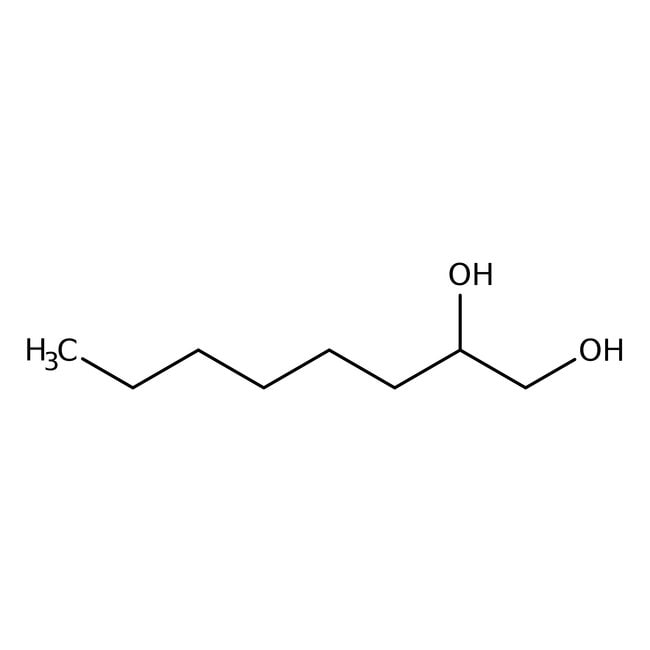


Thermo Scientific Chemicals
1,2-Octanediol, 97%
CAS: 1117-86-8 | C8H18O2 | 146.23 g/mol
Change view


Catalog number L08031.18
also known as L08031-18
Price (JPY)
-
Quantity:
50 g
Chemical Identifiers
CAS1117-86-8
IUPAC Nameoctane-1,2-diol
Molecular FormulaC8H18O2
InChI KeyAEIJTFQOBWATKX-UHFFFAOYNA-N
SMILESCCCCCCC(O)CO
View more
Specifications Specification Sheet
Specification SheetIdentification (FTIR)Conforms
FormCrystals or powder or crystalline powder or fused solid
Assay (GC)≥96.0%
Appearance (Color)White
1,2-Octanediol was used as organic modifier to improve the HPLC separation of organic acids and bases. It was also used in preparation of halohydrin palmitates. It is useful for treating head louse infestation clinically. It is also used in coating materials, slurries, paper mills and water circulation systems for the effective preservation against bacteria and fungi. It is used as an emollient, humectant, and wetting agent in cosmetic and skin care products
This Thermo Scientific Chemicals brand product was originally part of the Alfa Aesar product portfolio. Some documentation and label information may refer to the legacy brand. The original Alfa Aesar product / item code or SKU reference has not changed as a part of the brand transition to Thermo Scientific Chemicals.
Solubility
Soluble in water (3 g/L) at 20°C.
Notes
Incompatible materials are oxidizing agents. Store in cool place. Keep container tightly closed in a dry and well-ventilated place. Store away from oxidizing agents.
Soluble in water (3 g/L) at 20°C.
Notes
Incompatible materials are oxidizing agents. Store in cool place. Keep container tightly closed in a dry and well-ventilated place. Store away from oxidizing agents.
RUO – Research Use Only
General References:
- Shelly Li; James S Fritz. Organic modifiers for the separation of organic acids and bases by liquid chromatography.Journal of Chromatography A.2002, 964 (1-2), 91-98.
- Ian F Burgess; Peter N Lee; Katrina Kay; Ruth Jones; Elizabeth R Brunton. 1,2-Octanediol, a novel surfactant, for treating head louse infestation: identification of activity, formulation, and randomised, controlled trials.PLoS ONE.2012, 7 (4), e35419.