Search
Invitrogen
RARA Monoclonal Antibody (Ralpha10)
{{$productOrderCtrl.translations['antibody.pdp.commerceCard.promotion.promotions']}}
{{$productOrderCtrl.translations['antibody.pdp.commerceCard.promotion.promocode']}}: {{promo.promoCode}} {{promo.promoTitle}} {{promo.promoDescription}}. {{$productOrderCtrl.translations['antibody.pdp.commerceCard.promotion.learnmore']}}
{{$ctrl.translations['antibody.pdp.skuNotes.additionalInformation']}}:

FIGURE: 1 / 7
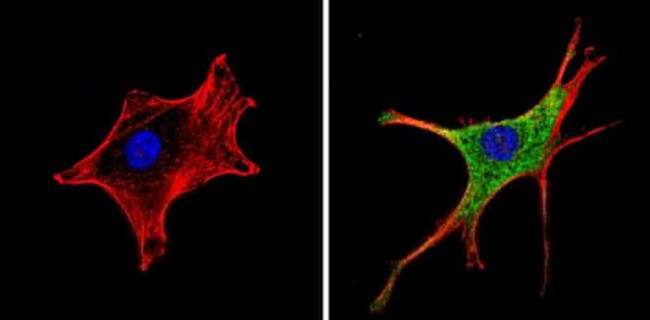
RARA Antibody (MA1-810A) in ICC/IF
Immunofluorescent analysis of Retinoic Acid Receptor alpha (green) showing staining in the cytoplasm of NIH-3T3 cells (right) compared to a negative control without primary antibody (left). Formalin-fixed cells were permeabilized with 0.1% Triton X-100 in TBS for 5-10 minutes and blocked with 3% BSA-PBS for 30 minutes at room temperature. Cells were probed with a Retinoic Acid Receptor alpha monoclonal antibody (Product # MA1-810A) in 3% BSA-PBS at a dilution of 1:100 and incubated overnight at 4 °C in a humidified chamber. Cells were wash... View More


Please note: We are reviewing Western blot images included in the antibody testing data in our catalog, including those provided by third parties. Unless expressly labeled or annotated as “raw-unedited”, Western blot images included in the antibody testing data in our catalog may have been edited, optimized or otherwise adjusted for presentation.




Product Details
MA1-810A
Applications
Tested Dilution
Publications
Product Specifications
Species Reactivity
Human,
Mouse,
Rat
Published species
Human,
Mouse,
Rat
Host/Isotype
Mouse
/ IgG1
Class
Monoclonal
Type
Antibody
Clone
Ralpha10
Immunogen
Synthetic peptide corresponding to residues C(444) S P S L S P S S H R S S P A T Q S P(462) of mouse RAR alpha.
Conjugate
Unconjugated
Unconjugated
Unconjugated
Form
Lyophilized
Concentration
Conc. Not Determined
Amount
50 µg
Storage buffer
ascites
Contains
0.05% sodium azide
Storage conditions
-20°C, Avoid Freeze/Thaw Cycles
Shipping conditions
Ambient (domestic); Wet ice (international)
RRID
Product Specific Information
MA1-810A detects retinoic acid receptor (RAR) alpha from human, rat and mouse tissues and overexpressed cells. This antibody does not detect any of the RAR beta or gamma forms.
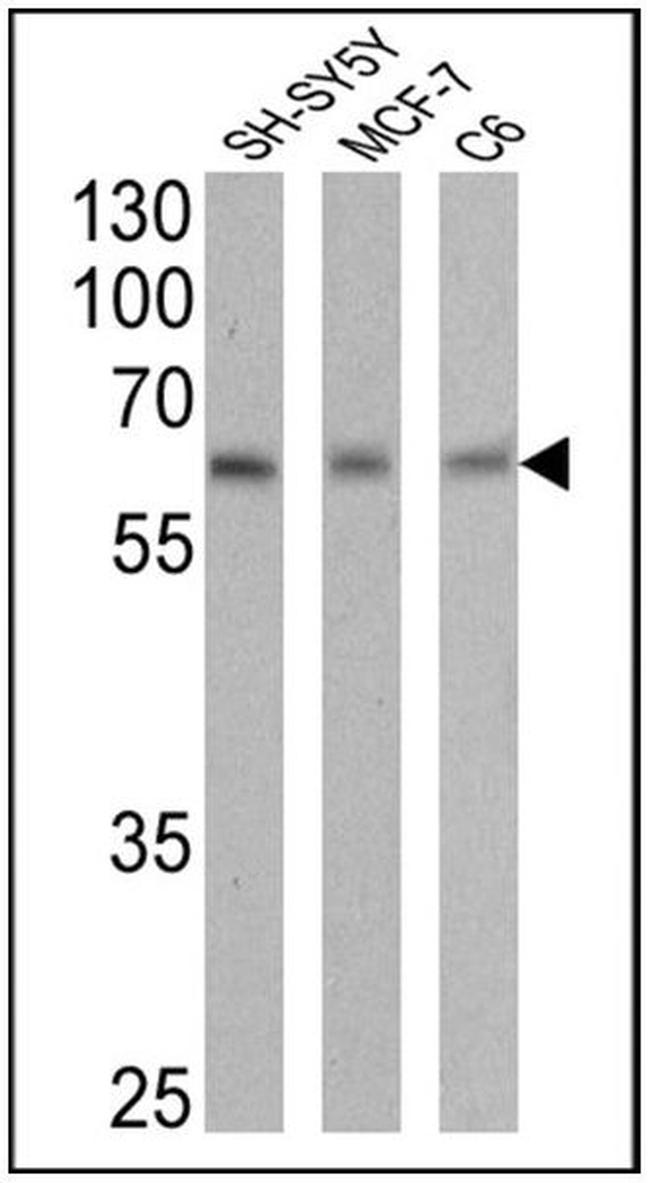
MA1-810A has been successfully used in Western blot and ICC/IF procedures. By Western blot, this antibody detects a single ~45 kDa protein representing RAR alpha in transfected COS cells. Due to the extremely low levels of RAR expressed in native tissues, it is recommended that sensitive detection systems, such as enhanced chemiluminescence, be used.
The apparent molecular weight of RAR alpha from transfected COS cells is ~45 kDa. In rat tissues, such as skin and testis, doublets in the ~50 kDa area are seen. RAR alpha has been identified with this antibody in human dermal and neonatal fibroblast cell lines, as well as mouse F9 and human SH-SY5Y cells; however, RAR alpha from human leukocytes and HUT102 cells were not identified by MA1-810 suggesting that there may be structural variation of RAR alpha between some cell types.
The MA1-810A immunogen is a synthetic peptide corresponding to residues C(444) S P S L S P S S H R S S P A T Q S P(462) of mouse RAR alpha. This peptide (Cat. # PEP-004) is available for use in neutralization and control experiments.
Reconstitute with PBS.
Target Information
RARA is a receptor for retinoic acid. Retinoic acid receptors bind as heterodimers to their target response elements in response to their ligands, all-trans or 9-cis retinoic acid, and regulate gene expression in various biological processes. The RXR/RAR heterodimers bind to the retinoic acid response elements (RARE) composed of tandem 5'-AGGTCA-3' sites known as DR1-DR5. In the absence of ligand, the RXR-RAR heterodimers associate with a multiprotein complex containing transcription corepressors that induce histone acetylation, chromatin condensation and transcriptional suppression. On ligand binding, the corepressors dissociate from the receptors and associate with the coactivators leading to transcriptional activation. RARA plays an essential role in the regulation of retinoic acid-induced germ cell development during spermatogenesis. Has a role in the survival of early spermatocytes at the beginning prophase of meiosis. In Sertoli cells, may promote the survival and development of early meiotic prophase spermatocytes. In concert with RARG, required for skeletal growth, matrix homeostasis and growth plate function. Regulates expression of target genes in a ligand-dependent manner by recruiting chromatin complexes containing KMT2E/MLL5. Mediates retinoic acid-induced granulopoiesis.
For Research Use Only. Not for use in diagnostic procedures. Not for resale without express authorization.
Bioinformatics
Protein Aliases: nuclear receptor; nuclear receptor subfamily 1 group B member 1; nucleophosmin-retinoic acid receptor alpha fusion protein NPM-RAR long form; PML gene product; PML-DDX5-RARA fusion; PML-DDX5-RARA fusion protein; RAR Alpha; RAR alpha 1; RAR-alpha; RARA; retinoic acid; retinoic acid receptor; retinoic acid receptor, alpha polypeptide; RRA; TTMV/RARA fusion; TTMV/RARA fusion protein; unnamed protein product
Gene Aliases: NR1B1; RAR; RARalpha; RARalpha1
UniProt ID: (Human) P10276, (Mouse) P11416
Entrez Gene ID: (Human) 5914, (Rat) 24705, (Mouse) 19401
translation repressor activity, nucleic acid binding
transcription regulatory region sequence-specific DNA binding
RNA polymerase II regulatory region sequence-specific DNA binding
RNA polymerase II core promoter proximal region sequence-specific DNA binding
RNA polymerase II transcription factor activity, sequence-specific DNA binding
bacterial-type RNA polymerase transcriptional repressor activity, sequence-specific DNA binding
transcription coactivator binding
retinoic acid binding
DNA binding
chromatin binding
transcription factor activity, sequence-specific DNA binding
RNA polymerase II transcription factor activity, ligand-activated sequence-specific DNA binding
receptor binding
protein binding
zinc ion binding
enzyme binding
protein domain specific binding
chromatin DNA binding
histone deacetylase binding
protein kinase B binding
sequence-specific DNA binding
retinoic acid-responsive element binding
mRNA 5'-UTR binding
protein kinase A binding
alpha-actinin binding
heterocyclic compound binding
sequence-specific double-stranded DNA binding
phosphatidylinositol 3-kinase regulator activity
negative regulation of transcription from RNA polymerase II promoter
liver development
regulation of transcription, DNA-templated
protein phosphorylation
germ cell development
female pregnancy
positive regulation of cell proliferation
negative regulation of cell proliferation
male gonad development
positive regulation of gene expression
negative regulation of translation
hippocampus development
cell differentiation
prostate gland development
negative regulation of granulocyte differentiation
regulation of myelination
response to estradiol
response to retinoic acid
negative regulation of interferon-gamma production
negative regulation of tumor necrosis factor production
positive regulation of interleukin-13 production
positive regulation of interleukin-4 production
positive regulation of interleukin-5 production
response to vitamin A
response to cytokine
mRNA transcription from RNA polymerase II promoter
regulation of apoptotic process
apoptotic cell clearance
response to ethanol
positive regulation of T-helper 2 cell differentiation
positive regulation of neuron differentiation
positive regulation of cell cycle
negative regulation of transcription, DNA-templated
positive regulation of transcription, DNA-templated
positive regulation of transcription from RNA polymerase II promoter
regulation of synaptic plasticity
retinoic acid receptor signaling pathway
positive regulation of binding
Sertoli cell fate commitment
cellular response to lipopolysaccharide
cellular response to retinoic acid
cellular response to estrogen stimulus
negative regulation of pri-miRNA transcription from RNA polymerase II promoter
ureteric bud development
neural tube closure
glandular epithelial cell development
outflow tract septum morphogenesis
growth plate cartilage development
spermatogenesis
negative regulation of gene expression
regulation of granulocyte differentiation
embryonic camera-type eye development
multicellular organism growth
camera-type eye development
negative regulation of apoptotic process
negative regulation of cell differentiation
negative regulation of translational initiation
embryonic organ development
embryonic morphogenesis
ventricular cardiac muscle cell differentiation
limb development
face development
bone development
trachea cartilage development
chondroblast differentiation
negative regulation of cartilage development
positive regulation of protein kinase B signaling
positive regulation of ERK1 and ERK2 cascade
nucleus-associated proteasomal ubiquitin-dependent protein catabolic process
Disclaimer

Clicking the images or links will redirect you to a website hosted by BenchSci that provides third-party scientific content. Neither the content nor the BenchSci technology and processes for selection have been evaluated by us; we are providing them as-is and without warranty of any kind, including for use or application of the Thermo Fisher Scientific products presented.

Performance Guarantee
If an Invitrogen™ antibody doesn't perform as described on our website or datasheet,we'll replace the product at no cost to you, or provide you with a credit for a future purchase.*
Learn more
We're here to help
Get expert recommendations for common problems or connect directly with an on staff expert for technical assistance related to applications, equipment and general product use.
Contact tech support