 The lactose-free dairy market has expanded at a rate of about
 Lactose testing in dairy products using HPAE-PAD-MS
Lactose-free dairy products are prepared by breaking down lactose into glucose and galactose using enzymes. The process is not 100% efficient, and so the resulting products contain varying amounts of residual lactose. Determining how much lactose remains is important for ingredient labeling requirements, as some countries set threshold levels for the use of terms such as “lactose-free”, with a maximum concentration of 0.01% generally used.
High-performance anion-exchange (HPAE) coupled with pulsed amperometric detection (PAD) is widely used for the determination of lactose in milk products. However, when it comes to analyzing more complex food matrices, detecting carbohydrates at μg/L concentrations can be demanding using HPAE coupled with PAD alone. Dairy products contain several structurally similar sugars that can be hard to separate and quantify. For these challenging matrices, low-mass detection methods such as mass spectrometry (MS) can be used as a complementary technique for confirmatory carbohydrate analysis. By resolving co-eluting sugar molecules according to their mass-to-charge ratio, MS can achieve the high levels of specificity and selectivity that are required for lactose quantification.
HPAE-PAD-MS systems use PAD and MS detection in parallel to support dual analysis of the sample flow. However, an important technical consideration when using HPAE-PAD-MS is that HPAE employs high-pH eluents, which require the removal of sodium ions before they can be introduced into the mass spectrometer. This can be achieved using a post-column desalter device to convert the sodium (or potassium) hydroxide eluent to water.
Dual detection HPAE-PAD-MS systems deliver exceptional sensitivity
Ongoing improvements in HPAE-PAD-MS technologies are supporting increasingly sensitive and selective methods for lactose determination. Modern HPAE systems such as the Thermo Scientific Dionex ICS-6000 HPIC deliver high-resolution chromatographic separation, thanks to their high-pressure capability. Coupled with MS instruments like the Thermo Scientific™ ISQ™ EC single quadrupole mass spectrometer, HPAE-PAD-MS systems are driving improvements in analytical limits of detection (LODs) and quantification (LOQs).
As demonstrated in a recent app note, methods for lactose determination that use dual detection HPAE-PAD-MS systems can detect lactose in lactose-free dairy products at concentrations as low as 0.004%. The LODs and LOQs for the carbohydrates studied in this particular analysis were 2–3-fold lower with MS detection than with PAD.
High-resolution separation with advanced anion-exchange columns
It’s not just improvements in instrumentation that are enhancing lactose analysis. Effective chromatographic separation is essential to avoid over-estimation of content due to analyte co-elution, and this is particularly important for reliable lactose analysis in dairy products.
Advances in anion-exchange chromatography column chemistry are delivering fast, high-resolution separations of mono-, di-, tri- and tetra-saccharides in a variety of food and beverage samples. The Thermo Scientific Dionex CarboPac PA210-4μm column is optimized specifically for direct quantification of non-derivatized sugars, enabling fast analyses and short separation times while ensuring high reproducibility. Figure 1 highlights the excellent separation of lactose from other sugars in lactose-free, fat-free milk. In this study, we achieved recoveries in the range of 85–110%.
Advanced HPAE-PAD-MS techniques for lactose determination in dairy products
Modern dual detection HPAE-PAD-MS technologies are supporting fast, reliable and sensitive methods for lactose analysis. You can learn more about advanced techniques for the determination of lactose in lactose-free dairy products in this app note.
In future blog posts, we’ll be looking at how advances in ion chromatography are pushing the limits of quantitative analysis in other applications – so stay tuned!
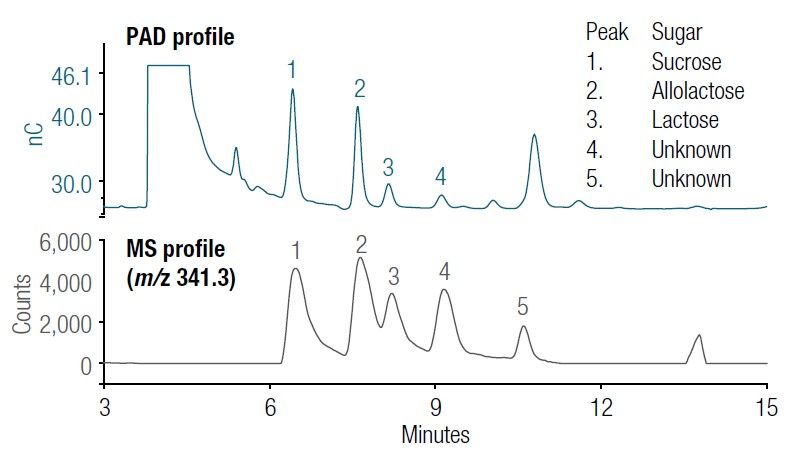
Figure 1: PAD profile (top) and MS profile (bottom) of lactose-free, fat-free milk.

Innovations of 1975 and the Birth of the First Commercialized Suppressed Ion Chromatograph
The year 1975 was a remarkable period in the history of tech...
Read More
Understanding PFAS and Combustion-Ion Chromatography
Per- and polyfluoroalkyl substances (PFAS) comprise more tha...
Read More
Robust Analysis of Halogens and Sulfur in Industrial and Environmental Samples
In industrial processes, accurately determining halogens and...
Read More
What is the Ion Chromatography Golden Jubilee? Celebrating 50 Years of IC Innovation
The year 2025 marks the golden jubilee of ion chromatography...
Read More