As researchers search for extraterrestrial life, volcanic caves on Mars are considered potential habitats for past or present life since they provide shelter from the harsh radiation, dust storms, and wide temperature swings on the surface of the planet. As interest in these caves has grown, so has the desire to explore similar caves on Earth to see what clues they hold about life on Mars and how the Red Planet eventually evolved into an inhospitable place.
Among the areas researchers have been interested in exploring are the terrestrial and marine caves of the Selvagens Islands, a remote archipelago in the North Atlantic Sea. In 2021, Francesco Sauro, a geologist at the University of Bologna, joined a team of scientists from a wide variety of disciplines to better understand these caves and the promise they hold for future expeditions in space.
Exploring the unique caves of the Selvagens Islands
The “Microceno Project” brought a team of 17 scientists together from seven countries, including researchers working with the European Space Agency and a Russian cosmonaut. Sauro and his team wanted to better understand the age of the caves, the minerals they contain, the environment that led to their formation and the life inside of these caves.
“I’ve never seen caves like these in any other place in the world as in the Selvagens,” says Sauro. “They’re not just the normal volcanic caves you’d expect. They’re quite peculiar and may be very similar to the way caves formed on Mars.”

Mars-like landscape of the Selvagens Islands
As part of the geology research, Sauro and his peers for the first time built a three-dimensional map of the main caves on Selvagem Grande, the biggest island in the archipelago. This research led to the discovery of a new cave that hadn’t been previously identified.
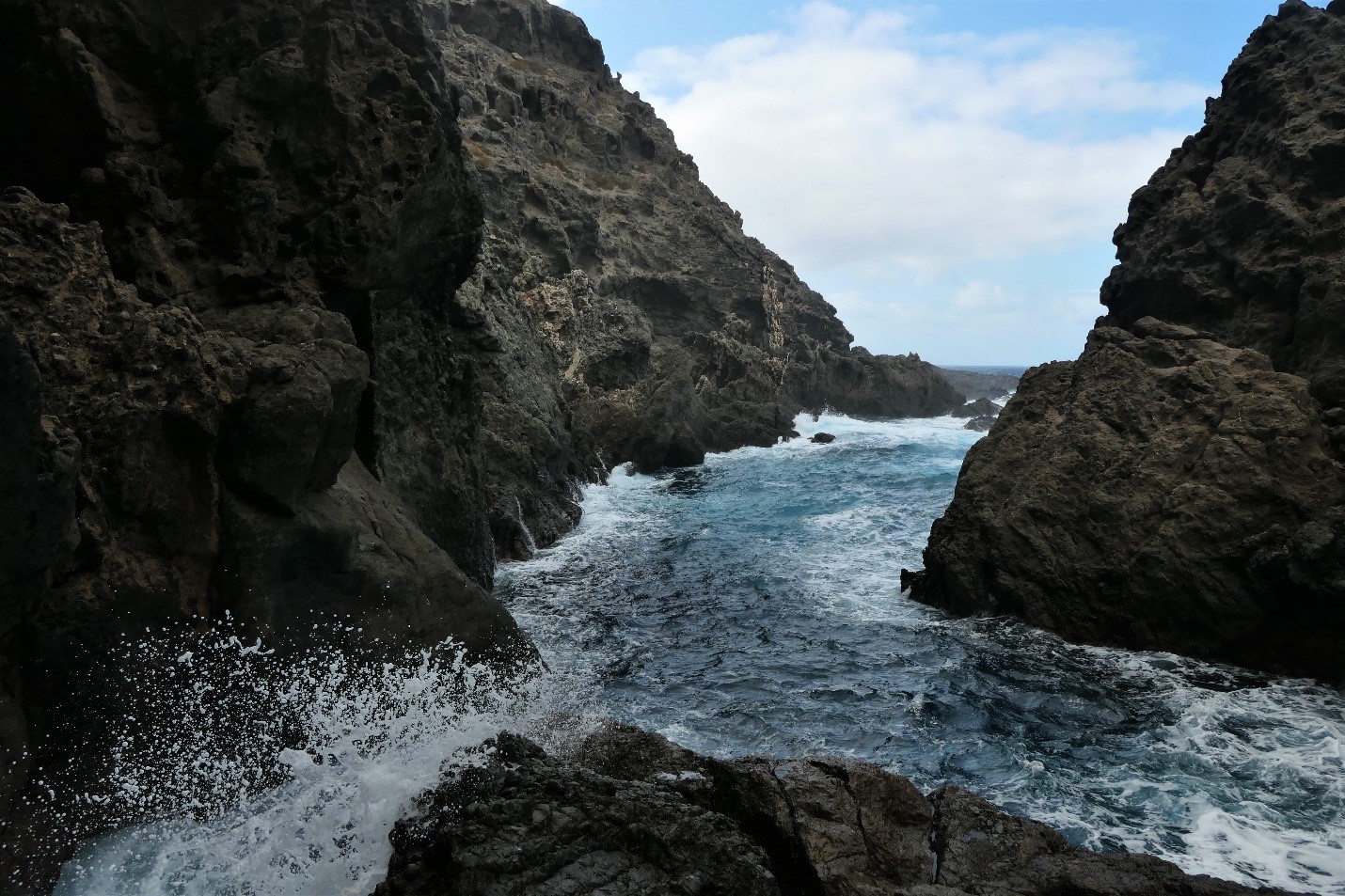
View from the entrance of the newly discovered cave. During exploration of the island, researchers had to check the tides because some areas could only be reached when tides were low. Staying inside the caves was too long is dangerous because of the rough Atlantic sea.

A researcher at the entrance of one of the Selvagens Island caves. This research expedition was the first to discover this cave and were the first humans to have ever been inside!
Caves as “archives of time”
Unlike most volcanic caves created by lava tubes, Sauro says the caves on the Selvagens Islands were formed by calcium carbonate deposits in cracks that have weathered away to form voids over time. In addition, the caves are thought to be 10 million to 15 million years old, far older than other caves researchers have explored on Earth.
“Most caves are a few million years old,” says Sauro. “To go beyond 10 million years, that’s really considered a very old cave. Caves are essentially archives of time, which means that the record of minerals and life that could be found inside these caves is extremely valuable.”

Sauro and another researcher, Sergey, exploring the cave.

Geologist Matteo Massironi teaches Sergey how to “read” the rocks to discover the history and origins of the island.
Screening samples in the field
To help them with their research, the geologists had access to a Thermo Scientific Phenom XL G2 Scanning Electron Microscope (SEM), the first-ever SEM to be used in field research. Having a Phenom XL G2 SEM on-site made it possible to analyze samples as they were collected, reducing the damage that would otherwise have occurred with fluctuating temperatures and pressures during transportation.
The Phenom XL G2 SEM also made it possible for geologists to determine the age of the caves as they worked, which, in turn, led to a more precise 3D map. “The Phenom XL G2 SEM is incredible from my perspective because you take a sample, and even without coating it, you put it in the instrument and get spectacular images along with the chemical composition—all within 10 minutes,” says Sauro. “You get multiple layers of information, fast, which is incredibly valuable.”
Perhaps most importantly, the Phenom XL G2 SEM helped the researchers ensure they only brought the best samples back with them for further analysis in the lab. “By screening our samples with the Phenom XL G2 SEM, we didn’t need to take an entire kilo of a mineral, just a few grams that we determined were of interest,” Sauro says. “Without it, we risked getting back to the lab only to discover that we brought back the wrong samples or lacked enough of the good ones. Coming back to the Selvagens Islands [to take even more samples] would have been quite expensive!”
An incredible advantage for remote expeditions
Sauro says taking only the right samples is similar to the pressures an astronaut would face while on Mars. “We cannot take a lot of samples on Mars back to Earth,” he says. “We need a way to assess what’s interesting and deserves more attention, and the Phenom XL G2 SEM enables us to do that. The Phenom SEM is a phenomenal instrument that would provide an incredible advantage to many expeditions in remote places.”
To learn more, about how the Phenom XL G2 Desktop SEM assisted scientists with their discoveries during the Selvagens Islands expedition, please see our previous blog posts, “Phenom XL G2 SEM Accompanies Scientists on First-Ever Field Expedition Using a Portable SEM,” and “Phenom XL G2 Advances Microbiology and Mineralogy Research on Selvagens Islands Expedition.” Also, visit our Phenom XL G2 Desktop SEM webpage.
//
Rogier Miltenburg is an applications and product specialist for the Phenom Desktop SEMs at Thermo Fisher Scientific.

K 2025: Showcasing the Future of Sustainable, Smart, and Responsible Plastics Production
This week, more than 3,000 exhibitors and 177,000 visitors f... Keith Cornell Nimesh Khadka, PhD
Read More
What is scanning electron microscopy?
How does a scanning electron microscope work? You have likel...
Read More
How Does an Electron Microscope Work?
Since the advent of electron microscopy in the 1930s, this r...
Read More
How the Axia ChemiSEM System Supports DEON’s Quality Control Lab
Quality control lab utilizing the Axia ChemiSEM Scanning Ele...
Read More
Leave a Reply