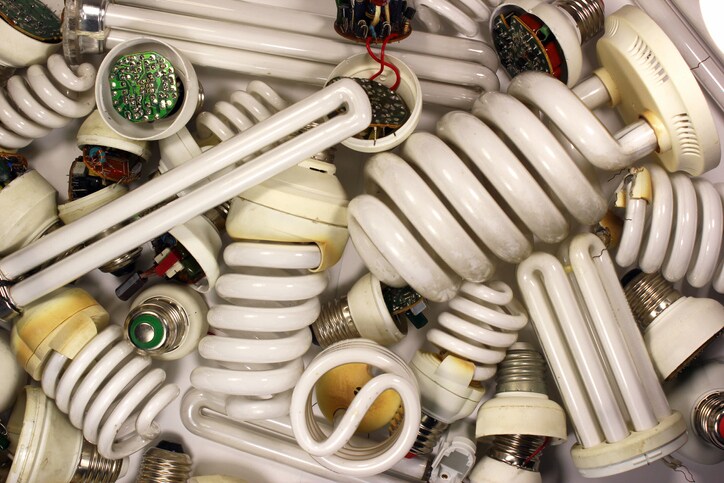
 Researchers continue to develop new technologies to recover and recycle rare earth elements (REEs), an essential component in consumer electronic products. Such projects abound because not only are these metals difficult to mine, but fluctuating supply and demand factors have some industry experts guessing as to whether the world’s REE supply will eventually run out.
X-ray fluorescence technology is an important tool in the rare earth element recycling industry because handheld XRF analyzers can help detect lead, mercury, and cadmium in electronics such as printed circuit board (PCB) finishes, leads, terminations, solder and internal/external interconnects, keeping these toxic metals out of the recycling stream and future products. XRF analyzers are also used to positively identify the chemical composition of numerous metal alloys. Finally, handheld XRF analyzers are useful instruments for REE exploration because they can provide real-time, on-site assays of REEs and other elements in any type of geological samples.
Phys.org recently described on a REE recycling project underway at Kanazawa University in Japan to extract yttrium and europium from spent phosphors in fluorescent lamps.
As reported in Waste Management, the Kanazawa team turned to chelator chemistry. Chelators—organic compounds containing elements such as N or O—bond to metals through electron donation. This allows them to gently leach out REEs from the solid mass of a spent phosphor, without the need for strong acids.
“An ideal type of chelator compound is known as amino-polycarboxylates,” explains study co-author Ryuta Murase. “These are already used to remove toxic metals from solid waste. We found they were also very efficient at extracting REEs from spent phosphors—especially yttrium and lanthanum, which are used in the more chemically reactive red phosphors. The best performance was by the chelator EDTA, probably because it forms the strongest complexes with the metals.”
“We worked hard to optimize the process in every detail, including temperature, pH, milling speed, ball size, and other factors,” says corresponding author Hiroshi Hasegawa. “Our efforts paid off, and the most economically important REE metals were leached out from spent lamps with recoveries from 53% to 84%. Recycling REEs will be vital for sustainable technology, and we hope to show that it can be done cleanly and efficiently.”
Other notable recycling efforts include a project to recover rare earths such as europium, cerium and lutetium from LED bulbs without using any chemicals, according to mining.com.
Agmetalminer.com reported that a team of researchers at Worcester Polytechnic Institute may have developed both a technically and commercially viable means for recycling neodymium, dysprosium and praseodymium from the drive units and motors of discarded electric and hybrid cars.
Another emerging technology, reported on the Oak Ridge National Laboratory web site, simplifies the process of recycling critical materials from electronic waste by using a combination of hollow fiber membranes, organic solvents, and neutral extractants to selectively recover rare earth elements.
According to engadget, Honda has co-developed a new hybrid motor with Daido Steel that doesn’t use heavy rare earth metals like dysprosium and terbium, instead relying on magnets from Daido Steel that cost and weigh less than the previous components.
The National reports that researchers at the Masdar Institute of Science and Technology are interested in developing magnets that could replace the most common form of rare-earth magnet, namely those that contain neodymium. The technology involves high-throughput screening to identify promising compositions, followed by an analysis of the physical properties, including the magnetic energy product, of the compositions.
Phys.org reports that scientists are recycling magnets by the melt spinning process, also known as rapid solidification, a method already tried and tested for other alloys. The scientists are now optimizing the properties of the recycled magnets by varying the melt spinning process.

What’s Everyone Reading this Year?
According to Google, here are the Top 10 read articles this ... Marlene Gasdia-Cochrane, Editor
Read More
Here’s a Free Periodic Table for Your Halloween Goody-Bag
No tricks here. Download this handy periodic table and X-ray... Marlene Gasdia-Cochrane, Editor
Read More
Metallic Microneedle Manufacturing
A metallic microneedle manufacturer faces challenges ensurin... Marc Liu
Read More
INFOGRAPHIC: 8 Fun Facts About Copper
What do pennies, asparagus and police officers have in commo...
Read More


Leave a Reply