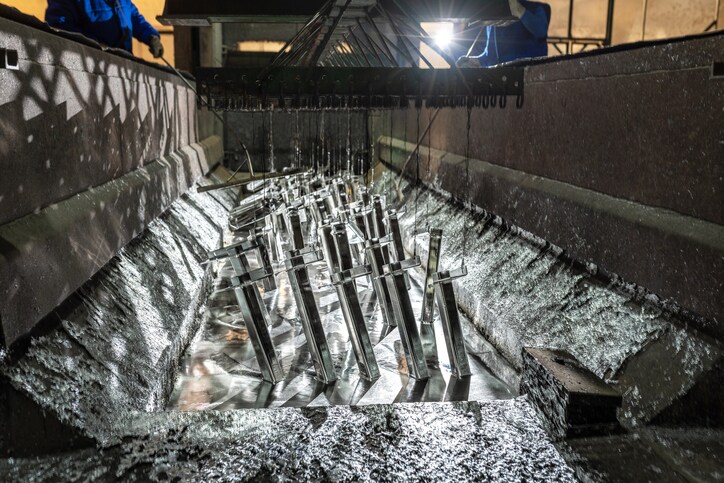
 Industries in the fabricated metal product manufacturing subsector transform metal into intermediate or end products, or treat metals and metal formed products fabricated elsewhere, as described by the U.S. Bureau of Labor Statistics.
During the fabrication process, metal coatings can be applied on all kinds of items made of metals, alloys and plastics either for decorative purposes or to optimize the physical and chemical properties of their surface (corrosion, wear and heat resistance, hardness, electrical conductivity, adhesion, solderability or lubricity).
Coatings analysis is extremely important to the fabrication industry because it helps to ensure fabricators meet or exceed client material specifications. Some examples of coatings include copper used in electrification products. The product is coated with silver to increase the electrical conductivity at high frequency. Zirconium conversion coating over hot-dip galvanized steel is a second example, which is used in the automotive industry, among others. It is a two-layered coating system consisting of a relatively thick layer of zinc that protects steel from rusting and a second layer of zirconium to prevent so-called white rusting of zinc. A third example is an electroless nickel coating over Kovar alloy when a reliable glass-to-metal seal is needed.
Metal coatings must be applied in certain thickness specifications to perform as expected. Over coating can significantly increase the cost of manufacturing, but under coating can cause dramatic product failure. That is why controlling the coat weight or the coating thickness is essential in metal finishing, fabrication, automotive and aerospace industries.
Among available technologies for measurement of metal coat weight is X-ray fluorescence (XRF) spectrometry which has numerous advantages: it is non-destructive and element specific, and it delivers very accurate results.1 Nevertheless, for certain elements XRF cannot measure metal layers that are too thick or purely organic coatings.
For many years, this was addressed by bringing the specimen to be analyzed inside or close to the analyzer chamber so it could be analyzed by benchtop XRF equipment. Measuring coating thickness on large and heavy parts was impractical without cutting samples. This limitation can be overcome using handheld XRF technology.
Handheld XRF analyzers are an extremely efficient technology for rapid compositional analysis of alloys and coating thickness measurements. Since the analyzers are handheld, they can be utilized to perform spot analysis anywhere in the supply chain, help ensure that expensive coating material isn’t wasted, and enhance process monitoring and quality control.
The latest analyzers utilize a coatings mode that can measure the coat weight or coating thickness of up to 4 layers over one substrate. The substrate can be either defined as metal, alloy, plastic or wood while the layers can be defined as pure element, alloy or compound (via pseudo element). (Read the Application Note: Measuring Metal Coating Thickness at Line.)
To ensure customer coating specifications are met, quality control at-line, online or during final product inspection is a necessity. In an article published by the Fabricators & Manufacturers Association, it was noted that “fabricated metal has most triumphantly leant itself to space exploration, providing safe air and space travel with incredibly durable fabricated metal that can withstand extreme heat and pressure while in orbit.” But we must keep in mind that safety depends on quality so the fabricators must get the alloy and the coatings right.
Resources:
- Application Note: Measuring Metal Coating Thickness at Line.
References 1. S. Piorek, Coatings, Paint and Thin Film Deposits, Chapter 4 in Portable X-ray Fluorescence Spectrometry Capabilities for In Situ Analysis, Edited by Philip Potts and Margaret West, RSC Publishing 2008
Additional Resources:
- Download our free eBook: A Practical Guide to Improving Steel Manufacturing Processes and Production Methods
- Visit our center for Improving Steel Manufacturing Processes and Production


Here’s a Free Periodic Table for Your Halloween Goody-Bag
No tricks here. Download this handy periodic table and X-ray... Marlene Gasdia-Cochrane, Editor
Read More
Metallic Microneedle Manufacturing
A metallic microneedle manufacturer faces challenges ensurin... Marc Liu
Read More
INFOGRAPHIC: 8 Fun Facts About Copper
What do pennies, asparagus and police officers have in commo...
Read More
Why Sinter Chemistry is Important and How to Get it Right
When sinter chemistry fluctuates, it can significantly impac... Kevin Gordon
Read More


Leave a Reply