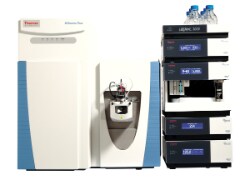
 Mass spectrometry is a rapidly burgeoning analytical technique with a trajectory guided by the technological enhancements brought with each new generation of instruments.
Recently, Williamson et al. (2016) turned their attention to two Orbitrap-based hybrid tandem instruments: the Q Exactive Plus Hybrid Quadrupole-Orbitrap mass spectrometer and the Orbitrap Fusion Lumos Tribrid mass spectrometer (both Thermo Scientific). While the Q Exactive Plus instrument is a more sensitive, more robust incarnation of the Q Exactive mass spectrometer line, the Orbitrap Fusion Lumos Tribrid instrument offers advancements like fragmentation mode, MSn capability and decision tree–based experimental design. To compare the two platforms, the team optimized the instruments and adopted a two-fold focus:
-
typical peptide identification using E. coli lysate (>2,000 proteins) on a short LC gradient
-
quantitative capacity involving both label-free and isobaric tagging (iTRAQ) using an E. coli heat shock model, including a comparison of MS2 and MS3/SPS (synchronous precursor selection) modes
For pure identification capacity, the Orbitrap Fusion Lumos Tribrid instrument outperformed the Q Exactive Plus instrument, with more identifications per minute for proteins, total peptide spectrum matches (PSMs) and unique PSMs. The Orbitrap Fusion Lumos Tribrid instrument’s Orbitrap-Ion trap mode produced up to a 21% increase in PSMs in comparison with the Orbitrap-Orbitrap mode. The team observed a 40% increase in peptide identification rate for the Orbitrap Fusion Lumos Tribrid instrument’s Orbitrap-Ion trap mode and indicate that this mode produced more than twice the number of scans than did the Q Exactive Plus instrument,. Both instruments resulted in effective MS2 quantitation with comparable dynamic ranges.
For labeled samples, MS3/SPS serves to ameliorate dynamic range compression but does not re-create the data set available with label-free analysis. This means that researchers can attain better agreement between SPS and label-free data sets when compared with MS2. The team turned to the heat shock model to assess the relationship between SPS and proteins with significantly altered abundance (i.e., biological significance). They found clear dynamic range compression for the majority of the MS2 data; however, despite this, all three quantitative methods produced sufficient data for 11 out of 14 heat shock proteins to derive valid biological conclusions.
Williamson et al. report overall superior performance with the Orbitrap Fusion Lumos Tribrid instrument, citing enhanced sensitivity and faster acquisition speeds (leading to more PSMs) as well as increased quantitative accuracy for isobaric tagging experiments when they selected SPS mode. They note that post-translational modification studies in particular might benefit from this technology. However, they strongly indicate that when it comes to biological impact, the MS2 data produced by the Q Exactive Plus instrument proved more than sufficient, rendering it a solid instrument choice, particularly when cost is a factor.
Reference
1. Williamson, et al. (2016) “High-performance hybrid Orbitrap mass spectrometers for quantitative proteome analysis: observations and implications,” Proteomics, doi: 10.1002/pmic.201400545 [Epub ahead of print].

Analysis of Ketosteroids by Girard P Derivatization
Dehydroepiandrosterone (DHEA); 4-androstene-3,17-dione (AD);...
Read More
Profiling Human Islet Cells with Laser Capture Microdissection
Composed mainly of β-cells, human islet cells secrete h...
Read More
Intact Proteins in Native Conditions with Quadrupole-Orbitrap Mass Spectrometry
Successful research focusing on antibody and drug interactio...
Read More
Autophagy Helps Control Endothelial Permeability
A research team in Glasgow has identified autophagy as a str...
Read More
Leave a Reply